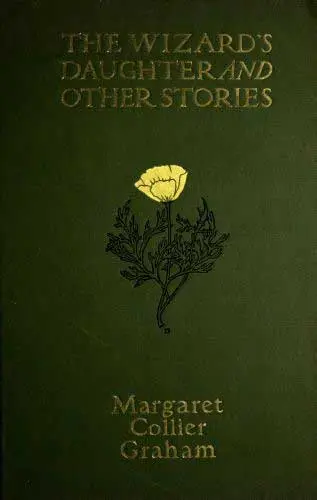
The Wizard’s Daughter, and Other Stories
Margaret Collier Graham
THE CLASSIC COLLECTION · 1895
"Stories of the Foot-hills" by Margaret Collier Graham is a collection of fictional narratives written in the late 19th century. The book appears to explore the lives of various characters in a rural Californian setting, addressing themes such as land rights, family dynamics, and interpersonal conflicts against the backdrop of the wilderness. The narrative is likely to focus on individuals like Lysander Sproul and his wife, Minervy, as they navigate their lives among neighbors and the complexity of their relationships. The opening of the story introduces Lysander Sproul, who is driving his mules toward a mesa and is contemplative about the surrounding land and his interactions with Colonel Nate Forrester, a wealthy figure in their community. As he travels, he encounters his wife, Minervy, who expresses both excitement and anxiety about his dealings with Forrester, particularly regarding the land they own and the contentious relationships with others, including his mother-in-law, Mrs. Withrow. There’s a sense of tension and struggle as the characters deal with issues related to property and water rights, foreshadowing potential conflicts that may arise in the storyline. As the narrative develops, it hints at broader societal themes while focusing on domestic life and the challenges that come with it.
Introduction adapted from the source catalogue; source summaries may be automatically generated.
Free to read · English · 47,936 words · No account needed
MAKE TIME FOR A GOOD BOOK
On by default. Untick to stop anonymous reading totals. Each page counts after 10 seconds in view. How this works.
Anonymous counting is on unless you have switched it off.
We were sojourning between Anaheim and the sea. There was a sunshiny dullness about the place, like the smiles of a vapid woman. The bit of vineyard surrounding our whitewashed cabin was an emerald set in the dull, golden-brown plain. Before the door an artesian well glittered in the sun like an inverted crystal bowl. Esculapius called the spot Fezzan, and gradually I came to think the well a fountain, and the sunburnt waste about us a stretch of yellow sand.
When I had walked to the field of whispering corn behind the house, and through the straggling vines to the edge of the vineyard in front, I came back to where my invalid sat beneath the feathery acacias, dreaming in happy lonesomeness.
"Did you ever see such placid, bright, ethereal stillness?" I asked.
Esculapius took his cigar from his lips and looked at me pensively.
"It may be my misfortune, I hope it is not my fault, but I do not remember to have seen stillness of any sort."
Esculapius has but one shortcoming--he is not a poet. I never wound him by appearing to notice this defect, so I sat down on the dry burr-clover and made no reply.
"You think it is still," he went on in a mannish, instructive way, "but in fact there are a thousand sounds. At night, when it is really quiet, you will hear the roar of the ocean ten miles away. Hark!"
Our host was singing far down in the corn. He was a minister, a deep-toned Methodist, brimming over with vocal piety.
"Nearer the great white throne,
Nearer the jasper sea,"--
came to us in slow, rich cadences.
The fern-like branches above us stirred softly against the blue. Little aromatic whiffs came from the grove of pale eucalyptus-trees near the house. Esculapius diluted the intoxicating air with tobacco smoke and remained sane, but as for me the sunshine went to my head, and whirled and eddied there like some Eastern drug.
"My love," I said wildly, "if we stay here very long and nothing happens, I shall do something rash."
The next morning a huge derrick frowned in the dooryard, and a picturesque group of workmen lounged under the acacias. The well had ceased to flow.
Esculapius called me to a corner of the piazza, and spoke in low,
hurried tones.
"Something has happened," he said; "the well has stopped. I thought it might relieve your feelings to get off that quotation about the golden bowl and the wheel, and the pitcher, and the fountain, etc.; then, if it is safe to leave you, I would like to go hunting."
I looked at him with profound compassion.
Your reading position is saved on this browser. Take it to another device with a library code. Reading pages adapt to text, rather than matching a printed edition.
Margaret Collier Graham
BEHIND THE BOOK
This eBook is for the use of anyone anywhere in the United States and most other parts of the world at no cost and with almost no restrictions whatsoever. You may copy it, give it away or re-use it under the terms of the Project Gutenberg License included with this eBook or online at www.gutenberg.org. If you are not located in the United States, you will have to check the laws of the country where you are located before using this eBook. Read the source licence.
The original source file, including credits and licence, is retained by this library. Request an original-format copy at no charge. Please include the book title and Project Gutenberg identifier #31687.
KEEP YOUR CURIOSITY GOING
Coulson Kernahan

Maurice Baring
Frances Wright
Cécile Tormay

Frederic Jesup Stimson

W. H. P. (William Henry Pope) Jarvis