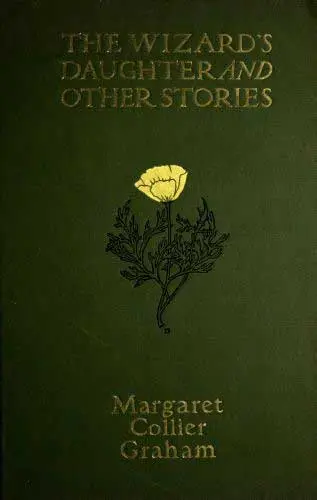
The Wizard’s Daughter, and Other Stories
Margaret Collier Graham
THE CLASSIC COLLECTION · 1895
"Stories of the Foot-hills" by Margaret Collier Graham is a collection of fictional narratives written in the late 19th century. The book appears to explore the lives of various characters in a rural Californian setting, addressing themes such as land rights, family dynamics, and interpersonal conflicts against the backdrop of the wilderness. The narrative is likely to focus on individuals like Lysander Sproul and his wife, Minervy, as they navigate their lives among neighbors and the complexity of their relationships. The opening of the story introduces Lysander Sproul, who is driving his mules toward a mesa and is contemplative about the surrounding land and his interactions with Colonel Nate Forrester, a wealthy figure in their community. As he travels, he encounters his wife, Minervy, who expresses both excitement and anxiety about his dealings with Forrester, particularly regarding the land they own and the contentious relationships with others, including his mother-in-law, Mrs. Withrow. There’s a sense of tension and struggle as the characters deal with issues related to property and water rights, foreshadowing potential conflicts that may arise in the storyline. As the narrative develops, it hints at broader societal themes while focusing on domestic life and the challenges that come with it.
Introduction adapted from the source catalogue; source summaries may be automatically generated.
Free to read · English · 47,936 words · No account needed
MAKE TIME FOR A GOOD BOOK
On by default. Untick to stop anonymous reading totals. Each page counts after 10 seconds in view. How this works.
Anonymous counting is on unless you have switched it off.
"The doctor says you're getting on real well, Ben," said Em steadily.
The young fellow looked down at his wasted hands, gray and ghostly in
the twilight.
"Was 'Rene there?" he asked.
"Yes."
"It isn't like having your sister go out to work, Benny," said Mrs. Wickersham soothingly; "just the neighbors, and real nice folks, too. I wouldn't fret about it."
On Wednesday morning, as Em neared the camp, she saw the grape-pickers gathered in a little group before the girls' tent. Steve Elliott separated himself from the crowd, and came to meet her.
"We've struck, Em," he said, smiling down at her from the shadow of his
big hat.
"Who's we?" asked Em gravely.
"All of us. They're paying a dollar and a quarter over at Briggs's; we ain't a-goin' to stand it."
Em had stopped in the path. The young fellow stepped behind her, and she
went on.
"Why don't you all go over to Briggs's and go to work?" she asked,
without turning her head.
"Too far--the foreman'll come to time."
They came up to the noisy group, and Em seated herself on a pile of trays and loosened the strings of her wide hat; she was tired from her walk, and the pallor of her face made her lips seem redder.
Irene Burnham crossed over to the newcomer, shrugging herself with
girlish self-consciousness.
"Isn't it just too mean, Em?" she panted; "I know they'll discharge us. That means good-by to my new parasol; I've been dying for one all summer, a red silk one"--
"Let up on the parasol racket, Sis," called one of the Burnham boys;
"business is business."
The hum of the young voices went on, mingled with gay, irresponsible laughter. Em got up and began to tie her hat.
"Where are you going?" asked one of the girls.
"I'm going to work."
"To work! why, we've struck!"
"I haven't," said Em soberly. "I'm willing to work for a dollar a day."
There was a little cry of dismay from the girls; Steve Elliott's tanned face flushed a coppery red.
"You ain't goin' back on us, Em?" he said angrily.
"I ain't going back on my word," answered the girl; "you needn't work if you don't want to; this is a free country."
"It isn't, though,"' said Ike Burnham; "the raisin men have a ring--there's no freedom where there's rings."
"I suppose they go into them because they want to," said Em, setting her
lips.
"They go into them because they'd get left if they didn't."
Your reading position is saved on this browser. Take it to another device with a library code. Reading pages adapt to text, rather than matching a printed edition.
Margaret Collier Graham
BEHIND THE BOOK
This eBook is for the use of anyone anywhere in the United States and most other parts of the world at no cost and with almost no restrictions whatsoever. You may copy it, give it away or re-use it under the terms of the Project Gutenberg License included with this eBook or online at www.gutenberg.org. If you are not located in the United States, you will have to check the laws of the country where you are located before using this eBook. Read the source licence.
The original source file, including credits and licence, is retained by this library. Request an original-format copy at no charge. Please include the book title and Project Gutenberg identifier #31687.
KEEP YOUR CURIOSITY GOING
Coulson Kernahan

Maurice Baring
Frances Wright
Cécile Tormay

Frederic Jesup Stimson

W. H. P. (William Henry Pope) Jarvis