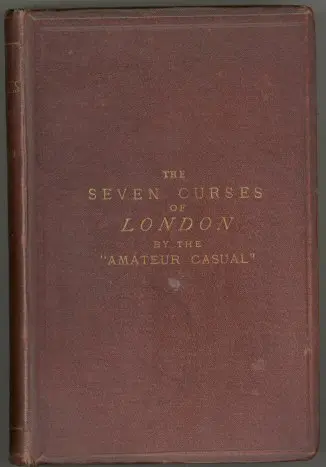
The seven curses of London
James Greenwood
THE CLASSIC COLLECTION · 1865
"Stirring Scenes in Savage Lands" by James Greenwood is a historical account written in the late 19th century. The book provides a detailed exploration of the customs, manners, and habits of various uncivilized societies around the world, highlighting both peaceful and warlike aspects of their cultures. It aims to broaden the reader's understanding of human nature and the diversity of human experience through vivid storytelling. The opening of the book sets the stage by describing the complex relationship between savages and their leaders, exploring the expectations and realities of kingship among various tribes. It delves into the lives of individuals like the King of Dahomey, characterized as someone whose rule is marked by brutality and human sacrifice, showcasing the grotesque display of wealth and power associated with his reign. The narrative discusses the expectations that come with leadership in these savage lands and the often horrifying customs that surround these ancient ways of life, establishing an intriguing tone for the accounts that follow.
Introduction adapted from the source catalogue; source summaries may be automatically generated.
Free to read · English · 191,595 words · No account needed
MAKE TIME FOR A GOOD BOOK
On by default. Untick to stop anonymous reading totals. Each page counts after 10 seconds in view. How this works.
Anonymous counting is on unless you have switched it off.
CHAP. XXVI.--Religion in savage lands--the mysterious “still small voice”--its existence indissociable from human nature--“incomprehensible” synonymous with “evil” in the savage mind--nothing so incomprehensive as death--nothing so much feared--death the savage’s poisoned honey-pot--the greegree-man must be patronized at any price--Samoan mythology--Tangaloa and his daughter--she descends and plants a creeping plant on the barren rock--what the plant grew to--the man who pushed the heavens up--the young men who resolved to visit the moon--the one was smoked up and the other climbed up--how the moon came down and took up a scoffing woman--the child of the sun--that great luminary in danger of being strangled with a rope--“Oh! have mercy on me and spare my life”--a Figian version of the flood--toilsome journey of the soul from earth to heaven--the savage charm--desperate endeavours to cheat the grim ferrymen--quarrelsome Figian gods--a singular case of abduction--the lonely Naiogabui and the daring Ravovonikaugawa--success of the expedition--Rokoua gets scent of the elopement and goes in pursuit--he disguises himself--all fair in love and war--failure of Rokoua’s stratagem--he tries once more--this time disguised as a fishwoman--the wicked Naiogabui betrays her father, who is knocked on the head--the Hades of the Samoans--miscellaneous gods of the Samoans--a deity for every village--Samoan form of oath--the cup of truth--mourning the destruction of a god’s image--the most fashionable god in Polynesia--human sacrifices--whole families set apart for this purpose, to be fetched when wanted--sudden death to the victim--Tapu--its ancient institution--universal influence of the tapu--Mr. Ellis’s opinion of the working of “tapu”--muzzled pigs and blindfolded chickens--tapued pigs--the ceremony of taking “tapu” off the porkers--the princes and noblemen exhibit their prowess in carrying pigs about--presenting his majesty with pig’s fry--a tremendous feast--The institution of Tapu in New Zealand--inconvenience of being tapued--a good jacket lost through the superstition--The terrible tinder box--how to secure a canoe--the chief’s sacred head--the sacred kumara grounds--the sacred pole and the missionaries--the chief’s backbone--the difference between noa and tapu--tapuing a river--the Pakeka and the iron pot--one of the best uses of tapu--its advantages and disadvantages--Tapu among the Samoans--snake and shark and thunder tapus--Born tapus--witchcraft in New Zealand--Introduction of an Englishman to a “retired” witch--how he found her--she declines to act, having given up the business and become a “praying” woman--she is persuaded, and sets about humbugging the visitors--the little beetle in the thatch--the god begging a blanket--the Englishman not perfectly convinced--Religion among the Dayaks of the land and sea--the supreme Tewata--extent of their religious system--“physic” for sacred anointing--the four chief spirits of the Dayak belief--how man became less than the spirits--what becomes of the Dayak when he dies--the artful “Umot Perusong”--“Mino Buau,” or warrior ghosts--alarming apparition of a headless dog--Dayak methods of propitiating the gods--lucky days, omens, and warnings--the ceremony of making brothers--how Singauding became the brother of Mr. St. John--a sanguinary cigarette--how the Kiniahs enter into the bands of brotherhood--making brothers in Western Africa--pledged in blood--Dayak good and evil spirits--what it is to dream of Singallong Burong the god of war--delicate way of alluding to small-pox--has “he” left you?--the Karam of Baram and his god Totadungan--the Dayak who went to heaven--what he saw--the sacred Bornean bull--Dayak superstitions concerning dogs and snakes--the legend of the painted dog--the savage of North America and his “happy hunting ground”--“Kitchi-manitou” and “Matchi-munedoo”--the North American Indians’ version of the flood--a savage Noah--how the earth was reformed--the loon, the beaver, and the musk-rat--a legend of Kitchi-Manitou--he meets the first man--pitying his disconsolate condition he finds him a mate, Mami by name--the happy meeting--their garden of Eden with its “tables and chairs and glass windows”--Kitchi-Manitou warns them against the fruit of the evil tree--Mami is tempted and falls--she invites her husband and his weakness is too strong for him--anger of Kitchi-Manitou--banishment of the erring pair--they begin their worldly cares--Mami’s husband finds a book--finding it too big to carry about he declines to appropriate it--he is furnished with one of convenient size in which he learns the art of medicine--the Indian who made a return trip to heaven--how he got there, what he saw, and how he got back to earth again--the man of the fire-stone--his great enemy Manabozho--they have a terrible fight and the fire-stone man is beaten--how Manabozho exerted himself for the good of mankind--his friend Chibiabos--the Manitous play Chibiabos a cunning trick--grief of Manabozho--the friends are united--discovering a “thunder’s nest”--Hans Hansom and the beaver trapper--“second sight” among the Winnebagos--the prophecy--its verification--the dream of Little Wasp--Indian picture-writing--signs of the different tribes--what stands for “kill”--a narration in pantomime--Crashey Jane’s compliments to the editor--Mr. Catlin’s Indian experiences--he paints the “old bear”--the artist is made much of and likes it--the benighted savages kiss the hem of Mr. Catlin’s swallow-tail--he does not get on quite so well with the ladies--all difficulties conquered--Mandan festival of the deluge--“seeking whom he may devour”--discomfiture and flight of the prince of darkness--covetousness of the North American Indians--Mr. Murray’s experience on this head--the old gentleman who coveted the elastic jacket--how he found it a tight fit--“a good creature in the ice-month”--the Ojibbeway nations of old--the Pawnees--the Delawares--the confederate six nations--the Shawnees--From North America to Abyssinia--religious ceremonies observed in that country--mothers of small account--purification of houses and platters--the Kalijas and the Lubas--concerning Boudas--Bouda exorcists--Mr. Stern makes the acquaintance of a Bouda--the woman’s tremendous struggles and arrival of the exorcist--his operations--he interrogates the Bouda and obtains from it some interesting information--its strange vagaries before it consents to take its departure--the Zar--Religion of the Dahoman--the food of the sacred buzzards--fetish snakes and the punishment for harming them--the Bonny people and the jewjews--popular superstitions--the king’s charms against witchcraft--the sacrifice to the bar--the unconscious victim--his doom--sacred pig’s jaws--“talk and pray”--devil worship--the “Sukia” of the Mosquito shore--her unprepossessing appearance--Mr. Bard gives her a piece of calico on condition she stands in the midst of a blazing fire--she earns the calico and lives to wear it--the belly gods of the Tinguians--Madagascar “the country without a god”--“Sikidy”--the ceremony of touching the bull--King Peppel’s religious convictions--a palaver unpalatable to his sable majesty--“Suppose God were here I must kill him”--a modest wish to live for ever--Mr. Moffat and the African king--startling news of a universal resurrection--“will all the slain in battle arise?”--a Namaqua chief’s religious ideas--frying the sun in a pot--“when we are dead we are dead”--Boles-ki-bo--a Basutos witch-finder--guessing made easy--end of the farce, commencement of the tragedy--unclean meats of the Damaras--on the manufacture of rain--drought at Kuruman--the rain-maker sent for--the commands of the great benefactor--he churns rain from a milk sack--goat rain and ox rain--the ceremony of the blighted tree--the sprinkling of the people with a zebra’s tail dipped in water--still no rain--he demands a baboon “perfect to a hair” and is not sorry that it cannot be procured--he must have the heart of a lion--he must have something else too horrible to name, and has it--still the heavens are inexorable--the last appeal, “It is the face of the white man that scares the rain clouds”--unpleasant predicament for a man with a white face--the impostor’s end--A fine day for a butcher’s knife--Figian coming of age--how Mr. Petherick “Barnumized” the natives as a rain-maker--perpetrates something not many degrees short of blasphemy--the artful device of the floured flies--a Sabbath in Equatorial Africa--The worship of Njambai--paying for peeping--“who bewitched the king?”--the appeal to Ilogo--an unlucky wizard--appalling end of a witch man--Mfumbo the all-powerful--what came of felling a “devil-tree”--the business of a Mganga--how he points out the road the traveller should travel--King Passol’s dancing fetish--his extraordinary performance on stilts--“he be de debil”--a bal-masqué--“dance, oh snake! for this is indeed a happy day”--old King Kalabar--“Nabikems”--Kalabar fash--A Yoruba man’s opinion of the chameleon. Pages 204–336.
Your reading position is saved on this browser. Take it to another device with a library code. Reading pages adapt to text, rather than matching a printed edition.
James Greenwood
BEHIND THE BOOK
This eBook is for the use of anyone anywhere in the United States and most other parts of the world at no cost and with almost no restrictions whatsoever. You may copy it, give it away or re-use it under the terms of the Project Gutenberg License included with this eBook or online at www.gutenberg.org. If you are not located in the United States, you will have to check the laws of the country where you are located before using this eBook. Read the source licence.
The original source file, including credits and licence, is retained by this library. Request an original-format copy at no charge. Please include the book title and Project Gutenberg identifier #71512.
KEEP YOUR CURIOSITY GOING
Cécile Tormay

Moritz Busch
John L. Ransom
Frances Wright
Cécile Tormay

Mabel Potter Daggett