READ · DISCOVER · ENJOYClassic literature · Always free
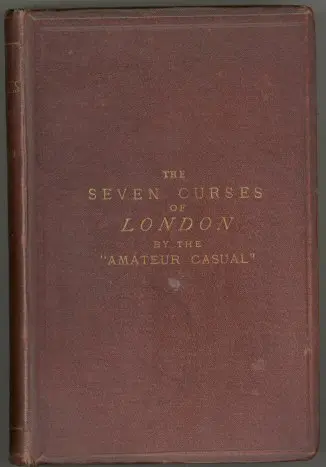
The seven curses of London — digital edition cover

THE CLASSIC COLLECTION · 1869

The seven curses of London

"The Seven Curses of London" by James Greenwood is a social commentary written in the late 19th century. This thought-provoking work delves into the dire conditions faced by the impoverished and neglected in London, particularly focusing on the plight of pauper children, criminals, and beggars. Through vivid descriptions and poignant narratives, the book aims to shed light on the systemic issues contributing to these societal curses, making it a significant historical account of urban poverty. The beginning of this work introduces the overwhelming issue of neglected children in London, highlighting startling statistics about the number of children living in destitution. Greenwood paints a grim picture of these vulnerable kids, often left to wander the streets without guardians, food, or care, setting the stage for a broader investigation of societal neglect and its consequences. He discusses the structural failures of society in managing and protecting these children, suggesting that the root causes of their plight stem from systemic poverty and moral decay, foreshadowing a critical exploration of London's darker underbelly as the text unfolds.

Introduction adapted from the source catalogue; source summaries may be automatically generated.

Start reading ↓

Free to read · English · 124,120 words · No account needed

MAKE TIME FOR A GOOD BOOK

The seven curses of London

On by default. Untick to stop anonymous reading totals. Each page counts after 10 seconds in view. How this works.

Anonymous counting is on unless you have switched it off.

The seven curses of London

I. Neglected Children. CHAPTER I. STARTLING FACTS. The Pauper Population.—Pauper Children.—Opinions page 1 concerning their proper Treatment.—A Hundred Thousand Children loose in London Streets.—Neglected Babies.—Juvenile “Market Prowlers” CHAPTER II. RESPECTING THE PARENTAGE OF SOME OF OUR GUTTER POPULATION. Who are the Mothers?—The Infant Labour-Market.—Watch p. 13 London and Blackfriars Bridges.—The Melancholy Types.—The Flashy, Flaunting “Infant.”—Keeping Company.—Marriage.—The Upshot CHAPTER III. BABY-FARMING. “Baby-Farmers” and Advertising “Child-Adopters.”—“F. X.” p. 29 of Stepney.—The Author’s Interview with Farmer Oxleek.—The Case of Baby Frederick Wood CHAPTER IV. WORKING BOYS. The London Errand-Boy.—His Drudgery and Privations.—His p. 58 Temptations.—The London Boy after Dark.—The Amusements provided for him CHAPTER V. THE PROBLEM OF DELIVERANCE. Curious Problem.—The best Method of Treatment.—The “Child p. 76 of the Gutter” not to be entirely abolished.—The genuine Alley-bred Arab.—The Poor Lambs of the Ragged Flock.—The Tree of Evil in our midst.—The Breeding Places of Disease and Vice II. Professional Thieves. CHAPTER VI. THEIR NUMBER AND DIFFICULTIES. Twenty Thousand Thieves in London.—What it means.—The p. 85 Language of “Weeds.”—Cleverness of the Pilfering Fraternity.—A Protest against a barbarous Suggestion.—The Prisoner’s great Difficulty.—The Moment of Leaving Prison.—Bad Friends.—What becomes of Good Resolutions and the Chaplain’s Counsel?—The Criminal’s Scepticism of Human Goodness.—Life in “Little Hell.”—The Cow-Cross Mission. CHAPTER VII. HOMES AND HAUNTS OF THE BRITISH THIEF. The Three Classes of Thieving Society.—Popular p. 108 Misapprehensions.—A True Picture of the London Thief.—A Fancy Sketch of the “Under-ground Cellar.”—In Disguise at a Thieves’ Raffle.—The Puzzle of “Black Maria.”—Mr. Mullins’s Speech and his Song CHAPTER VIII. JUVENILE THIEVES. The Beginning of the Downhill Journey.—Candidates for p. 124 Newgate Honours.—Black Spots of London.—Life from the Young Robber’s Point of View.—The Seedling Recruits the most difficult to reform.—A doleful Summing-up.—A Phase of the Criminal Question left unnoticed.—Budding Burglars.—Streams which keep at full flood the Black Sea of Crime.—The Promoters of “Gallows Literature.”—Another Shot at a Fortress of the Devil.—“Poison-Literature.”—“Starlight Sall.”—“Panther Bill” CHAPTER IX. THE THIEF NON-PROFESSIONAL. The Registered and the Unregistered Thieves of the London p. 144 Hunting-ground.—The Certainty of the Crop of Vice.—Omnibus Drivers and Conductors.—The “Watchers.”—The London General Omnibus Company.—The Scandal of their System.—The Shopkeeper Thief.—False Weights and Measures.—Adulteration of Food and Drink.—Our Old Law, “I am as honest as I can afford to be!”—Rudimentary Exercises in the Art of Pillage CHAPTER X. CRIMINAL SUPPRESSION AND PUNISHMENT. Lord Romilly’s Suggestion concerning the Education of the p. 173 Children of Criminals.—Desperate Criminals.—The Alleys of the Borough.—The worst Quarters not, as a rule, the most noisy.—The Evil Example of “Gallows Heroes,” “Dick Turpin,” “Blueskin,” &c.—The Talent for “Gammoning Lady Green.”—A worthy Governor’s Opinion as to the best way of “Breaking” a Bad Boy.—Affection for “Mother.”—The Dark Cell and its Inmate.—An Affecting Interview CHAPTER XI. ADULT CRIMINALS AND THE NEW LAW FOR THEIR BETTER GOVERNMENT. Recent Legislation.—Statistics.—Lord Kimberley’s “Habitual p. 183 Criminals” Bill.—The Present System of License-Holders.—Colonel Henderson’s Report.—Social Enemies of Suspected Men.—The Wrong-headed Policeman and the Mischief he may cause.—Looking out for a Chance.—The last Resource of desperate Honesty.—A Brotherly Appeal.—“Ginger will settle her.”—Ruffians who should be shut up III. Professional Beggars. CHAPTER XII. THE BEGGAR OF OLDEN TIME. “Only a Beggar.”—The Fraternity 333 Years ago.—A savage p. 211 Law.—Origin of the Poor-Laws.—Irish Distinction in the Ranks of Beggary.—King Charles’s Proclamation.—Cumberland Discipline CHAPTER XIII. THE WORK OF PUNISHMENT AND RECLAMATION. The Effect of “The Society for the Suppression of p. 221 Mendicity.”—State Business earned out by Individual Enterprise.—“The Discharged Prisoners’ Aid Society.”—The quiet Work of these Societies.—Their Mode of Work.—Curious Statistics.—Singular Oscillations.—Diabolical Swindling CHAPTER XIV. BEGGING “DODGES.” The Variety and Quality of the Imposture.—Superior p. 242 Accomplishments of the Modern Practitioner.—The Recipe for Success.—The Power of “Cheek.”—“Chanting” and the “Shallow Lay.”—Estimates of their Paying Value.—The Art of touching Women’s Hearts.—The Half-resentful Trick.—The Loudon “Cadger.”—The Height of the “Famine Season.” CHAPTER XV. GENTEEL ADVERTISING BEGGARS. The Newspaper Plan and the delicate Process.—Forms of 259 Petition.—Novel Applications of Photography.—Personal Attractions of the Distressed.—Help, or I perish! IV. Fallen Women. CHAPTER XVI. THIS CURSE. The Difficulty in handling it.—The Question of its p. 271 Recognition.—The Argyll Rooms.—Mr. Acton’s Visit there.—The Women and their Patrons.—The Floating Population of Windmill-street.—Cremorne Gardens in the Season CHAPTER XVII. THE PLAIN FACTS AND FIGURES OF PROSTITUTION. Statistics of Westminster, Brompton, and Pimlico.—Methods p. 281 of conducting the nefarious Business.—Aristocratic Dens.—The High Tariff.—The Horrors of the Social Evil.—The Broken Bridge behind the Sinner.—“Dress Lodgers.”—There’s always a “Watcher.”—Soldiers and Sailors.—The “Wrens of the Curragh” CHAPTER XVIII. THE PRESENT CONDITION OF THE QUESTION. The Laws applying to Street-walkers.—The Keepers of the p. 304 Haymarket Night-houses.—Present Position of the Police-magistrates.—Music-hall Frequenters.—Refreshment-bars.—Midnight Profligacy—“Snuggeries.”—Over-zealous Blockheads. CHAPTER XIX. SUGGESTIONS. Ignoring the Evil.—Punishment fit for the “Deserter” and p. 324 the Seducer.—The “Know-nothing” and “Do-nothing” Principle.—The Emigration of Women of Bad Character V. The Curse of Drunkenness. CHAPTER XX. ITS POWER. The crowning Curse.—No form of sin or sorrow in which it p. 332 does not play a part.—The “Slippery Stone” of Life.—Statistics.—Matters not growing worse.—The Army Returns.—The System of Adulteration CHAPTER XXI. ATTEMPTS TO ARREST IT. The Permissive Liquors Bill.—Its Advocates and their p. 351 Arguments.—The Drunkenness of the Nation.—Temperance Facts and Anecdotes.—Why the Advocates of Total Abstinence do not make more headway.—Moderate Drinking.—Hard Drinking.—The Mistake about childish Petitioners VI. Betting Gamblers. CHAPTER XXII. “ADVERTISING TIPSTERS” AND “BETTING COMMISSIONERS.” The Vice of Gambling on the increase among the p. 377 Working-classes.—Sporting “Specs.”—A “Modus.”—Turf Discoveries.—Welshers.—The Vermin of the Betting-field.—Their Tactics.—The Road to Ruin VII. Waste of Charity. CHAPTER XXIII. METROPOLITAN PAUPERISM. Parochial Statistics.—The Public hold the p. 421 Purse-strings.—Cannot the Agencies actually at work be made to yield greater Results?—The need of fair Rating.—The Heart and Core of the Poor-law Difficulty.—My foremost thought when I was a “Casual.”—Who are most liable to slip?—“Crank-work.”—The Utility of Labour-yards.—Scales of Relief.—What comes of breaking-up a Home CHAPTER XXIV. THE BEST REMEDY. Emigration.—The various Fields.—Distinguish the p. 455 Industrious Worker in need of temporary Relief.—Last Words

Your reading position is saved on this browser. Take it to another device with a library code. Reading pages adapt to text, rather than matching a printed edition.

More from this author

BEHIND THE WORDS

About James Greenwood

James Greenwood (1832–1929). Explore Stirring scenes in savage lands, The seven curses of London in this collection. These books span history.

Explore this author’s books →

THE READERS’ VERDICT

How did this story stay with you?

Not rated yet
Your rating for The seven curses of London

Be the first to share your verdict.

One rating per browser, which you can change or remove. A necessary browser identifier remembers your vote. How ratings work

A GOOD STORY DESERVES COMPANY

Pass this book along.

A great read is even better when it’s shared.

SEND A LITTLE INSPIRATION

Share this book

BEHIND THE BOOK

Edition & source details.

Title
The seven curses of London
Author
James Greenwood
First publication (Open Library catalogue match)
1869
Digital edition publisher
Project Gutenberg
Gutenberg release date
2014-05-05
Language
English
Source edition imprint
Not stated in source catalogue
Source identifier
Project Gutenberg #45585
Contributors
No additional named contributors in source metadata

Public-domain source & licence

This eBook is for the use of anyone anywhere in the United States and most other parts of the world at no cost and with almost no restrictions whatsoever. You may copy it, give it away or re-use it under the terms of the Project Gutenberg License included with this eBook or online at www.gutenberg.org. If you are not located in the United States, you will have to check the laws of the country where you are located before using this eBook. Read the source licence.

Full source licence and obtaining an original copy

The original source file, including credits and licence, is retained by this library. Request an original-format copy at no charge. Please include the book title and Project Gutenberg identifier #45585.

the full Project Gutenberg License must appear
prominently whenever any copy of a Project Gutenberg work (any work
on which the phrase “Project Gutenberg” appears, or with which the
phrase “Project Gutenberg” is associated) is accessed, displayed,
performed, viewed, copied or distributed:

This eBook is for the use of anyone anywhere in the United States and most
other parts of the world at no cost and with almost no restrictions
whatsoever. You may copy it, give it away or re-use it under the terms
of the Project Gutenberg™ License included with this eBook or online
at www.gutenberg.org. If you
are not located in the United States, you will have to check the laws
of the country where you are located before using this eBook.

1.E.2. If an individual Project Gutenberg electronic work is
derived from texts not protected by U.S. copyright law (does not
contain a notice indicating that it is posted with permission of the
copyright holder), the work can be copied and distributed to anyone in
the United States without paying any fees or charges. If you are
redistributing or providing access to a work with the phrase “Project
Gutenberg” associated with or appearing on the work, you must comply
either with the requirements of paragraphs 1.E.1 through 1.E.7 or
obtain permission for the use of the work and the Project Gutenberg
trademark as set forth in paragraphs 1.E.8 or 1.E.9.

1.E.3. If an individual Project Gutenberg electronic work is posted
with the permission of the copyright holder, your use and distribution
must comply with both paragraphs 1.E.1 through 1.E.7 and any
additional terms imposed by the copyright holder. Additional terms
will be linked to the Project Gutenberg License for all works
posted with the permission of the copyright holder found at the
beginning of this work.

1.E.4. Do not unlink or detach or remove the full Project Gutenberg
License terms from this work, or any files containing a part of this
work or any other work associated with Project Gutenberg.

1.E.5. Do not copy, display, perform, distribute or redistribute this
electronic work, or any part of this electronic work, without
prominently displaying the sentence set forth in paragraph 1.E.1 with
active links or immediate access to the full terms of the Project
Gutenberg License.

1.E.6. You may convert to and distribute this work in any binary,
compressed, marked up, nonproprietary or proprietary form, including
any word processing or hypertext form. However, if you provide access
to or distribute copies of a Project Gutenberg work in a format
other than “Plain Vanilla ASCII” or other format used in the official
version posted on the official Project Gutenberg website
(www.gutenberg.org), you must, at no additional cost, fee or expense
to the user, provide a copy, a means of exporting a copy, or a means
of obtaining a copy upon request, of the work in its original “Plain
Vanilla ASCII” or other form. Any alternate format must include the
full Project Gutenberg License as specified in paragraph 1.E.1.

1.E.7. Do not charge a fee for access to, viewing, displaying,
performing, copying or distributing any Project Gutenberg works
unless you comply with paragraph 1.E.8 or 1.E.9.

1.E.8. You may charge a reasonable fee for copies of or providing
access to or distributing Project Gutenberg electronic works
provided that:

• You pay a royalty fee of 20% of the gross profits you derive from
the use of Project Gutenberg works calculated using the method
you already use to calculate your applicable taxes. The fee is owed
to the owner of the Project Gutenberg trademark, but he has
agreed to donate royalties under this paragraph to the Project
Gutenberg Literary Archive Foundation. Royalty payments must be paid
within 60 days following each date on which you prepare (or are
legally required to prepare) your periodic tax returns. Royalty
payments should be clearly marked as such and sent to the Project
Gutenberg Literary Archive Foundation at the address specified in
Section 4, “Information about donations to the Project Gutenberg
Literary Archive Foundation.”

• You provide a full refund of any money paid by a user who notifies
you in writing (or by e-mail) within 30 days of receipt that s/he
does not agree to the terms of the full Project Gutenberg™
License. You must require such a user to return or destroy all
copies of the works possessed in a physical medium and discontinue
all use of and all access to other copies of Project Gutenberg™
works.

• You provide, in accordance with paragraph 1.F.3, a full refund of
any money paid for a work or a replacement copy, if a defect in the
electronic work is discovered and reported to you within 90 days of
receipt of the work.

• You comply with all other terms of this agreement for free
distribution of Project Gutenberg™ works.


1.E.9. If you wish to charge a fee or distribute a Project
Gutenberg™ electronic work or group of works on different terms than
are set forth in this agreement, you must obtain permission in writing
from the Project Gutenberg Literary Archive Foundation, the manager of
the Project Gutenberg™ trademark. Contact the Foundation as set
forth in Section 3 below.

1.F.

1.F.1. Project Gutenberg volunteers and employees expend considerable
effort to identify, do copyright research on, transcribe and proofread
works not protected by U.S. copyright law in creating the Project
Gutenberg™ collection. Despite these efforts, Project Gutenberg™
electronic works, and the medium on which they may be stored, may
contain “Defects,” such as, but not limited to, incomplete, inaccurate
or corrupt data, transcription errors, a copyright or other
intellectual property infringement, a defective or damaged disk or
other medium, a computer virus, or computer codes that damage or
cannot be read by your equipment.

1.F.2. LIMITED WARRANTY, DISCLAIMER OF DAMAGES - Except for the “Right
of Replacement or Refund” described in paragraph 1.F.3, the Project
Gutenberg Literary Archive Foundation, the owner of the Project
Gutenberg™ trademark, and any other party distributing a Project
Gutenberg™ electronic work under this agreement, disclaim all
liability to you for damages, costs and expenses, including legal
fees. YOU AGREE THAT YOU HAVE NO REMEDIES FOR NEGLIGENCE, STRICT
LIABILITY, BREACH OF WARRANTY OR BREACH OF CONTRACT EXCEPT THOSE
PROVIDED IN PARAGRAPH 1.F.3. YOU AGREE THAT THE FOUNDATION, THE
TRADEMARK OWNER, AND ANY DISTRIBUTOR UNDER THIS AGREEMENT WILL NOT BE
LIABLE TO YOU FOR ACTUAL, DIRECT, INDIRECT, CONSEQUENTIAL, PUNITIVE OR
INCIDENTAL DAMAGES EVEN IF YOU GIVE NOTICE OF THE POSSIBILITY OF SUCH
DAMAGE.

1.F.3. LIMITED RIGHT OF REPLACEMENT OR REFUND - If you discover a
defect in this electronic work within 90 days of receiving it, you can
receive a refund of the money (if any) you paid for it by sending a
written explanation to the person you received the work from. If you
received the work on a physical medium, you must return the medium
with your written explanation. The person or entity that provided you
with the defective work may elect to provide a replacement copy in
lieu of a refund. If you received the work electronically, the person
or entity providing it to you may choose to give you a second
opportunity to receive the work electronically in lieu of a refund. If
the second copy is also defective, you may demand a refund in writing
without further opportunities to fix the problem.

1.F.4. Except for the limited right of replacement or refund set forth
in paragraph 1.F.3, this work is provided to you ‘AS-IS’, WITH NO
OTHER WARRANTIES OF ANY KIND, EXPRESS OR IMPLIED, INCLUDING BUT NOT
LIMITED TO WARRANTIES OF MERCHANTABILITY OR FITNESS FOR ANY PURPOSE.

1.F.5. Some states do not allow disclaimers of certain implied
warranties or the exclusion or limitation of certain types of
damages. If any disclaimer or limitation set forth in this agreement
violates the law of the state applicable to this agreement, the
agreement shall be interpreted to make the maximum disclaimer or
limitation permitted by the applicable state law. The invalidity or
unenforceability of any provision of this agreement shall not void the
remaining provisions.

1.F.6. INDEMNITY - You agree to indemnify and hold the Foundation, the
trademark owner, any agent or employee of the Foundation, anyone
providing copies of Project Gutenberg™ electronic works in
accordance with this agreement, and any volunteers associated with the
production, promotion and distribution of Project Gutenberg™
electronic works, harmless from all liability, costs and expenses,
including legal fees, that arise directly or indirectly from any of
the following which you do or cause to occur: (a) distribution of this
or any Project Gutenberg work, (b) alteration, modification, or
additions or deletions to any Project Gutenberg work, and (c) any
Defect you cause.

Section 2. Information about the Mission of Project Gutenberg

Project Gutenberg is synonymous with the free distribution of
electronic works in formats readable by the widest variety of
computers including obsolete, old, middle-aged and new computers. It
exists because of the efforts of hundreds of volunteers and donations
from people in all walks of life.

Volunteers and financial support to provide volunteers with the
assistance they need are critical to reaching Project Gutenberg’s
goals and ensuring that the Project Gutenberg collection will
remain freely available for generations to come. In 2001, the Project
Gutenberg Literary Archive Foundation was created to provide a secure
and permanent future for Project Gutenberg and future
generations. To learn more about the Project Gutenberg Literary
Archive Foundation and how your efforts and donations can help, see
Sections 3 and 4 and the Foundation information page at www.gutenberg.org.

Section 3. Information about the Project Gutenberg Literary Archive Foundation

The Project Gutenberg Literary Archive Foundation is a non-profit
501(c)(3) educational corporation organized under the laws of the
state of Mississippi and granted tax exempt status by the Internal
Revenue Service. The Foundation’s EIN or federal tax identification
number is 64-6221541. Contributions to the Project Gutenberg Literary
Archive Foundation are tax deductible to the full extent permitted by
U.S. federal laws and your state’s laws.

The Foundation’s business office is located at 41 Watchung Plaza #516,
Montclair NJ 07042, USA, +1 (862) 621-9288. Email contact links and up
to date contact information can be found at the Foundation’s website
and official page at www.gutenberg.org/contact

Section 4. Information about Donations to the Project Gutenberg
Literary Archive Foundation

Project Gutenberg™ depends upon and cannot survive without widespread
public support and donations to carry out its mission of
increasing the number of public domain and licensed works that can be
freely distributed in machine-readable form accessible by the widest
array of equipment including outdated equipment. Many small donations
($1 to $5,000) are particularly important to maintaining tax exempt
status with the IRS.

The Foundation is committed to complying with the laws regulating
charities and charitable donations in all 50 states of the United
States. Compliance requirements are not uniform and it takes a
considerable effort, much paperwork and many fees to meet and keep up
with these requirements. We do not solicit donations in locations
where we have not received written confirmation of compliance. To SEND
DONATIONS or determine the status of compliance for any particular state
visit www.gutenberg.org/donate.

While we cannot and do not solicit contributions from states where we
have not met the solicitation requirements, we know of no prohibition
against accepting unsolicited donations from donors in such states who
approach us with offers to donate.

International donations are gratefully accepted, but we cannot make
any statements concerning tax treatment of donations received from
outside the United States. U.S. laws alone swamp our small staff.

Please check the Project Gutenberg web pages for current donation
methods and addresses. Donations are accepted in a number of other
ways including checks, online payments and credit card donations. To
donate, please visit: www.gutenberg.org/donate.

Section 5. General Information About Project Gutenberg electronic works

Professor Michael S. Hart was the originator of the Project
Gutenberg concept of a library of electronic works that could be
freely shared with anyone. For forty years, he produced and
distributed Project Gutenberg eBooks with only a loose network of
volunteer support.

Project Gutenberg eBooks are often created from several printed
editions, all of which are confirmed as not protected by copyright in
the U.S. unless a copyright notice is included. Thus, we do not
necessarily keep eBooks in compliance with any particular paper
edition.

Most people start at our website which has the main PG search
facility: www.gutenberg.org.

This website includes information about Project Gutenberg,
including how to make donations to the Project Gutenberg Literary
Archive Foundation, how to help produce our new eBooks, and how to
subscribe to our email newsletter to hear about new eBooks.


KEEP YOUR CURIOSITY GOING

Your next chapter awaits.