READ · DISCOVER · ENJOYClassic literature · Always free
THE CLASSIC COLLECTION✦Stirring scenes in savage landsJames GreenwoodCLASSIC FREE BOOKS

THE CLASSIC COLLECTION · 1865

Stirring scenes in savage lands

"Stirring Scenes in Savage Lands" by James Greenwood is a historical account written in the late 19th century. The book provides a detailed exploration of the customs, manners, and habits of various uncivilized societies around the world, highlighting both peaceful and warlike aspects of their cultures. It aims to broaden the reader's understanding of human nature and the diversity of human experience through vivid storytelling. The opening of the book sets the stage by describing the complex relationship between savages and their leaders, exploring the expectations and realities of kingship among various tribes. It delves into the lives of individuals like the King of Dahomey, characterized as someone whose rule is marked by brutality and human sacrifice, showcasing the grotesque display of wealth and power associated with his reign. The narrative discusses the expectations that come with leadership in these savage lands and the often horrifying customs that surround these ancient ways of life, establishing an intriguing tone for the accounts that follow.

Introduction adapted from the source catalogue; source summaries may be automatically generated.

Start reading ↓

Free to read · English · 191,595 words · No account needed

MAKE TIME FOR A GOOD BOOK

Stirring scenes in savage lands

On by default. Untick to stop anonymous reading totals. Each page counts after 10 seconds in view. How this works.

Anonymous counting is on unless you have switched it off.

Stirring scenes in savage lands

When, in the year 1818, Captain Basil Hall undertook what was in those days considered a formidable undertaking--a voyage of discovery to the coast of Corea and the great Loo Choo Island--he was entertained at the former place by a potentate of so remarkable a character as to entitle him to a place among the necessarily few and consequently rare specimens of savage royalty which figure on these pages. It will be understood that Captain Hall’s ship, the “Alceste,” had anchored off Corea, and in the morning sent a boat ashore to feel the way to closer intimacy.

“The curiosity of the natives was already aroused; every boat was crowded with people, and ornamented with numerous flags and streamers; but one of them being distinguished by a large blue umbrella, we steered towards it, on the supposition that this was an emblem of rank, in which opinion we were soon confirmed by the sound of music, which played only on board this boat. On coming closer we saw a fine patriarchal figure seated under the umbrella; his full white beard covered his breast and reached below his middle; his robe or mantle, which was of blue silk and of an immense size, flowed about him in a magnificent style. His sword was suspended from his waist by a small belt; but the insignia of his office appeared to be a slender black rod tipped with silver, about a foot and a half long, with a small leather thong at one end, and a piece of black crape tied to the other; this he held in his hand. His hat exceeded in breadth of brim anything we had yet met with, being, as we supposed, nearly three feet across. The old chief by signs expressed his wish to go to the ships. We accordingly rowed to the “Lyra,” which lay nearer to the shore than the “Alceste.” When the chief’s boat was within ten yards of the brig, they let go their anchor and threw a rope on board her by which they drew the boat alongside in a very seamanlike style. The old man did not find it an easy matter to get up the ship’s side, encumbered as he was with his splendid robes; he was no sooner on board, however, than we were crowded with the natives, who boarded us on all sides. Some climbed up the rigging so as to overlook the quarter-deck, others got on the poop, and a line was formed along the hammock netting from one end of the brig to the other. As the evening was fine, it was thought best to entertain the venerable chief upon deck, rather than give him the trouble of going down to the cabin, which, indeed, we had reason to fear would prove too small for the party. Chairs were accordingly placed upon deck, but the chief made signs that he could not sit on a chair, nor would he consent for a time to use his mat, which was brought on board by one of his attendants. He seemed embarrased and displeased, which we could not at the moment account for, though it has since occurred to us that he objected to the publicity of the conference. At length, however, he sat down upon his mat and began talking with great gravity and composure, without appearing in the smallest degree sensible that we did not understand a single word that he said. Meanwhile the crowd of natives increased, and their curiosity became so great, that they pressed round us in a way nowise agreeable. Some of them roved about the ship and appeared highly entertained with everything they saw. The chief himself, however, did not appear at ease, but continued giving directions to his officers and people about him with an air of impatience. He more than once ordered them all into their boats, but they always returned after a few minutes. One man persevered in climbing over the hammocks close to the chief to see what was going on; the noise made to keep him back attracted the chief’s attention, who immediately gave orders to one of the attendants for his being taken away: it will be seen by and by what was his fate. It was nearly dark when the chief gave directions for preparing the boats, and at the same time to two of his attendants to assist him to get on his legs. Each took an arm, and in this way succeeded in raising him up, which was no sooner observed by the people, than they jumped into their boats with the utmost alacrity, and the chief, after many bows and salaams, walked into his boat. This did not give him so much trouble as he had experienced in coming on board, for a platform of grating and planks had been prepared for his accommodation during his visit, an attention with which he seemed much pleased. So far all seemed well; but there was still something amiss, for the old man, seated in state under his umbrella, remained alongside with his attendants ranged on deck about him, he and his people preserving the most perfect silence, and making no signs to explain. We were greatly puzzled to discover what the old gentleman wanted, till at length it was suggested that, having paid us a visit, he expected a similar compliment in return. This idea was no sooner started than we proceeded to pay our respects to him in his boat. He made signs for us to sit down, honouring us at the same time with a corner of his own mat. When we were seated he looked about as if in distress at having nothing to entertain us with, upon which a bottle of wine was sent for and given him. He ordered an attendant to pour it into several bowls, and putting the bottle away, made signs for us to drink, but would not taste it himself till all of us had been served. He was nowise discomposed at being obliged to entertain his company at their own expense; on the contrary, he carried off the whole affair with so much cheerfulness and ease as to make us suspect sometimes that he saw and enjoyed the oddity of the scene and circumstances as fully as we did ourselves. After sitting about ten minutes we left the chief in great good humour and returned on board, thinking of course that he would go straight to the shore; but in this we were mistaken, for we had no sooner left him than he pushed off to the distance of ten or twelve yards, and calling the other boats round him, gave orders for inflicting the discipline of the bamboo upon the unfortunate culprit who had been ordered into confinement during the conference. This exhibition, which it was evidently intended we should witness, had a very ludicrous effect, for it followed so much in train with the rest of the ceremony, and was carried on with so much gravity and order, that it looked like an essential part of the etiquette. During the infliction of this punishment a profound silence was observed by all the party, except by five or six persons immediately about the delinquent, whose cries they accompanied by a sort of song or yell at each blow of the bamboo. This speedy execution of justice was, no doubt, intended to impress us with notions of Corean discipline. As it was now dark we did not expect the chief to pay any more visits this evening; but we underrated his politeness, for the moment the above scene was concluded he steered for the ‘Alceste.’ He was in great good humour, and seemed entertained with the efforts which were made to please him. He asked to look at a mirror which had caught his attention. When it was put into his hands he seemed very well satisfied with the figure which it presented, and continued for some time pulling his beard from side to side with an air of perfect complacency. One of the attendants thought there could be no harm in looking at the mirror likewise; but the chief was of a different opinion, and no sooner observed what he was doing, than he very angrily made him put down the glass and leave the cabin. The secretary, too, fell under his displeasure, and was reprimanded with much acrimony for overlooking our paper when we were writing. Scarcely five minutes elapsed in short during his stay, without his finding some cause of complaint against his people; but we could not determine whether this arose from mere captiousness, or was done to give us a higher notion of his consequence, because in the interval he was all cheerfulness and good humour. He was offered tea and cherry-brandy, which he took along with us, and appeared at his ease in every respect. We thought that he made signs implying a wish for us to visit him on shore; to this we cheerfully assented, and an arrangement for landing in the morning was made accordingly by means of similar signs, with which the chief appeared much pleased, and rose to go away. He had not got much beyond the cabin-door, however, before the serenity of his temper was once more overturned. On passing the gun-room skylight, he heard the voices of some of his people whom the officers had taken below, and who were enjoying themselves very merrily amongst their new acquaintance. The old chief looked down, and observing them drinking and making a noise, he called to them in a loud passionate voice, which made them leave their glasses and run up the ladder in great terror. From thence alarm spread along the lower deck to the midshipmen’s berth, where another party was carousing. The grog and wine with which they had been entertained was too potent for this party, as they did not seem to care much for the old chief, who, posting himself at the hatchway, ascertained by personal examination who the offenders were. On this occasion his little rod of office was of much use; he pushed the people about with it to make them speak, and used it to turn them round in order to discover their faces. One man, watching his opportunity when the chief was punching away at somebody who had just come up, slipped past and ran off; but the quick eye of the old man was not so easily deceived, and he set off in chase of him round the quarter-deck. The man had an apron full of biscuits which had been given to him by the midshipmen; this impeded his running, so that the chief, nothwithstanding his robes, at last came up with him; but while he was stirring him up with his rod, the fellow slipped his cargo of bread into a coil of rope, and then went along with the chief quietly enough. The old man came back afterwards and found the biscuits, which he pointed out to us to show that they had not been taken away. He continued for some time at the hatchway, expecting more people, but finding none come up, he went below himself to the main-deck and rummaged under the guns and round the mainmast to discover whether any one was concealed, but finding no person there he came upon deck, and shortly after went into his boat.”

Your reading position is saved on this browser. Take it to another device with a library code. Reading pages adapt to text, rather than matching a printed edition.

More from this author

BEHIND THE WORDS

About James Greenwood

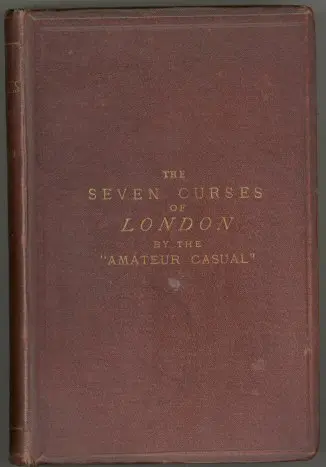
James Greenwood (1832–1929). Explore Stirring scenes in savage lands, The seven curses of London in this collection. These books span history.

Explore this author’s books →

THE READERS’ VERDICT

How did this story stay with you?

Not rated yet
Your rating for Stirring scenes in savage lands

Be the first to share your verdict.

One rating per browser, which you can change or remove. A necessary browser identifier remembers your vote. How ratings work

A GOOD STORY DESERVES COMPANY

Pass this book along.

A great read is even better when it’s shared.

SEND A LITTLE INSPIRATION

Share this book

BEHIND THE BOOK

Edition & source details.

Title
Stirring scenes in savage lands
Author
James Greenwood
First publication (Open Library catalogue match)
1865
Digital edition publisher
Project Gutenberg
Gutenberg release date
2023-08-28
Language
English
Source edition imprint
$aLondon :$bWard, Locke & Co, $c1865.
Source identifier
Project Gutenberg #71512
Contributors
No additional named contributors in source metadata

Public-domain source & licence

This eBook is for the use of anyone anywhere in the United States and most other parts of the world at no cost and with almost no restrictions whatsoever. You may copy it, give it away or re-use it under the terms of the Project Gutenberg License included with this eBook or online at www.gutenberg.org. If you are not located in the United States, you will have to check the laws of the country where you are located before using this eBook. Read the source licence.

Full source licence and obtaining an original copy

The original source file, including credits and licence, is retained by this library. Request an original-format copy at no charge. Please include the book title and Project Gutenberg identifier #71512.

the full Project Gutenberg License must appear
prominently whenever any copy of a Project Gutenberg work (any work
on which the phrase “Project Gutenberg” appears, or with which the
phrase “Project Gutenberg” is associated) is accessed, displayed,
performed, viewed, copied or distributed:

This eBook is for the use of anyone anywhere in the United States and most
other parts of the world at no cost and with almost no restrictions
whatsoever. You may copy it, give it away or re-use it under the terms
of the Project Gutenberg™ License included with this eBook or online
at www.gutenberg.org. If you
are not located in the United States, you will have to check the laws
of the country where you are located before using this eBook.

1.E.2. If an individual Project Gutenberg electronic work is
derived from texts not protected by U.S. copyright law (does not
contain a notice indicating that it is posted with permission of the
copyright holder), the work can be copied and distributed to anyone in
the United States without paying any fees or charges. If you are
redistributing or providing access to a work with the phrase “Project
Gutenberg” associated with or appearing on the work, you must comply
either with the requirements of paragraphs 1.E.1 through 1.E.7 or
obtain permission for the use of the work and the Project Gutenberg
trademark as set forth in paragraphs 1.E.8 or 1.E.9.

1.E.3. If an individual Project Gutenberg electronic work is posted
with the permission of the copyright holder, your use and distribution
must comply with both paragraphs 1.E.1 through 1.E.7 and any
additional terms imposed by the copyright holder. Additional terms
will be linked to the Project Gutenberg License for all works
posted with the permission of the copyright holder found at the
beginning of this work.

1.E.4. Do not unlink or detach or remove the full Project Gutenberg
License terms from this work, or any files containing a part of this
work or any other work associated with Project Gutenberg.

1.E.5. Do not copy, display, perform, distribute or redistribute this
electronic work, or any part of this electronic work, without
prominently displaying the sentence set forth in paragraph 1.E.1 with
active links or immediate access to the full terms of the Project
Gutenberg License.

1.E.6. You may convert to and distribute this work in any binary,
compressed, marked up, nonproprietary or proprietary form, including
any word processing or hypertext form. However, if you provide access
to or distribute copies of a Project Gutenberg work in a format
other than “Plain Vanilla ASCII” or other format used in the official
version posted on the official Project Gutenberg website
(www.gutenberg.org), you must, at no additional cost, fee or expense
to the user, provide a copy, a means of exporting a copy, or a means
of obtaining a copy upon request, of the work in its original “Plain
Vanilla ASCII” or other form. Any alternate format must include the
full Project Gutenberg License as specified in paragraph 1.E.1.

1.E.7. Do not charge a fee for access to, viewing, displaying,
performing, copying or distributing any Project Gutenberg works
unless you comply with paragraph 1.E.8 or 1.E.9.

1.E.8. You may charge a reasonable fee for copies of or providing
access to or distributing Project Gutenberg electronic works
provided that:

• You pay a royalty fee of 20% of the gross profits you derive from
the use of Project Gutenberg works calculated using the method
you already use to calculate your applicable taxes. The fee is owed
to the owner of the Project Gutenberg trademark, but he has
agreed to donate royalties under this paragraph to the Project
Gutenberg Literary Archive Foundation. Royalty payments must be paid
within 60 days following each date on which you prepare (or are
legally required to prepare) your periodic tax returns. Royalty
payments should be clearly marked as such and sent to the Project
Gutenberg Literary Archive Foundation at the address specified in
Section 4, “Information about donations to the Project Gutenberg
Literary Archive Foundation.”

• You provide a full refund of any money paid by a user who notifies
you in writing (or by e-mail) within 30 days of receipt that s/he
does not agree to the terms of the full Project Gutenberg™
License. You must require such a user to return or destroy all
copies of the works possessed in a physical medium and discontinue
all use of and all access to other copies of Project Gutenberg™
works.

• You provide, in accordance with paragraph 1.F.3, a full refund of
any money paid for a work or a replacement copy, if a defect in the
electronic work is discovered and reported to you within 90 days of
receipt of the work.

• You comply with all other terms of this agreement for free
distribution of Project Gutenberg™ works.


1.E.9. If you wish to charge a fee or distribute a Project
Gutenberg™ electronic work or group of works on different terms than
are set forth in this agreement, you must obtain permission in writing
from the Project Gutenberg Literary Archive Foundation, the manager of
the Project Gutenberg™ trademark. Contact the Foundation as set
forth in Section 3 below.

1.F.

1.F.1. Project Gutenberg volunteers and employees expend considerable
effort to identify, do copyright research on, transcribe and proofread
works not protected by U.S. copyright law in creating the Project
Gutenberg™ collection. Despite these efforts, Project Gutenberg™
electronic works, and the medium on which they may be stored, may
contain “Defects,” such as, but not limited to, incomplete, inaccurate
or corrupt data, transcription errors, a copyright or other
intellectual property infringement, a defective or damaged disk or
other medium, a computer virus, or computer codes that damage or
cannot be read by your equipment.

1.F.2. LIMITED WARRANTY, DISCLAIMER OF DAMAGES - Except for the “Right
of Replacement or Refund” described in paragraph 1.F.3, the Project
Gutenberg Literary Archive Foundation, the owner of the Project
Gutenberg™ trademark, and any other party distributing a Project
Gutenberg™ electronic work under this agreement, disclaim all
liability to you for damages, costs and expenses, including legal
fees. YOU AGREE THAT YOU HAVE NO REMEDIES FOR NEGLIGENCE, STRICT
LIABILITY, BREACH OF WARRANTY OR BREACH OF CONTRACT EXCEPT THOSE
PROVIDED IN PARAGRAPH 1.F.3. YOU AGREE THAT THE FOUNDATION, THE
TRADEMARK OWNER, AND ANY DISTRIBUTOR UNDER THIS AGREEMENT WILL NOT BE
LIABLE TO YOU FOR ACTUAL, DIRECT, INDIRECT, CONSEQUENTIAL, PUNITIVE OR
INCIDENTAL DAMAGES EVEN IF YOU GIVE NOTICE OF THE POSSIBILITY OF SUCH
DAMAGE.

1.F.3. LIMITED RIGHT OF REPLACEMENT OR REFUND - If you discover a
defect in this electronic work within 90 days of receiving it, you can
receive a refund of the money (if any) you paid for it by sending a
written explanation to the person you received the work from. If you
received the work on a physical medium, you must return the medium
with your written explanation. The person or entity that provided you
with the defective work may elect to provide a replacement copy in
lieu of a refund. If you received the work electronically, the person
or entity providing it to you may choose to give you a second
opportunity to receive the work electronically in lieu of a refund. If
the second copy is also defective, you may demand a refund in writing
without further opportunities to fix the problem.

1.F.4. Except for the limited right of replacement or refund set forth
in paragraph 1.F.3, this work is provided to you ‘AS-IS’, WITH NO
OTHER WARRANTIES OF ANY KIND, EXPRESS OR IMPLIED, INCLUDING BUT NOT
LIMITED TO WARRANTIES OF MERCHANTABILITY OR FITNESS FOR ANY PURPOSE.

1.F.5. Some states do not allow disclaimers of certain implied
warranties or the exclusion or limitation of certain types of
damages. If any disclaimer or limitation set forth in this agreement
violates the law of the state applicable to this agreement, the
agreement shall be interpreted to make the maximum disclaimer or
limitation permitted by the applicable state law. The invalidity or
unenforceability of any provision of this agreement shall not void the
remaining provisions.

1.F.6. INDEMNITY - You agree to indemnify and hold the Foundation, the
trademark owner, any agent or employee of the Foundation, anyone
providing copies of Project Gutenberg™ electronic works in
accordance with this agreement, and any volunteers associated with the
production, promotion and distribution of Project Gutenberg™
electronic works, harmless from all liability, costs and expenses,
including legal fees, that arise directly or indirectly from any of
the following which you do or cause to occur: (a) distribution of this
or any Project Gutenberg work, (b) alteration, modification, or
additions or deletions to any Project Gutenberg work, and (c) any
Defect you cause.

Section 2. Information about the Mission of Project Gutenberg

Project Gutenberg is synonymous with the free distribution of
electronic works in formats readable by the widest variety of
computers including obsolete, old, middle-aged and new computers. It
exists because of the efforts of hundreds of volunteers and donations
from people in all walks of life.

Volunteers and financial support to provide volunteers with the
assistance they need are critical to reaching Project Gutenberg’s
goals and ensuring that the Project Gutenberg collection will
remain freely available for generations to come. In 2001, the Project
Gutenberg Literary Archive Foundation was created to provide a secure
and permanent future for Project Gutenberg and future
generations. To learn more about the Project Gutenberg Literary
Archive Foundation and how your efforts and donations can help, see
Sections 3 and 4 and the Foundation information page at www.gutenberg.org.

Section 3. Information about the Project Gutenberg Literary Archive Foundation

The Project Gutenberg Literary Archive Foundation is a non-profit
501(c)(3) educational corporation organized under the laws of the
state of Mississippi and granted tax exempt status by the Internal
Revenue Service. The Foundation’s EIN or federal tax identification
number is 64-6221541. Contributions to the Project Gutenberg Literary
Archive Foundation are tax deductible to the full extent permitted by
U.S. federal laws and your state’s laws.

The Foundation’s business office is located at 41 Watchung Plaza #516,
Montclair NJ 07042, USA, +1 (862) 621-9288. Email contact links and up
to date contact information can be found at the Foundation’s website
and official page at www.gutenberg.org/contact

Section 4. Information about Donations to the Project Gutenberg
Literary Archive Foundation

Project Gutenberg™ depends upon and cannot survive without widespread
public support and donations to carry out its mission of
increasing the number of public domain and licensed works that can be
freely distributed in machine-readable form accessible by the widest
array of equipment including outdated equipment. Many small donations
($1 to $5,000) are particularly important to maintaining tax exempt
status with the IRS.

The Foundation is committed to complying with the laws regulating
charities and charitable donations in all 50 states of the United
States. Compliance requirements are not uniform and it takes a
considerable effort, much paperwork and many fees to meet and keep up
with these requirements. We do not solicit donations in locations
where we have not received written confirmation of compliance. To SEND
DONATIONS or determine the status of compliance for any particular state
visit www.gutenberg.org/donate.

While we cannot and do not solicit contributions from states where we
have not met the solicitation requirements, we know of no prohibition
against accepting unsolicited donations from donors in such states who
approach us with offers to donate.

International donations are gratefully accepted, but we cannot make
any statements concerning tax treatment of donations received from
outside the United States. U.S. laws alone swamp our small staff.

Please check the Project Gutenberg web pages for current donation
methods and addresses. Donations are accepted in a number of other
ways including checks, online payments and credit card donations. To
donate, please visit: www.gutenberg.org/donate.

Section 5. General Information About Project Gutenberg electronic works

Professor Michael S. Hart was the originator of the Project
Gutenberg concept of a library of electronic works that could be
freely shared with anyone. For forty years, he produced and
distributed Project Gutenberg eBooks with only a loose network of
volunteer support.

Project Gutenberg eBooks are often created from several printed
editions, all of which are confirmed as not protected by copyright in
the U.S. unless a copyright notice is included. Thus, we do not
necessarily keep eBooks in compliance with any particular paper
edition.

Most people start at our website which has the main PG search
facility: www.gutenberg.org.

This website includes information about Project Gutenberg,
including how to make donations to the Project Gutenberg Literary
Archive Foundation, how to help produce our new eBooks, and how to
subscribe to our email newsletter to hear about new eBooks.


KEEP YOUR CURIOSITY GOING

Your next chapter awaits.

