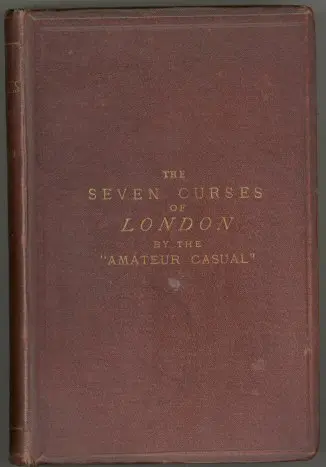
The seven curses of London
James Greenwood
THE CLASSIC COLLECTION · 1865
"Stirring Scenes in Savage Lands" by James Greenwood is a historical account written in the late 19th century. The book provides a detailed exploration of the customs, manners, and habits of various uncivilized societies around the world, highlighting both peaceful and warlike aspects of their cultures. It aims to broaden the reader's understanding of human nature and the diversity of human experience through vivid storytelling. The opening of the book sets the stage by describing the complex relationship between savages and their leaders, exploring the expectations and realities of kingship among various tribes. It delves into the lives of individuals like the King of Dahomey, characterized as someone whose rule is marked by brutality and human sacrifice, showcasing the grotesque display of wealth and power associated with his reign. The narrative discusses the expectations that come with leadership in these savage lands and the often horrifying customs that surround these ancient ways of life, establishing an intriguing tone for the accounts that follow.
Introduction adapted from the source catalogue; source summaries may be automatically generated.
Free to read · English · 191,595 words · No account needed
MAKE TIME FOR A GOOD BOOK
On by default. Untick to stop anonymous reading totals. Each page counts after 10 seconds in view. How this works.
Anonymous counting is on unless you have switched it off.
The reader has already been made aware of the many curious ceremonies finding favour at Old Kalabar, but on the authority of Mr. Hutchinson, who was frequently an eye-witness of them, the rites connected with their funeral obsequies are the most singular of all:
“At the death of ‘Iron Bar,’ a very respectable trader, and of the late king Archibongo, I saw the absurdity of these rites carried out to their fullest extent. At ‘Iron Bar’s,’ as I went into the yard, there was a dense crowd gathered round what was supposed to be his grave, which was made in the room where he died, and sunk to a depth of ten or twelve feet, that it might hold all the things put into it for his use in the next world. At the head of his grave a palm oil light was burning with a livid flame, and cast a dim shade over a man who had descended into it for the purpose of arranging his furniture--brass pans, copper rods, mugs, jugs, pots, ewers, tureens, plates, knives, forks, spoons, soap, looking-glasses, and a heap of Manchester cloth, all impaired in their integrity by a slight fracture or a tear. In the evening I visited the place again. The grave was filled up and levelled. Over it was placed a number of mats, on which were squatted a score of women. In all the apartments of the court numbers of the soft sex were in a like position, and kept up the most dismal and dolorous mourning it is possible for the imagination to conceive. I find it out of my power to convey any idea of the sensation it communicated to me. It was not harsh, it was not loud, it was not crying, nor was it shrieking; it bore no resemblance to an Irish wake, or to the squalling of a congregation of cats; but it was a puling, nauseating, melancholy howl, that would have turned my stomach long before it could have affected my brain. Over the grave, and suspended by a string from the roof, was a living cock, tied up by his legs, with its beak pointed downward. There is always a hole left in the side of the grave, through which, from time to time, rum or mimbo is poured for the spirit’s refreshment. With this there are also erected, within the house, or on the public road, or by the river’s side, what are called ‘devil houses,’ of which Iron Bar’s were good specimens. There were three structures of this kind constructed for him; one in the court attached to the house, one outside, and one on the beach, adjoining the canopy, overspread the bamboo roof placed to shelter the table, and over this again was a trio of parasols, two crimson and one blue, of silk material, and white fringe to each. Around the table were three large sofas, and at either end of the roof a pendant glass lamp. But the greatest display was on the table. In the centre was a large mirror, with a huge brass jug behind it; on either side, and covering every spare inch of the table, heaped over each other as high up as an equilibrium could be sustained, were monster jugs, decanters, tumblers, soup tureens, flower vases, bottles and mugs of all shapes and sizes, china and glass articles, as much as would stock a large shop; all being damaged like the articles placed in the graves, perhaps on the supposition that their materiality should be destroyed in order to allow the spirit to escape with them, for the ghostly company they were intended to serve, or perhaps, and more likely, to render them useless to any of the thieving fraternity, who in the practice of their science might stray in the road of these establishments. In another of the ‘devil-houses’ a quantity of cooked meat, cooked plaintain, and the pounded yam called foo-poo, were placed in calabashes for the refreshment of himself and those who were to be his fellow-travellers in the world of spirits. It shows clearly that they have a belief in a future existence, because these ‘devil-houses’ are always furnished as profusely as their means will allow, from the conviction that of whatever quality his comforts may have been to the defunct when he was in this world, they will be similar in the next. The houses erected for King Archibongo, to entertain his devil in, were superior in their furniture to those of Iron Bar. That on the beach, particularly, contained a quantity of the productions of native art. The women always go in mourning by painting patterns of deep black on their foreheads, and the men by covering their bodies over with ashes. When the mourning time is over a general smash is made of all the things in the devil house, the house itself is pulled down, and nothing but the wreck of matter left behind. Together with the widows and slaves, who in former times were sacrificed at the death of a gentleman, there were added to the list a number of persons who were accused by the friends of the deceased as being accessory to his death, and obliged to undergo what is called the ‘chop-nut’ test. They cannot believe, or at least they will not try to understand, how natural causes create disease, and attribute them and subsequent death to ‘ijod,’ or witchcraft. Hence a plan is adopted to find out the perpetrator by fixing on a number of persons, and compelling them to take a quantity of a poisonous nut, which is supposed to be innocuous if the accused be innocent, and to be fatal if he be guilty.”
Your reading position is saved on this browser. Take it to another device with a library code. Reading pages adapt to text, rather than matching a printed edition.
James Greenwood
BEHIND THE BOOK
This eBook is for the use of anyone anywhere in the United States and most other parts of the world at no cost and with almost no restrictions whatsoever. You may copy it, give it away or re-use it under the terms of the Project Gutenberg License included with this eBook or online at www.gutenberg.org. If you are not located in the United States, you will have to check the laws of the country where you are located before using this eBook. Read the source licence.
The original source file, including credits and licence, is retained by this library. Request an original-format copy at no charge. Please include the book title and Project Gutenberg identifier #71512.
KEEP YOUR CURIOSITY GOING
Cécile Tormay

Moritz Busch
John L. Ransom
Frances Wright
Cécile Tormay

Mabel Potter Daggett