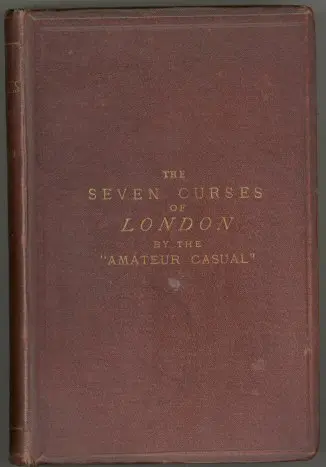
The seven curses of London
James Greenwood
THE CLASSIC COLLECTION · 1865
"Stirring Scenes in Savage Lands" by James Greenwood is a historical account written in the late 19th century. The book provides a detailed exploration of the customs, manners, and habits of various uncivilized societies around the world, highlighting both peaceful and warlike aspects of their cultures. It aims to broaden the reader's understanding of human nature and the diversity of human experience through vivid storytelling. The opening of the book sets the stage by describing the complex relationship between savages and their leaders, exploring the expectations and realities of kingship among various tribes. It delves into the lives of individuals like the King of Dahomey, characterized as someone whose rule is marked by brutality and human sacrifice, showcasing the grotesque display of wealth and power associated with his reign. The narrative discusses the expectations that come with leadership in these savage lands and the often horrifying customs that surround these ancient ways of life, establishing an intriguing tone for the accounts that follow.
Introduction adapted from the source catalogue; source summaries may be automatically generated.
Free to read · English · 191,595 words · No account needed
MAKE TIME FOR A GOOD BOOK
On by default. Untick to stop anonymous reading totals. Each page counts after 10 seconds in view. How this works.
Anonymous counting is on unless you have switched it off.
Again he tells us--“A young Mandingo negro was celebrating the funeral of his mother, who had been dead about a fortnight. On the very day of her death I had been attracted to the neighbourhood by the sound of the music. I saw in the court-yard two large drums, made like ours, and some persons were beating them and clashing cymbals. The cymbals consist of two pieces of iron, about five inches long and two and a half wide. The two negroes who were beating the drums held these cymbals in their left hands. Each of the pieces of iron has a ring, one is passed over the thumb and the other over the forefinger, and by a movement of the hand they are struck together in regular time. The women of the neighbourhood brought little presents by way of showing respect to the deceased. A large circular basket was placed exactly in the centre of the yard to receive the offerings. The women having deposited their presents assumed a grave look, and ranging themselves in a file, marched along, keeping time to the music, and making motions with their hands and heads expressive of sorrow. Sometimes they beat time by clapping their hands while they sang a melancholy song. The scene continued the whole of the day. I enquired whether the presents which had been brought in honour of the deceased were to be buried with her, for the Bambaras observe this superstitious custom.
“Four little boys, whose bodies were covered with leaves of trees well arranged, and whose heads were adorned with plumes of ostrich feathers, held in each hand a round basket with a handle, in which were bits of iron and pebbles. They kept time with the music, jumping and shaking their baskets, the contents of which produced a strange jingling. There were two leaders of the band who regulated the intervals when the performers were to play. They wore beautiful mantles of cotton network, very white and fringed round. On their heads they had black caps edged with scarlet and adorned with cowries and ostrich feathers. The musicians stood at the foot of a baobab. The assemblage was numerous and all were well dressed. The men were tricked out in all their finery. I saw several with little coussabes of a rusty colour and almost covered with amulets rolled up in little pieces of yellow cloth. Some were armed with muskets, and others with bows and arrows, as if prepared for combat. They also wore large round straw hats of their own native manufacture. They walked all together round the assembled circle, leaping and dancing to the sound of the music, which I thought very agreeable. Sometimes they appeared furious, firing their muskets and running about with threatening looks. The men with bows and arrows appeared as if on the point of rushing on an enemy, and they pretended to shoot their arrows. The men were followed by a number of women, all neatly dressed, having about their shoulders white pagones, or mantles of native cloth, which they tossed about from side to side, while they walked to the sound of the music and observed profound silence. Those who were fatigued withdrew and their places were immediately supplied by others. When they left the party they ran away very fast and were followed by some of the musicians, who accompanied them playing as far as their huts, where they received a small present. About the middle of the festival all the male relatives of the deceased made their appearance, dressed in white. They walked in two files, each carrying in his hand a piece of flat iron which they struck with another smaller piece. They walked round the assembly, keeping time, and singing a melancholy air. They were followed by women who repeated the same song in chorus and at intervals clapped their hands. Next came the son of the deceased, who was well dressed and armed with a sabre. He did not appear much affected, and after having walked round the assembly he withdrew, and the warlike dancers were renewed. The whole festival was arranged by two old men, relatives of the deceased. They addressed the assembled party and delivered an eulogium on the good qualities of their departed kinswoman. The festival ended with a grand feast, during which the goat which was killed in the morning was eaten. I remarked with pleasure the good order which prevailed throughout the entertainment, which was kept up with great merriment. The young people danced almost the whole of the night. The son of the deceased withdrew from the supper which he had provided for his friends, and came to partake of ours.”
Your reading position is saved on this browser. Take it to another device with a library code. Reading pages adapt to text, rather than matching a printed edition.
James Greenwood
BEHIND THE BOOK
This eBook is for the use of anyone anywhere in the United States and most other parts of the world at no cost and with almost no restrictions whatsoever. You may copy it, give it away or re-use it under the terms of the Project Gutenberg License included with this eBook or online at www.gutenberg.org. If you are not located in the United States, you will have to check the laws of the country where you are located before using this eBook. Read the source licence.
The original source file, including credits and licence, is retained by this library. Request an original-format copy at no charge. Please include the book title and Project Gutenberg identifier #71512.
KEEP YOUR CURIOSITY GOING
Cécile Tormay

Moritz Busch
John L. Ransom
Frances Wright
Cécile Tormay

Mabel Potter Daggett