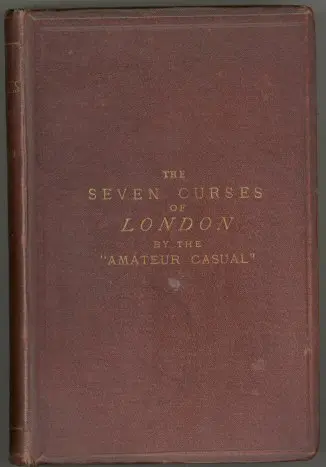
The seven curses of London
James Greenwood
THE CLASSIC COLLECTION · 1865
"Stirring Scenes in Savage Lands" by James Greenwood is a historical account written in the late 19th century. The book provides a detailed exploration of the customs, manners, and habits of various uncivilized societies around the world, highlighting both peaceful and warlike aspects of their cultures. It aims to broaden the reader's understanding of human nature and the diversity of human experience through vivid storytelling. The opening of the book sets the stage by describing the complex relationship between savages and their leaders, exploring the expectations and realities of kingship among various tribes. It delves into the lives of individuals like the King of Dahomey, characterized as someone whose rule is marked by brutality and human sacrifice, showcasing the grotesque display of wealth and power associated with his reign. The narrative discusses the expectations that come with leadership in these savage lands and the often horrifying customs that surround these ancient ways of life, establishing an intriguing tone for the accounts that follow.
Introduction adapted from the source catalogue; source summaries may be automatically generated.
Free to read · English · 191,595 words · No account needed
MAKE TIME FOR A GOOD BOOK
On by default. Untick to stop anonymous reading totals. Each page counts after 10 seconds in view. How this works.
Anonymous counting is on unless you have switched it off.
By-the-by, mention has several times been made of the curious institution existing in this part of the world known as the order of “Egbo.” It is a sort of negro brotherhood of kings, chiefs, and free men, and the title is derived from “Ekpe,” the Efik name for tiger. There are eleven grades, the three superior of which are not purchaseable by slaves. In former times the Egbo title was confined entirely to freemen, the second or third generation of a slave born within the pale of an Egboman’s dwelling being liberated by this fact, and allowed to purchase it after their parents were dead. It cannot be compared to any institution familiar to European minds but to that of Freemasonry. Previous to initiation, the Egbo candidate is obliged to go through a number of ceremonial observances; as, for instance, on a “Brass Egbo”--one of the superior grades--applicant’s admission into that order, his body is daubed over with yellow dye to simulate brass, and there is a sacrifice of animals on the occasion. The secrets and meetings of Egbo men are strictly private. If a man, woman, or child have a complaint of grievance against a master or neighbour, he or she has only to give notification of it by slapping an Egbo gentleman on the front of his body, or by going into the market square and tolling the large Egbo bell. The gentleman apprised by the first-mentioned form of notice, is bound to have at once an Egbo meeting to redress the grievance complained of, and if this be found to be trivial the punishment is inflicted on the complainant. When an Egbo man wants to make a proclamation relative to a theft committed, or the recovery of a debt, he sends out into the town what is supposed to be Idem, or spiritual representation of Egbo, a man with a black vizard on his black face, and the whole of his body covered cap-a-pie with a fantastical dress of bamboo matting. This personage is sometimes preceded by a few drummers, and he always has a bell fastened to his side, which rings as he goes along. In his left hand he carries a bunch of green leaves (for he is believed to have been exorcised from the woods, and of course must keep up his sylvan character); in his right is an enormous cow-hide whip with which he flogs every slave, man or woman, whom he meets, as taste or inclination may suggest. A brutal peculiarity of the Egboship is this, that the want of a single variety of the title will expose him who is so unfortunate as to lack it, to the lashings of the Idem of that particular grade which he has not purchased. If an individual who is in possession of all the inferior grades, and of three of the superior ones, happens to be out on the day when the Idem of that particular Egbo that he was in want of is walking, he is marked out from the common multitude and treated with extra severity. Should the Idem not meet any slave in the streets to whip on his rounds, he is at liberty to go into their houses and whip them to his heart’s content. The sound of Egbo bells, and the name of Egbo day, are enough to terrify all the slave population of Duketown, and when they hear it they hide in every available place. Latterly females have been permitted to buy Egbo privileges, but are not allowed to be present at the councils of the Egbo gentlemen, nor to enter at any time within the wall of the Egbo Palaver-house. When a yellow flag floats from the king’s house it is understood to be Brass Egbo day, and none but a few of the privileged are allowed to walk abroad. A strip of cloth of the same colour nailed to any man’s door implies that his house is under the powerful protection of Brass Egbo, the indication being significant of the master’s absence from home. If an Idem meets a European in his progress, where there are two roads or pathways available, the Idem walks off on the one different from that which the white man is approaching; if there be but one road, the latter is expected to turn his back and let the supposed spirit pass unnoticed and undisturbed. “Aqua Osong,” the last day of the Kalabar week, is grand Egbo day, on which there is a carnival and Egbo procession, with the usual amount of brutality. All legal and judicial proceedings in the country are ushered in and carried out under Egbo demonstrations, for the purpose evidently of keeping the law in terrorem over the slave population. And no stronger evidence of this can be adduced than that a man tried and condemned by Egbo law has to forfeit all his slaves and other property in his possession, no matter to whom this latter may belong. These are all divided as prey amongst the highest Egbo authorities. Persons sentenced to death by Egbo trial are allowed what is considered a privilege of leaving this world in a state of intoxication. There is a class of people called Bloodmen, who live in the interior at the plantations, and whose presence in Duketown does not give much comfort to the Egbo authorities. Sometime after the death of King Eyamba in 1846, a number of slaves belonging to the duke’s family ran away from their owners, and entered into a blood covenant for mutual protection. In a short time others joined them, and they now amount to several thousands. The present King of Duketown, Duke Ephraim, is the lineal descendant of the master of the original refugees, and consequently has considerable influence over them. Some time back they tried to be allowed the establishment of a separate Egboship for themselves, but were refused. They come into town whenever any ceremonial is to be performed having reference to a deed of blood; but what their relation is to the Egbo order still remains a profound secret. The gentlemen at Old Kalabar have all private fetishes at their houses--the skulls of human beings, the bones of leopards, hippopotami, crocodiles, and manattis, arranged according to the owner’s taste and fancy. Peculiar species of food are not eaten by many families, from the fact that some members of them die after eating of such condiments, and their ju-ju consequently places an interdict on their use.
Your reading position is saved on this browser. Take it to another device with a library code. Reading pages adapt to text, rather than matching a printed edition.
James Greenwood
BEHIND THE BOOK
This eBook is for the use of anyone anywhere in the United States and most other parts of the world at no cost and with almost no restrictions whatsoever. You may copy it, give it away or re-use it under the terms of the Project Gutenberg License included with this eBook or online at www.gutenberg.org. If you are not located in the United States, you will have to check the laws of the country where you are located before using this eBook. Read the source licence.
The original source file, including credits and licence, is retained by this library. Request an original-format copy at no charge. Please include the book title and Project Gutenberg identifier #71512.
KEEP YOUR CURIOSITY GOING
Cécile Tormay

Moritz Busch
John L. Ransom
Frances Wright
Cécile Tormay

Mabel Potter Daggett