READ · DISCOVER · ENJOYClassic literature · Always free
THE CLASSIC COLLECTION✦Stirring scenes in savage landsJames GreenwoodCLASSIC FREE BOOKS

THE CLASSIC COLLECTION · 1865

Stirring scenes in savage lands

"Stirring Scenes in Savage Lands" by James Greenwood is a historical account written in the late 19th century. The book provides a detailed exploration of the customs, manners, and habits of various uncivilized societies around the world, highlighting both peaceful and warlike aspects of their cultures. It aims to broaden the reader's understanding of human nature and the diversity of human experience through vivid storytelling. The opening of the book sets the stage by describing the complex relationship between savages and their leaders, exploring the expectations and realities of kingship among various tribes. It delves into the lives of individuals like the King of Dahomey, characterized as someone whose rule is marked by brutality and human sacrifice, showcasing the grotesque display of wealth and power associated with his reign. The narrative discusses the expectations that come with leadership in these savage lands and the often horrifying customs that surround these ancient ways of life, establishing an intriguing tone for the accounts that follow.

Introduction adapted from the source catalogue; source summaries may be automatically generated.

Start reading ↓

Free to read · English · 191,595 words · No account needed

MAKE TIME FOR A GOOD BOOK

Stirring scenes in savage lands

On by default. Untick to stop anonymous reading totals. Each page counts after 10 seconds in view. How this works.

Anonymous counting is on unless you have switched it off.

Stirring scenes in savage lands

From Issapoo we accompany Mr. Hutchinson to Duketown, and on the road that gentleman tells us of the iron palace that was sent out some years since from Liverpool for the late king Eyamba; and which, though now utterly ruined, may be recollected in its prime, as well as King Eyamba, in the same enviable condition, and still another king, one Archibong, though whether Archibong was Eyamba’s successor, or vice versâ, is not quite clear. However, the reader may judge for himself.

“No man was more impressed with an idea of the dignity attachable to the trappings of royalty than Eyamba, and so he must have a carriage. But the horses soon died, after dragging out life for some time. The skeletons of two only were visible about Duketown, perfect anatomies vivantes, at the time of my first visit there. Horses not being native to this part of the country, it puzzled the lexicographers very much to find a name for them in their Etick tongue, the language spoken at Old Kalabar. At length they hit upon the term Euang makara, which signifies “white man’s cow;” and to carry the absurdity further, entitled Eyamba’s carriage Efot euang makara, which literally means “white man’s cowhouse.” When I beheld the nature of the streets and roads in and around the town, it was a marvel to me how Eyamba could find a place broad or level enough for four wheels to roll upon. But he did make out a few yards meet for that purpose; and there it was his custom to have the carriage drawn before him by a number of slaves, whilst he walked after it, with his shining brass crown upon his head, and an immense party-coloured parasol held aloft by a strong-armed man. The Irishman who got into a sedan chair, and, finding the bottom out of it, said he might as well be walking, were it not for the grandeur of the thing, had a nearer semblance to state than this gander-brained monarch, who often used to boast of his desire to see Wellington and Napoleon, that he might shew his pre-eminence over them; and who was accustomed to sign all his letters and documents as Eyamba V., king of all black men. Everything in this once magnificent house was, on my visit to it, in a state of perfect ruin and decay, for his majesty died a few years after it had been constructed. This condition of affairs may be explained by the fact that there exists among the people of Old Kalabar, as amongst the majority of the heathen nations in western Africa, a silly superstition, that when a man dies he requires the spirit of all that belonged to him in this world, his wives, slaves, cloths, chattels, and furniture, for use in the unknown world to which he has gone. In proportion to what his competency was, and to the means of his friends to make a corresponding sacrifice for him, so is his anticipated comfort in the next state to be measured. I have been since informed that in a few hours after its fall there was not a single piece of its structure to be found on the site of its former location; for the inhabitants all acted as so many human turkey-buzzards; and the earliest bird of course picked up his choice of the best worms. Coming out of the palace, and not fifty yards from it, although I had a hill to go down, a rut to scramble through, and an eminence to ascend, I find myself in front of the Duketown palaver-house, a species of senatorial forum, where all the legislative matters of the country, the municipal affairs of the town, palavers on matters public or private, are discussed and settled by the king and the Egbos. The palaver-house consists of two walls running parallel for about forty yards, terminated by a transverse wall, about as many feet in length, and thatched with a stout bamboo roof. The end by which it is entered is opened from side to side; a space of nearly eighteen inches intervene between the tops of the walls running lengthways and the roof; and there is an ascent from the road by half-a-dozen steps to the floor, which is hard and smooth. In the centre of the entrance is a huge hollow brass pillar reaching up to the roof, further in are two more of equally imposing diameter, whilst between them are a large bell and a piece of wood; the latter is drum-like in shape, with a slit longitudinally in it, and fixed to the pillar. This is the Egbo drum, which is beaten to alarm the inhabitants in case of fire, to give notice of the attack of an enemy, or to signify the fact of a leopard having been captured, each occurrence being indicated by a peculiarity of beating the drum, which is known as soon as the sound is heard. In the farthest corner of the house is a private sanctuary, into which none but the privileged are admitted on occasions of Egbo meetings, and outside the front are two flourishing ju-ju trees, with five pillars of stone before them, said to be solidified basaltic lava, brought from Prince’s Island, and erected there to the memory of five sovereigns of Old Kalabar. Not far from this palaver-house was the residence of the late king, Archibong I. There was nothing noticeable in it beyond that of any other gentleman trader’s abode; but the king was one of the most extraordinary specimens of sable humanity I ever met. He could neither read nor write the English language, but spoke it in a very imperfect gabble, and go to his house whenever you would, he was nearly always in the condition in which he might be expected to agree with the sentiment of Sancho Panza: blessings on the man who first invented sleep. On the first day of the week, which consists of eight days, he was accustomed to entertain all the supercargoes and surgeons in the river at dinner, and this was called Chop-day. Duketown Chop-day is entitled Aqua-el-dere, and is equivalent to our Sunday, but it is only as a day of rest--drinking rum and palm wine being their chief devotions. They wash their court-yards with cow-dung and water on that morning, and the largest market in the week is held on Aqua-el-dere. Eyamba, when king, adopted it as his chop-day because it was the most honoured in the week, and he wished to be considered the most consequential man in the country. King Archibong followed in his footsteps with reference to the same practice. A similar custom is adopted on the second day of the week, called Aqua-ibibio. The dishes served up at King Archibong’s were very creditable to his culinary establishment. They consisted of various kinds of soup, containing goat’s flesh, fish, pork, cocoa leaf and root, plantains, bananas, with a variety of other dishes, such as Apicius, Meg Dod, or Alexis Soyer never smiled upon, and which are said to have contained “pepper enough in them to have scalded a silver spoon.” These were followed by roast maize, ground-nuts, and shrimps as a dessert. Mimbo or Mim-efick, the native name for palm wine, was the beverage at these dinners. It is a milky fluid, having sometimes an acid and sometimes a saccharine taste, and is procured from a particular species of the palm tree, by tapping it at the top and allowing the juice to exude into calabashes placed there to receive it. One dish relished very much by the king was a plate of pounded yam, made into the putty-like consistence of ju-ju wood, with a soup entitled palaver sauce. The mode of eating it was by grasping a lump from the dish, rolling it on the palm of the hand into the shape of a racket ball, putting the index finger into the centre, dipping it into the soup, and bolting it. The table was always neatly laid out with silver service, and the viands were brought up in large calabashes; covered with white cloths, on the head of a number of female slaves.

Your reading position is saved on this browser. Take it to another device with a library code. Reading pages adapt to text, rather than matching a printed edition.

More from this author

BEHIND THE WORDS

About James Greenwood

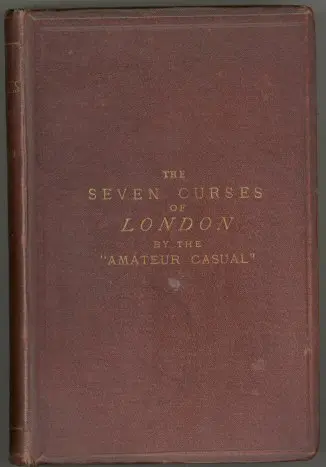
James Greenwood (1832–1929). Explore Stirring scenes in savage lands, The seven curses of London in this collection. These books span history.

Explore this author’s books →

THE READERS’ VERDICT

How did this story stay with you?

Not rated yet
Your rating for Stirring scenes in savage lands

Be the first to share your verdict.

One rating per browser, which you can change or remove. A necessary browser identifier remembers your vote. How ratings work

A GOOD STORY DESERVES COMPANY

Pass this book along.

A great read is even better when it’s shared.

SEND A LITTLE INSPIRATION

Share this book

BEHIND THE BOOK

Edition & source details.

Title
Stirring scenes in savage lands
Author
James Greenwood
First publication (Open Library catalogue match)
1865
Digital edition publisher
Project Gutenberg
Gutenberg release date
2023-08-28
Language
English
Source edition imprint
$aLondon :$bWard, Locke & Co, $c1865.
Source identifier
Project Gutenberg #71512
Contributors
No additional named contributors in source metadata

Public-domain source & licence

This eBook is for the use of anyone anywhere in the United States and most other parts of the world at no cost and with almost no restrictions whatsoever. You may copy it, give it away or re-use it under the terms of the Project Gutenberg License included with this eBook or online at www.gutenberg.org. If you are not located in the United States, you will have to check the laws of the country where you are located before using this eBook. Read the source licence.

Full source licence and obtaining an original copy

The original source file, including credits and licence, is retained by this library. Request an original-format copy at no charge. Please include the book title and Project Gutenberg identifier #71512.

the full Project Gutenberg License must appear
prominently whenever any copy of a Project Gutenberg work (any work
on which the phrase “Project Gutenberg” appears, or with which the
phrase “Project Gutenberg” is associated) is accessed, displayed,
performed, viewed, copied or distributed:

This eBook is for the use of anyone anywhere in the United States and most
other parts of the world at no cost and with almost no restrictions
whatsoever. You may copy it, give it away or re-use it under the terms
of the Project Gutenberg™ License included with this eBook or online
at www.gutenberg.org. If you
are not located in the United States, you will have to check the laws
of the country where you are located before using this eBook.

1.E.2. If an individual Project Gutenberg electronic work is
derived from texts not protected by U.S. copyright law (does not
contain a notice indicating that it is posted with permission of the
copyright holder), the work can be copied and distributed to anyone in
the United States without paying any fees or charges. If you are
redistributing or providing access to a work with the phrase “Project
Gutenberg” associated with or appearing on the work, you must comply
either with the requirements of paragraphs 1.E.1 through 1.E.7 or
obtain permission for the use of the work and the Project Gutenberg
trademark as set forth in paragraphs 1.E.8 or 1.E.9.

1.E.3. If an individual Project Gutenberg electronic work is posted
with the permission of the copyright holder, your use and distribution
must comply with both paragraphs 1.E.1 through 1.E.7 and any
additional terms imposed by the copyright holder. Additional terms
will be linked to the Project Gutenberg License for all works
posted with the permission of the copyright holder found at the
beginning of this work.

1.E.4. Do not unlink or detach or remove the full Project Gutenberg
License terms from this work, or any files containing a part of this
work or any other work associated with Project Gutenberg.

1.E.5. Do not copy, display, perform, distribute or redistribute this
electronic work, or any part of this electronic work, without
prominently displaying the sentence set forth in paragraph 1.E.1 with
active links or immediate access to the full terms of the Project
Gutenberg License.

1.E.6. You may convert to and distribute this work in any binary,
compressed, marked up, nonproprietary or proprietary form, including
any word processing or hypertext form. However, if you provide access
to or distribute copies of a Project Gutenberg work in a format
other than “Plain Vanilla ASCII” or other format used in the official
version posted on the official Project Gutenberg website
(www.gutenberg.org), you must, at no additional cost, fee or expense
to the user, provide a copy, a means of exporting a copy, or a means
of obtaining a copy upon request, of the work in its original “Plain
Vanilla ASCII” or other form. Any alternate format must include the
full Project Gutenberg License as specified in paragraph 1.E.1.

1.E.7. Do not charge a fee for access to, viewing, displaying,
performing, copying or distributing any Project Gutenberg works
unless you comply with paragraph 1.E.8 or 1.E.9.

1.E.8. You may charge a reasonable fee for copies of or providing
access to or distributing Project Gutenberg electronic works
provided that:

• You pay a royalty fee of 20% of the gross profits you derive from
the use of Project Gutenberg works calculated using the method
you already use to calculate your applicable taxes. The fee is owed
to the owner of the Project Gutenberg trademark, but he has
agreed to donate royalties under this paragraph to the Project
Gutenberg Literary Archive Foundation. Royalty payments must be paid
within 60 days following each date on which you prepare (or are
legally required to prepare) your periodic tax returns. Royalty
payments should be clearly marked as such and sent to the Project
Gutenberg Literary Archive Foundation at the address specified in
Section 4, “Information about donations to the Project Gutenberg
Literary Archive Foundation.”

• You provide a full refund of any money paid by a user who notifies
you in writing (or by e-mail) within 30 days of receipt that s/he
does not agree to the terms of the full Project Gutenberg™
License. You must require such a user to return or destroy all
copies of the works possessed in a physical medium and discontinue
all use of and all access to other copies of Project Gutenberg™
works.

• You provide, in accordance with paragraph 1.F.3, a full refund of
any money paid for a work or a replacement copy, if a defect in the
electronic work is discovered and reported to you within 90 days of
receipt of the work.

• You comply with all other terms of this agreement for free
distribution of Project Gutenberg™ works.


1.E.9. If you wish to charge a fee or distribute a Project
Gutenberg™ electronic work or group of works on different terms than
are set forth in this agreement, you must obtain permission in writing
from the Project Gutenberg Literary Archive Foundation, the manager of
the Project Gutenberg™ trademark. Contact the Foundation as set
forth in Section 3 below.

1.F.

1.F.1. Project Gutenberg volunteers and employees expend considerable
effort to identify, do copyright research on, transcribe and proofread
works not protected by U.S. copyright law in creating the Project
Gutenberg™ collection. Despite these efforts, Project Gutenberg™
electronic works, and the medium on which they may be stored, may
contain “Defects,” such as, but not limited to, incomplete, inaccurate
or corrupt data, transcription errors, a copyright or other
intellectual property infringement, a defective or damaged disk or
other medium, a computer virus, or computer codes that damage or
cannot be read by your equipment.

1.F.2. LIMITED WARRANTY, DISCLAIMER OF DAMAGES - Except for the “Right
of Replacement or Refund” described in paragraph 1.F.3, the Project
Gutenberg Literary Archive Foundation, the owner of the Project
Gutenberg™ trademark, and any other party distributing a Project
Gutenberg™ electronic work under this agreement, disclaim all
liability to you for damages, costs and expenses, including legal
fees. YOU AGREE THAT YOU HAVE NO REMEDIES FOR NEGLIGENCE, STRICT
LIABILITY, BREACH OF WARRANTY OR BREACH OF CONTRACT EXCEPT THOSE
PROVIDED IN PARAGRAPH 1.F.3. YOU AGREE THAT THE FOUNDATION, THE
TRADEMARK OWNER, AND ANY DISTRIBUTOR UNDER THIS AGREEMENT WILL NOT BE
LIABLE TO YOU FOR ACTUAL, DIRECT, INDIRECT, CONSEQUENTIAL, PUNITIVE OR
INCIDENTAL DAMAGES EVEN IF YOU GIVE NOTICE OF THE POSSIBILITY OF SUCH
DAMAGE.

1.F.3. LIMITED RIGHT OF REPLACEMENT OR REFUND - If you discover a
defect in this electronic work within 90 days of receiving it, you can
receive a refund of the money (if any) you paid for it by sending a
written explanation to the person you received the work from. If you
received the work on a physical medium, you must return the medium
with your written explanation. The person or entity that provided you
with the defective work may elect to provide a replacement copy in
lieu of a refund. If you received the work electronically, the person
or entity providing it to you may choose to give you a second
opportunity to receive the work electronically in lieu of a refund. If
the second copy is also defective, you may demand a refund in writing
without further opportunities to fix the problem.

1.F.4. Except for the limited right of replacement or refund set forth
in paragraph 1.F.3, this work is provided to you ‘AS-IS’, WITH NO
OTHER WARRANTIES OF ANY KIND, EXPRESS OR IMPLIED, INCLUDING BUT NOT
LIMITED TO WARRANTIES OF MERCHANTABILITY OR FITNESS FOR ANY PURPOSE.

1.F.5. Some states do not allow disclaimers of certain implied
warranties or the exclusion or limitation of certain types of
damages. If any disclaimer or limitation set forth in this agreement
violates the law of the state applicable to this agreement, the
agreement shall be interpreted to make the maximum disclaimer or
limitation permitted by the applicable state law. The invalidity or
unenforceability of any provision of this agreement shall not void the
remaining provisions.

1.F.6. INDEMNITY - You agree to indemnify and hold the Foundation, the
trademark owner, any agent or employee of the Foundation, anyone
providing copies of Project Gutenberg™ electronic works in
accordance with this agreement, and any volunteers associated with the
production, promotion and distribution of Project Gutenberg™
electronic works, harmless from all liability, costs and expenses,
including legal fees, that arise directly or indirectly from any of
the following which you do or cause to occur: (a) distribution of this
or any Project Gutenberg work, (b) alteration, modification, or
additions or deletions to any Project Gutenberg work, and (c) any
Defect you cause.

Section 2. Information about the Mission of Project Gutenberg

Project Gutenberg is synonymous with the free distribution of
electronic works in formats readable by the widest variety of
computers including obsolete, old, middle-aged and new computers. It
exists because of the efforts of hundreds of volunteers and donations
from people in all walks of life.

Volunteers and financial support to provide volunteers with the
assistance they need are critical to reaching Project Gutenberg’s
goals and ensuring that the Project Gutenberg collection will
remain freely available for generations to come. In 2001, the Project
Gutenberg Literary Archive Foundation was created to provide a secure
and permanent future for Project Gutenberg and future
generations. To learn more about the Project Gutenberg Literary
Archive Foundation and how your efforts and donations can help, see
Sections 3 and 4 and the Foundation information page at www.gutenberg.org.

Section 3. Information about the Project Gutenberg Literary Archive Foundation

The Project Gutenberg Literary Archive Foundation is a non-profit
501(c)(3) educational corporation organized under the laws of the
state of Mississippi and granted tax exempt status by the Internal
Revenue Service. The Foundation’s EIN or federal tax identification
number is 64-6221541. Contributions to the Project Gutenberg Literary
Archive Foundation are tax deductible to the full extent permitted by
U.S. federal laws and your state’s laws.

The Foundation’s business office is located at 41 Watchung Plaza #516,
Montclair NJ 07042, USA, +1 (862) 621-9288. Email contact links and up
to date contact information can be found at the Foundation’s website
and official page at www.gutenberg.org/contact

Section 4. Information about Donations to the Project Gutenberg
Literary Archive Foundation

Project Gutenberg™ depends upon and cannot survive without widespread
public support and donations to carry out its mission of
increasing the number of public domain and licensed works that can be
freely distributed in machine-readable form accessible by the widest
array of equipment including outdated equipment. Many small donations
($1 to $5,000) are particularly important to maintaining tax exempt
status with the IRS.

The Foundation is committed to complying with the laws regulating
charities and charitable donations in all 50 states of the United
States. Compliance requirements are not uniform and it takes a
considerable effort, much paperwork and many fees to meet and keep up
with these requirements. We do not solicit donations in locations
where we have not received written confirmation of compliance. To SEND
DONATIONS or determine the status of compliance for any particular state
visit www.gutenberg.org/donate.

While we cannot and do not solicit contributions from states where we
have not met the solicitation requirements, we know of no prohibition
against accepting unsolicited donations from donors in such states who
approach us with offers to donate.

International donations are gratefully accepted, but we cannot make
any statements concerning tax treatment of donations received from
outside the United States. U.S. laws alone swamp our small staff.

Please check the Project Gutenberg web pages for current donation
methods and addresses. Donations are accepted in a number of other
ways including checks, online payments and credit card donations. To
donate, please visit: www.gutenberg.org/donate.

Section 5. General Information About Project Gutenberg electronic works

Professor Michael S. Hart was the originator of the Project
Gutenberg concept of a library of electronic works that could be
freely shared with anyone. For forty years, he produced and
distributed Project Gutenberg eBooks with only a loose network of
volunteer support.

Project Gutenberg eBooks are often created from several printed
editions, all of which are confirmed as not protected by copyright in
the U.S. unless a copyright notice is included. Thus, we do not
necessarily keep eBooks in compliance with any particular paper
edition.

Most people start at our website which has the main PG search
facility: www.gutenberg.org.

This website includes information about Project Gutenberg,
including how to make donations to the Project Gutenberg Literary
Archive Foundation, how to help produce our new eBooks, and how to
subscribe to our email newsletter to hear about new eBooks.


KEEP YOUR CURIOSITY GOING

Your next chapter awaits.

