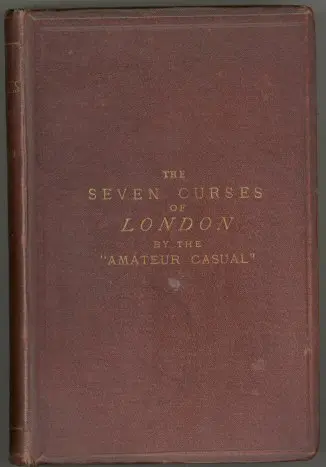
The seven curses of London
James Greenwood
THE CLASSIC COLLECTION · 1865
"Stirring Scenes in Savage Lands" by James Greenwood is a historical account written in the late 19th century. The book provides a detailed exploration of the customs, manners, and habits of various uncivilized societies around the world, highlighting both peaceful and warlike aspects of their cultures. It aims to broaden the reader's understanding of human nature and the diversity of human experience through vivid storytelling. The opening of the book sets the stage by describing the complex relationship between savages and their leaders, exploring the expectations and realities of kingship among various tribes. It delves into the lives of individuals like the King of Dahomey, characterized as someone whose rule is marked by brutality and human sacrifice, showcasing the grotesque display of wealth and power associated with his reign. The narrative discusses the expectations that come with leadership in these savage lands and the often horrifying customs that surround these ancient ways of life, establishing an intriguing tone for the accounts that follow.
Introduction adapted from the source catalogue; source summaries may be automatically generated.
Free to read · English · 191,595 words · No account needed
MAKE TIME FOR A GOOD BOOK
On by default. Untick to stop anonymous reading totals. Each page counts after 10 seconds in view. How this works.
Anonymous counting is on unless you have switched it off.
Mr. Bakie’s greatest adventure, however, was with the formidable King or Chief of Neam Nam, whose subjects were regarded by surrounding tribes as monsters of the blackest dye, and the chief himself as the Fe-fo-fum of ogres. The natives begged him not to think of visiting this nest of scorpions where he and his party would undoubtedly be slain and eaten, and have to think themselves highly fortunate if they escaped the most cruel tortures into the bargain. Bakie wanted guides, but it was only on the most unheard-of terms that he was able to procure them, as well as porters to carry presents wherewith to propitiate the terrible Neam Nam. At last, however, these difficulties were overcome, and the adventurers, after a considerable march, came in sight of Mundo, a Neam Nam village. “I could not, however, induce them to enter it, and, throwing off their loads, they decamped, leaving only the interpreter in the firm grip of two of my followers. Nothing daunted, my men took up the rejected loads and we proceeded towards the village. On nearing it, the sound of several tom-toms and the shrill whistle of their calls plainly indicated that the Neam Nam were on the alert. A large party bearing their arms and shields issued forth to meet us, and, drawing up in line across our path, seemed determined to impede our progress. Heedless of the impediment, we proceeded on our way, and my khartoumers, in the best spirits, joined lustily in a song. The sight of the savages before us was imposing, each man guarded the greater part of his body with a large shield, holding a lance vertically in his right hand. The party were evidently surprised at the confidence and unoffending manner of our approach, and evinced a greater disposition to run away than to attack. On we went joyfully, and when within two yards of them, their ranks opened, allowing us a passage through them, of which as a matter of course we availed ourselves, and entered the village (apparently deserted by women and children), with the Neam Nam following in the rear, and passing through a street of huts rather distantly situated from one another, we reached a slight eminence commanding a fine view of a highly fertile country. During our march the tom-toms continued their noise, but, regardless of consequences, we took up our position under the shade of a magnificent sycamore tree in the vicinity of a couple of huts; and, disembarrassing ourselves of our baggage, we quietly seated ourselves in a circle round it, exposing our fronts to the natives, who in great numbers soon surrounded us, apparently astonished at the coolness we displayed; they gradually closed, and, the front rank seating themselves, their proximity became disagreeable, as they hemmed us in so closely that several of them actually seated themselves upon our feet, indulging at the same time in laughter and loud conversation which we could not understand. Enjoining patience on my men, and convinced that, in case of necessity, the harmless discharge of a gun or two would scatter our visitors, I learnt with some difficulty, through the medium of the Baer and Dor interpreters, that these savages looked upon us in the light of bullocks fit for slaughter, and that they contemplated feasting upon us; but they disputed the propriety of slaying us until the arrival of their chief, who I learnt was not in the village. With this knowledge, a hearty laugh and many jokes as to their condition were indulged in by my brave companions, who, confident in their own arms, behaved admirably. The excessive joy of our would-be butchers ceased at the appearance of an aged grey-headed man, who, after a short intercourse with the Baer interpreter, in a loud voice addressed the mob in words to the following effect: ‘Neam Nam, do not insult these strange men; do you know whence they come?’ ‘No, but we will feast on them,’ was the rejoinder. Then the grey-headed old man, holding up his spear and commanding silence, proceeded thus: ‘Do you know of any tribe that would dare approach our village in so small a number as these men have done?’ ‘No,’ was again vociferated. ‘Very well, you know not whence they came, neither do I who am greatly your senior, and whose voice you ought to respect. Their country must indeed be distant, and to traverse the many tribes between their country and ours ought to be a proof to you of their valour. Look at the things they hold in their hands; they are neither spears, clubs, nor bows and arrows, but inexplicable bits of iron mounted on wood. Neither have they shields to defend their bodies from our weapons; therefore, to have travelled thus far, depend upon it their means of resistance must be so puzzling to us, and far superior to any arms that any tribe--ay, even our own--can oppose to them: therefore, Neam Nam, I, who have led you to many a fight, and whose counsels you have often followed, say, shed not your blood in vain, nor bring disgrace upon your fathers, who never have been vanquished. Touch them not, but prove yourselves worthy the friendship of such a handful of brave men, and do yourselves honour by entertaining them, rather than degrade yourselves by the continuance of your insults.’
Your reading position is saved on this browser. Take it to another device with a library code. Reading pages adapt to text, rather than matching a printed edition.
James Greenwood
BEHIND THE BOOK
This eBook is for the use of anyone anywhere in the United States and most other parts of the world at no cost and with almost no restrictions whatsoever. You may copy it, give it away or re-use it under the terms of the Project Gutenberg License included with this eBook or online at www.gutenberg.org. If you are not located in the United States, you will have to check the laws of the country where you are located before using this eBook. Read the source licence.
The original source file, including credits and licence, is retained by this library. Request an original-format copy at no charge. Please include the book title and Project Gutenberg identifier #71512.
KEEP YOUR CURIOSITY GOING
Cécile Tormay

Moritz Busch
John L. Ransom
Frances Wright
Cécile Tormay

Mabel Potter Daggett