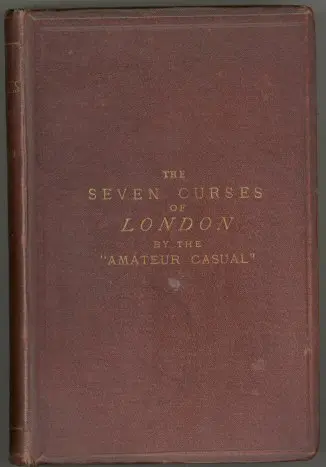
The seven curses of London
James Greenwood
THE CLASSIC COLLECTION · 1865
"Stirring Scenes in Savage Lands" by James Greenwood is a historical account written in the late 19th century. The book provides a detailed exploration of the customs, manners, and habits of various uncivilized societies around the world, highlighting both peaceful and warlike aspects of their cultures. It aims to broaden the reader's understanding of human nature and the diversity of human experience through vivid storytelling. The opening of the book sets the stage by describing the complex relationship between savages and their leaders, exploring the expectations and realities of kingship among various tribes. It delves into the lives of individuals like the King of Dahomey, characterized as someone whose rule is marked by brutality and human sacrifice, showcasing the grotesque display of wealth and power associated with his reign. The narrative discusses the expectations that come with leadership in these savage lands and the often horrifying customs that surround these ancient ways of life, establishing an intriguing tone for the accounts that follow.
Introduction adapted from the source catalogue; source summaries may be automatically generated.
Free to read · English · 191,595 words · No account needed
MAKE TIME FOR A GOOD BOOK
On by default. Untick to stop anonymous reading totals. Each page counts after 10 seconds in view. How this works.
Anonymous counting is on unless you have switched it off.
“We proposed,” says Mr. Seeman, “to the chief that we should be allowed to invest his son with the malo, which he at first refused, but to which he consented after deliberation with his people. At the appointed hour the multitude collected in the great strangers’ house or bure ni sa. The lad stood upright in the midst of the assembly guiltless of clothing, and holding a gun over his head. The consul and I approached, and in due form wrapped him up in thirty yards of Manchester print, the priest and people chanting songs and invoking the protection of their gods. A short address from the consul succeeded, stirring the lad to nobler efforts for his tribe than his ancestors had known, and pointing to the path of fame that civilization opened to him. The ceremony concluded by drinking kara, and chanting historical reminiscences of the lad’s ancestors; and thus we saved the lives of five hundred men. During the whole of this ceremony the old chief was much affected, and a few tears might be seen stealing down his cheeks; soon, however, cheering up, he gave us a full account of the time when he came of age, and the number of people that were slain to celebrate the occasion.”
To return, however, to the rain-making business. Lucky is it for the dim-minded heathen that these false priests of his have not the advantage of studying for their profession either in England or America; if it were so, heaven only knows the awful extent to which they would be bamboozled. Rain-makers especially would have a fine time of it, at least, if they were all as clever as Mr. Petherick, who, in his “Egypt and the Soudan,” unblushingly narrates how he “Barnumized” the Africans as a rain-maker.
“The rainy season was now approaching, and still no tidings of my men, and the natives daily continued to surround my encampment, and attempted, sometimes by the report of the murder of my men, and at others by night attacks upon ourselves when in the darkness we could not see them, to induce us to return to our boats and abandon our property. This they more strenuously insisted on, as they were convinced that as long as we remained in the country the rain would not fall, and both themselves and their cattle would be reduced to starvation. This idea being seriously entertained, I one day plainly stated to the chief and several of the principal men the absurdity of their assertions, and endeavoured to explain that God alone,--who had created heaven and earth,--could exercise any power over the elements. The attention with which my discourse was received induced me to prolong it, but to my discomfiture, at its close, it was treated as a capital joke, and only convinced them the more that I endeavoured to conceal from them my own powers. Finding no relief from their increasing persecutions, I at length was reduced to a ruse; and after a reference to an antiquated Weekly Times, I told them that the Supreme Being whose it was to afford them the so much-required rains, withheld them in consequence of their inhospitality towards myself; this, although it had the effect of procuring increased temporary supplies, could not induce them to furnish me with porters. Endless were the straits and absurdities to which I had recourse in order to obtain a respite, but the one creating the greatest amusement to myself and my followers was the following. A deputation of several hundred men, headed by a subchief, from their kraals some miles distant, in the most peremptory manner demanded rain or my immediate departure; the latter they were determined at whatever sacrifice to enforce. Placing my men under arms in an enclosure, and with a pair of revolver pistols at my waist, and a first-rate Dean and Adams’ revolver rifle in my hand, I went into the midst of them, and seated myself in the centre of them, opposite to the subchief, a man fully six feet six inches high, and proportionably well made. I stated that no intimidation could produce rain, and as to compelling me to withdraw, I defied them; that if I liked, with one single discharge of my gun, I could destroy the whole tribe and their cattle in an instant; but that with regard to rain, I would consult my oracle, and invited them to appear before me to-morrow, upon which, with as much dignity as I could command, I withdrew. Various were the feelings of the savages. Some expressed a wish to comply with my desire, whilst others showed an inclination to fall upon me. Although I was convinced that the chief, Tschol, secretly encouraged his men, he in the present instance made a demonstration in my favour; he threatened them with a curse unless they dispersed. Some device now became necessary to obtain a further respite for the desired rains; and setting my wits to work, I hit upon an expedient which I at once put in execution. Despatching some men to catch half-a-dozen large flies, bearing some resemblance to a horse-fly, but much larger, which infested a temporary shed where my donkey had been kept; the men, confident in the success of anything I undertook, set about the task with a will. In the course of the afternoon they were fortunately obtained, and were consigned to an empty bottle. At the appointed time my persecutors did not fail to appear, and shaking a little flower over my flies, I sallied out amongst them, bottle in hand. Referring to their wants, I treated them to a long harangue, touching the depredations which I had learnt in conversation with the chief they had committed upon the cattle of neighbouring tribes, and assassinations of unoffending men who had fallen into their power; also to several abstractions of girls from poor unprotected families of their own tribe, without the payment of the customary dowry in cattle, and dwelt upon the impossibility of their obtaining rain until restitution and satisfaction were made. They unanimously denied the charges; when I told them that it was nothing less than I had expected, but that I was furnished with the means of satisfying myself of the veracity of their assertions. The proof would consist in their restoring to me the flies, which I intended to liberate from the bottle I held. In the event of their succeeding, they should be rewarded with abundant rain; but if one fly escaped, it was a sign of their guilt, and they would be punished with a continuation of drought until restitution was made; therefore it was in their own power to procure rain or otherwise. Hundreds of clubs and lances were poised high in the air, amidst loud shouts of ‘Let them go! let them go! let them go!’ With a prayer for the safety of my flies, I held up the bottle, and smashing it against the barrel of my rifle, I had the satisfaction of seeing the flies in the enjoyment of their liberty. Man, woman, and child gave chase in hot pursuit, and the delight of my men at the success of the stratagem may be imagined. It was not until after the sun had set that the crest-fallen stragglers returned, their success having been limited to the capture of two of the flies, though several spurious ones, easily detected by the absence of the distinctive flour badge, were produced. A long consultation ensued, and in the firm belief of my oracle they determined to adopt measures for the carrying out of its requirements, but with a threat that if the promised rain did not follow, I should incur their vengeance. Aware of the difficulties in store for them from their unwillingness to part with cattle under any circumstances, I promised myself a long cessation from their molestations. I was not disappointed.”
Your reading position is saved on this browser. Take it to another device with a library code. Reading pages adapt to text, rather than matching a printed edition.
James Greenwood
BEHIND THE BOOK
This eBook is for the use of anyone anywhere in the United States and most other parts of the world at no cost and with almost no restrictions whatsoever. You may copy it, give it away or re-use it under the terms of the Project Gutenberg License included with this eBook or online at www.gutenberg.org. If you are not located in the United States, you will have to check the laws of the country where you are located before using this eBook. Read the source licence.
The original source file, including credits and licence, is retained by this library. Request an original-format copy at no charge. Please include the book title and Project Gutenberg identifier #71512.
KEEP YOUR CURIOSITY GOING
Cécile Tormay

Moritz Busch
John L. Ransom
Frances Wright
Cécile Tormay

Mabel Potter Daggett