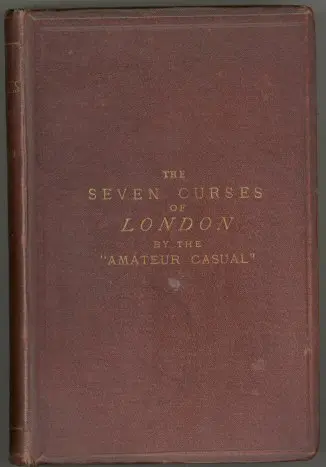
The seven curses of London
James Greenwood
THE CLASSIC COLLECTION · 1865
"Stirring Scenes in Savage Lands" by James Greenwood is a historical account written in the late 19th century. The book provides a detailed exploration of the customs, manners, and habits of various uncivilized societies around the world, highlighting both peaceful and warlike aspects of their cultures. It aims to broaden the reader's understanding of human nature and the diversity of human experience through vivid storytelling. The opening of the book sets the stage by describing the complex relationship between savages and their leaders, exploring the expectations and realities of kingship among various tribes. It delves into the lives of individuals like the King of Dahomey, characterized as someone whose rule is marked by brutality and human sacrifice, showcasing the grotesque display of wealth and power associated with his reign. The narrative discusses the expectations that come with leadership in these savage lands and the often horrifying customs that surround these ancient ways of life, establishing an intriguing tone for the accounts that follow.
Introduction adapted from the source catalogue; source summaries may be automatically generated.
Free to read · English · 191,595 words · No account needed
MAKE TIME FOR A GOOD BOOK
On by default. Untick to stop anonymous reading totals. Each page counts after 10 seconds in view. How this works.
Anonymous counting is on unless you have switched it off.
“But you will be old by-and-by, and if you live long enough will become very infirm, like that old man,” pointing to a man very old for an African, and thin, and lame, and almost blind, who had come into the court during the foregoing conversation to ask some favour, “and like him you will become lame, and deaf, and blind, and will be able to take no pleasure; would it not be better, then, for you to die when this takes place, and you are in pain and trouble, and so make room for your son as your father did for you?”
“No, it would not. I want to stand all same I stand now.”
“But supposing you should go to a place of happiness after death,
and----”
“I no savvy nothing about that. I know that I now live and have too many wives and niggers (slaves) and canoes” (he did not mean it when he said he had too many wives, etc.; it is their way of expressing a great number), “and that I am king, and plenty of ships come to my country. I know no other ting, and I want to stand.”
I offered a reply, but he would hear no more, and so the conversation on that subject ceased, and we proceeded to discuss one not much more agreeable to him, the payment of a very considerable debt which he owed me.
Getting round to the south of Africa we find but little improvement in the matter of the religious belief of royalty, at least according to what may be gleaned from another “conversation,” this time between the missionary Moffat and an African monarch:
“Sitting down beside this great man, illustrious for war and conquest, and amidst nobles and councillors, including rain-makers and others of the same order, I stated to him that my object was to tell him my news. His countenance lighted up, hoping to hear of feats of war, destruction of tribes, and such-like subjects, so congenial to his savage disposition. When he found my topics had solely a reference to the Great Being, of whom the day before he had told me he knew nothing, and of the Saviour’s mission to this world, whose name he had never heard, he resumed his knife and jackal’s skin and hummed a native air. One of his men sitting near me appeared struck with the character of the Redeemer, which I was endeavouring to describe, and particularly with his miracles. On hearing that he raised the dead he very naturally exclaimed, ‘What an excellent doctor he must have been to make dead men alive.’ This led me to describe his power and how the power would be exercised at the last day in raising the dead. In the course of my remarks the ear of the monarch caught the startling news of a resurrection. ‘What,’ he exclaimed with astonishment, ‘what are these words about; the dead, the dead arise?’ ‘Yes,’ was my reply, ‘all the dead shall arise.’ ‘Will my father arise?’ ‘Yes,’ I answered, ‘your father will arise.’ ‘Will all the slain in battle arise?’ ‘Yes.’ ‘And will all that have been killed and devoured by lions, tigers, hyænas, and crocodiles, again revive?’ ‘Yes, and come to judgment.’ ‘And will those whose bodies have been left to waste and to wither on the desert plains, and scattered to the winds, arise?’ he asked with a kind of triumph, as if he had now fixed me. ‘Yes,’ I replied, ‘not one will be left behind.’ This I repeated with increased emphasis. After looking at me for a few moments he turned to his people, to whom he spoke with a stentorian voice: ‘Hark, ye wise men, whoever is among you the wisest of past generations, did ever your ears hear such strange and unheard-of news?’ and addressing himself to one whose countenance and attire showed that he had seen many years and was a personage of no common order, ‘Have you ever heard such strange news as these?’ ‘No,’ was the sage’s answer; ‘I had supposed that I possessed all the knowledge of the country, for I have heard the tales of many generations. I am in the place of the ancients, but my knowledge is confounded with the words of his mouth. Surely he must have lived long before the period when we were born.’ Makaba then turning and addressing himself to me, and laying his hand on my breast, said: ‘Father, I love you much. Your visit and your presence have made my heart white as milk. The words of your mouth are sweet as honey, but the words of a resurrection are too great to be heard. I do not wish to hear again about the dead rising; the dead cannot arise; the dead must not arise.’ ‘Why,’ I enquired, ‘can so great a man refuse knowledge and turn away from wisdom? Tell me, my friend, why I must not speak of a resurrection.’ Raising and uncovering his arm, which had been strong in battle, and shaking his hand as if quivering a spear, he replied, ‘I have slain my thousands, and shall they arise?’ Never before had the light of divine revelation dawned upon his savage mind, and of course his conscience had never accused him; no, not for one of the thousands of deeds of rapine and murder which had marked his course through a long career.
Your reading position is saved on this browser. Take it to another device with a library code. Reading pages adapt to text, rather than matching a printed edition.
James Greenwood
BEHIND THE BOOK
This eBook is for the use of anyone anywhere in the United States and most other parts of the world at no cost and with almost no restrictions whatsoever. You may copy it, give it away or re-use it under the terms of the Project Gutenberg License included with this eBook or online at www.gutenberg.org. If you are not located in the United States, you will have to check the laws of the country where you are located before using this eBook. Read the source licence.
The original source file, including credits and licence, is retained by this library. Request an original-format copy at no charge. Please include the book title and Project Gutenberg identifier #71512.
KEEP YOUR CURIOSITY GOING
Cécile Tormay

Moritz Busch
John L. Ransom
Frances Wright
Cécile Tormay

Mabel Potter Daggett