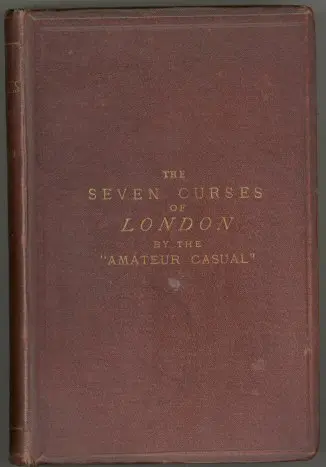
The seven curses of London
James Greenwood
THE CLASSIC COLLECTION · 1865
"Stirring Scenes in Savage Lands" by James Greenwood is a historical account written in the late 19th century. The book provides a detailed exploration of the customs, manners, and habits of various uncivilized societies around the world, highlighting both peaceful and warlike aspects of their cultures. It aims to broaden the reader's understanding of human nature and the diversity of human experience through vivid storytelling. The opening of the book sets the stage by describing the complex relationship between savages and their leaders, exploring the expectations and realities of kingship among various tribes. It delves into the lives of individuals like the King of Dahomey, characterized as someone whose rule is marked by brutality and human sacrifice, showcasing the grotesque display of wealth and power associated with his reign. The narrative discusses the expectations that come with leadership in these savage lands and the often horrifying customs that surround these ancient ways of life, establishing an intriguing tone for the accounts that follow.
Introduction adapted from the source catalogue; source summaries may be automatically generated.
Free to read · English · 191,595 words · No account needed
MAKE TIME FOR A GOOD BOOK
On by default. Untick to stop anonymous reading totals. Each page counts after 10 seconds in view. How this works.
Anonymous counting is on unless you have switched it off.
The bar of the river Bonny has sometimes proved fatal to vessels resorting thither, and being therefore injurious to the trade of the place, the inhabitants, considering it as an evil deity, endeavour to conciliate its good will by sacrificing at times a human victim upon it. The last ceremony of this sort took place not a very long time before our arrival. The handsomest and finest lad that could be procured was chosen for the purpose, and for several months before the period fixed for the close of his existence he was lodged with the king, who on account of his mild demeanour and pleasing qualities soon entertained a great affection for him, yet, swayed by superstitious fanaticism, he made no attempt to save him, but on the contrary regarded the fate to which the unfortunate lad was destined as the greatest honour that could be conferred upon him. From the time that he was chosen to propitiate by his death the forbearance of the bar he was considered as a sacred person; whatever he touched, even while casually passing along, was thenceforth his, and therefore when he appeared abroad the inhabitants fled before him to save the apparel which they had on or any articles which at the time they might be carrying. Unconscious, as it was affirmed, of the fate intended for him, he was conveyed in a large canoe to the bar and there persuaded to jump overboard to bathe, while those who took him out immediately turned their backs upon him and paddled away with the utmost haste, heedless of the cries of the wretched victim, at whom, pursuant to their stern superstition, not even a look was allowed to be cast back.
In Abo, says Mr. Bakie, every man and every woman of any consequence keeps as “dju-dju,” or jewjew, the lower jaw of a pig, or, until they can procure this, a piece of wood fashioned like one. This is preserved in their huts, and produced only when worshipped or when sacrifices are made to it, which are at certain times, at intervals of from ten days to three weeks. The particular days are determined by the dju-dju, with palm wine and touching it with a kola-nut; they speak to it and ask it to be good and propitious towards them. It is named Agba, meaning pig, or Agba-Ezhi, pig’s jaw; but when as dju-dju, it is also termed Ofum, or “my image.” People also select particular trees near their huts, or if there are none in the neighbourhood, they transplant one; these they worship, and call Tuhukum, or “my God.” They hang on these, bits of white baff (calico) as signs of a dju-dju tree, and as offerings to the deity. No one ever touches these, and if they rot off they are replaced. Little wooden images are also used, and are styled Ofo Tuhuku, “talk and pray.” When a man is suspected of falsehood, one of these is placed in his right hand, and he is made to swear by it, and if he does so falsely, it is believed that some evil will speedily befall him. Sacrifices, principally of fowls, are made to these latter as to the former. At Abo one large tree is held as dju-dju for the whole district; it is covered with offerings, and there is an annual festival in honour of it, when sacrifices of fowls, sheep, goats, and bullocks are made. When a man goes to Aro to consult Tshuku he is received by some of the priests outside of the town, near a small stream. Here he makes an offering; after which a fowl is killed, and if it appears unpropitious, a quantity of a red dye, probably camwood, is spilt into the water, which the priest tells the people is blood, and on this the votary is hurried off by the priests and is seen no more, it being given out that Tshuku has been displeased, and has taken him. The result of this preliminary ceremony is determined in general by the amount of the present given to the priests; and those who are reported to have been carried off by Tshuku are usually sold as slaves. Formerly they were commonly sent by canoes to Old Kalabar, and disposed of there. One of Mr. Bakie’e informants met upwards of twenty such unfortunates in Cuba, and another had also fallen in with several at Sierra Leone. If, however, the omen be pronounced to be favourable, the pilgrim is permitted to draw near to the shrine, and after various rites have been gone through, the question, whatever it may be, is propounded of course through the priests, and by them also the reply is given. A yellow powder is given to the devotee, who rubs it round his eyes. Little wooden images are also issued as tokens of a person having actually consulted the sacred oracle, and these are known as Ofo Tshuku, and are afterwards kept as dju-dju. A person who has been at Aro, after returning to his home is reckoned dju-dju, or sacred, for seven days, during which period he must stay in his house, and people dread to approach him. The shrine of Tshuku is said to be situated nearly in the centre of the town, and the inhabitants of Aro are often styled Omo Tshuku, or “God’s children.”
Your reading position is saved on this browser. Take it to another device with a library code. Reading pages adapt to text, rather than matching a printed edition.
James Greenwood
BEHIND THE BOOK
This eBook is for the use of anyone anywhere in the United States and most other parts of the world at no cost and with almost no restrictions whatsoever. You may copy it, give it away or re-use it under the terms of the Project Gutenberg License included with this eBook or online at www.gutenberg.org. If you are not located in the United States, you will have to check the laws of the country where you are located before using this eBook. Read the source licence.
The original source file, including credits and licence, is retained by this library. Request an original-format copy at no charge. Please include the book title and Project Gutenberg identifier #71512.
KEEP YOUR CURIOSITY GOING
Cécile Tormay

Moritz Busch
John L. Ransom
Frances Wright
Cécile Tormay

Mabel Potter Daggett