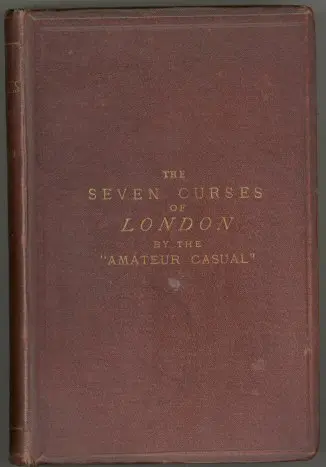
The seven curses of London
James Greenwood
THE CLASSIC COLLECTION · 1865
"Stirring Scenes in Savage Lands" by James Greenwood is a historical account written in the late 19th century. The book provides a detailed exploration of the customs, manners, and habits of various uncivilized societies around the world, highlighting both peaceful and warlike aspects of their cultures. It aims to broaden the reader's understanding of human nature and the diversity of human experience through vivid storytelling. The opening of the book sets the stage by describing the complex relationship between savages and their leaders, exploring the expectations and realities of kingship among various tribes. It delves into the lives of individuals like the King of Dahomey, characterized as someone whose rule is marked by brutality and human sacrifice, showcasing the grotesque display of wealth and power associated with his reign. The narrative discusses the expectations that come with leadership in these savage lands and the often horrifying customs that surround these ancient ways of life, establishing an intriguing tone for the accounts that follow.
Introduction adapted from the source catalogue; source summaries may be automatically generated.
Free to read · English · 191,595 words · No account needed
MAKE TIME FOR A GOOD BOOK
On by default. Untick to stop anonymous reading totals. Each page counts after 10 seconds in view. How this works.
Anonymous counting is on unless you have switched it off.
The Pawnees imitate a wolf’s ears with the two forefingers--the right hand is always understood unless otherwise specified--extended together, upright, on the left side of the head.
The Araphos, or Dirty Noses, rub the right side of that organ with the forefingers; some call this bad tribe the Smellers, and make their sign to consist of seizing the nose with the thumb and forefinger.
The Comanches imitate by the waving of the hand or forefinger the forward crawling motion of a snake.
The Cheyennes, Piakanoves, or Cut Wrists, draw the lower edge of the hand across the left arm, as if gashing it with a knife.
The Sioux, by drawing the lower edge of the hand across the throat; it is a gesture not unknown to us, but forms a truly ominous salutation, considering those by whom it is practised; hence the Sioux are called by the Yutas Hand-cutters.
The Hapsaroke, by imitating the flapping of the bird’s wings with the two hands, palms downwards, brought close to the shoulders.
The Kiowas, or Prairie-men, make the signs of the prairie, and of
drinking water.
The Yutas, they who live on mountains, have a complicated sign which denotes “living in mountains.”
The Black-feet, called by the Yutas Paike or Goers, pass the right
hand, bent spoon-fashion, from the heel to the little toe of the right
foot.
The following are a few preliminaries indispensable to the prairie
traveller:
Halt! Raise the hand, with the palm in front, and push it backward and forward several times, a gesture well known in the East.
I don’t know you. Move the raised hand, with the palm in front, slowly to the right and left.
I am angry. Close the fist, place it against the forehead, and turn it to and fro in that position.
Are you friendly? Raise both hands, grasped as if in the act of shaking hands, or lock the two forefingers together, while the hands are raised.
See. Strike out the two forefingers forward from the eyes.
Smell. Touch the nose-tip. A bad smell is expressed by the same sign, ejaculating at the same time, “pooh,” and making the sign of bad.
Taste. Touch the tongue-tip.
Eat. Imitate the actions of conveying food with the fingers to
the mouth.
Drink. Scoop up with the hand imaginary water into the mouth.
Smoke. With the crooked index describe a pipe in the air, beginning at the lips, then wave the open hand from the mouth to imitate curls of smoke.
Speak. Extend the open hand from the chin.
Fight. Make a motion with both fists to and fro like a pugilist of the eighteenth century who preferred a high guard.
Your reading position is saved on this browser. Take it to another device with a library code. Reading pages adapt to text, rather than matching a printed edition.
James Greenwood
BEHIND THE BOOK
This eBook is for the use of anyone anywhere in the United States and most other parts of the world at no cost and with almost no restrictions whatsoever. You may copy it, give it away or re-use it under the terms of the Project Gutenberg License included with this eBook or online at www.gutenberg.org. If you are not located in the United States, you will have to check the laws of the country where you are located before using this eBook. Read the source licence.
The original source file, including credits and licence, is retained by this library. Request an original-format copy at no charge. Please include the book title and Project Gutenberg identifier #71512.
KEEP YOUR CURIOSITY GOING
Cécile Tormay

Moritz Busch
John L. Ransom
Frances Wright
Cécile Tormay

Mabel Potter Daggett