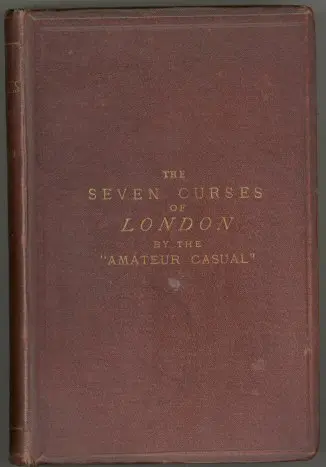
The seven curses of London
James Greenwood
THE CLASSIC COLLECTION · 1865
"Stirring Scenes in Savage Lands" by James Greenwood is a historical account written in the late 19th century. The book provides a detailed exploration of the customs, manners, and habits of various uncivilized societies around the world, highlighting both peaceful and warlike aspects of their cultures. It aims to broaden the reader's understanding of human nature and the diversity of human experience through vivid storytelling. The opening of the book sets the stage by describing the complex relationship between savages and their leaders, exploring the expectations and realities of kingship among various tribes. It delves into the lives of individuals like the King of Dahomey, characterized as someone whose rule is marked by brutality and human sacrifice, showcasing the grotesque display of wealth and power associated with his reign. The narrative discusses the expectations that come with leadership in these savage lands and the often horrifying customs that surround these ancient ways of life, establishing an intriguing tone for the accounts that follow.
Introduction adapted from the source catalogue; source summaries may be automatically generated.
Free to read · English · 191,595 words · No account needed
MAKE TIME FOR A GOOD BOOK
On by default. Untick to stop anonymous reading totals. Each page counts after 10 seconds in view. How this works.
Anonymous counting is on unless you have switched it off.
At the time when Mariner was traversing Polynesia and became a guest of King Finow’s, he happened to witness the ceremony of removing a tapu, which for certain reasons had been laid on hogs. The places appropriated for this ceremony were two marleys and the grave of Tooitonga. For distinction’s sake, we shall call the first marley Tooitonga’s, and the second Finow’s. Tooitonga’s marley is near Finow’s residence, and on this were erected four columns of yams in the following manner:--Four poles about eighteen feet long were fixed upright in the ground, to the depth of a few feet, at about four feet distance from each other, in a quadrangular form, the spaces between them all the way to the top being crossed by smaller poles about six inches distant from each other, and lashed on by the bark of the fow (species of the Hibiscus), the interior of this erection being filled up as they went with yams; and afterwards other upright poles were lashed on to the top, with cross pieces in like manner, still piling up the yams; then a third set of poles, etc., till the column of yams was about fifty or sixty feet high, when on the top of all was placed a cold baked pig. Four such columns were erected, one at each corner of the marley, the day before the ceremony, and three or four hundred hogs were killed and about half baked. The following day the hogs were carried to the king’s marley, about a quarter of a mile off, and placed upon the ground before the house, as well as four or five wooden cars or sledges full of yams, each holding about five hundred. While this was doing, the people assembling from all quarters, those who were already arrived sat themselves down round the king’s marley. Occasionally some of them got up to amuse themselves, and the rest of the company, by wrestling with one another. The king and his chiefs, all dressed in plaited gnatoo, were already seated in the house, viewing what was going forward. The company being at length all arrived, and having seated themselves, the king gave notice that the ceremony was to begin. The young chiefs and warriors, and those who prided themselves in their strength, then got up singly and endeavoured in turns to carry off the largest hog. When one failed, another tried, then a third, and so on till every one that chose had made a trial of his strength. To carry one of the largest hogs is not a thing easy to be done, on account of its greasiness as well as its weight, but it affords a considerable share of diversion to see a man embracing a large fat, baked hog, and endeavouring to raise it on his shoulder. As the hog was found too heavy for one man’s strength, it was carried away by two, whilst a third followed with its liver. They were deposited on the ground near Tooitonga’s marley, where the men waited till the other hogs were brought. In the mean time the trial was going on with the second hog, which being found also too heavy for one man, was carried away by two in like manner, and so on with the third, fourth, etc., the largest being carried away first and the least last. The second, third, fourth, etc., afforded more sport than the first, as being a nearer counterbalance with a man’s strength. Sometimes he had got it nearly upon his shoulder, when his greasy burden slipped through his arms, and his endeavour to save it brought him down after it. It is an honour to attempt these things, and even the king sometimes put his hand to it. The small hogs and pigs afforded no diversion, as they were easily lifted and carried away, each by one man, and deposited, not at the outside of Tooitonga’s marley along with the largest hogs, but carried at once into it, where the cars of yams were also dragged, one at a time. When everything was thus cleared from the king’s marley, the company got up and proceeded to the other marley, where they again seated themselves, whilst Tooitonga presided, and the king and his chiefs, out of respect, sat on the outside of the ring among the great body of the people. The large hogs which had been deposited in the neighbourhood of the marley were now to be brought in each by one man, and as it had been found that one man’s strength was not sufficient to raise any of them upon his shoulders, two others were allowed to lift the hog and place it upon his shoulders for him, and then he tottered in with his load, followed by another man with the liver; and in this manner all the hogs and their livers were carried in and deposited in two or three rows before Tooitonga. Their number was then counted by the head cooks of Tooitonga and Finow, and announced aloud to Tooitonga by his own head cook; the number of cars and piles of yams was also announced at the same time.
Your reading position is saved on this browser. Take it to another device with a library code. Reading pages adapt to text, rather than matching a printed edition.
James Greenwood
BEHIND THE BOOK
This eBook is for the use of anyone anywhere in the United States and most other parts of the world at no cost and with almost no restrictions whatsoever. You may copy it, give it away or re-use it under the terms of the Project Gutenberg License included with this eBook or online at www.gutenberg.org. If you are not located in the United States, you will have to check the laws of the country where you are located before using this eBook. Read the source licence.
The original source file, including credits and licence, is retained by this library. Request an original-format copy at no charge. Please include the book title and Project Gutenberg identifier #71512.
KEEP YOUR CURIOSITY GOING
Cécile Tormay

Moritz Busch
John L. Ransom
Frances Wright
Cécile Tormay

Mabel Potter Daggett