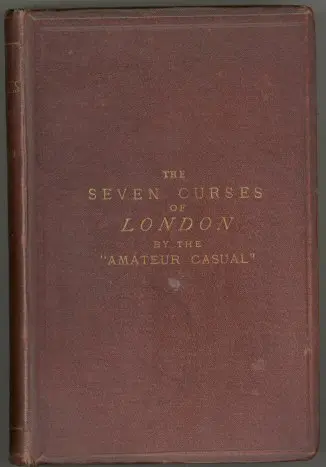
The seven curses of London
James Greenwood
THE CLASSIC COLLECTION · 1865
"Stirring Scenes in Savage Lands" by James Greenwood is a historical account written in the late 19th century. The book provides a detailed exploration of the customs, manners, and habits of various uncivilized societies around the world, highlighting both peaceful and warlike aspects of their cultures. It aims to broaden the reader's understanding of human nature and the diversity of human experience through vivid storytelling. The opening of the book sets the stage by describing the complex relationship between savages and their leaders, exploring the expectations and realities of kingship among various tribes. It delves into the lives of individuals like the King of Dahomey, characterized as someone whose rule is marked by brutality and human sacrifice, showcasing the grotesque display of wealth and power associated with his reign. The narrative discusses the expectations that come with leadership in these savage lands and the often horrifying customs that surround these ancient ways of life, establishing an intriguing tone for the accounts that follow.
Introduction adapted from the source catalogue; source summaries may be automatically generated.
Free to read · English · 191,595 words · No account needed
MAKE TIME FOR A GOOD BOOK
On by default. Untick to stop anonymous reading totals. Each page counts after 10 seconds in view. How this works.
Anonymous counting is on unless you have switched it off.
The king now left the tent, amid cries of ‘Kok-pah-sah-kree’ (a peculiarly fierce eagle); whilst all fell prostrate. The king received a handsome ebony club, and danced with it. Then the amazons rose, and the king thus addressed them: ‘The hunter buys a dog, and having trained him, he takes him out hunting without telling him the game he expects to meet. When in the bush he sees a beast, and by his teaching the dog pursues it. If the dog returns without the game, the huntsman in his anger kills him, and leaves his carcass a prey to the wolves and vultures. If I order you to clear the bush and you do not do it, will I not punish you? If I tell my people to put their hands in the fire, they must do it. When you go to war, if you are taken prisoners, you will be sacrificed, and your bodies become food for wolves and vultures.’ Having concluded his oration, the king again danced and drank; then handed round rum in a large pewter basin to the amazon officers. On his return to his tent all the amazons, in number about 2,400, marched off,--and thus ended the parade.”
Although the African warrior has already occupied rather more than his fair share of our space, we must still find room for a description of an Abyssinian chief as he was witnessed by our countryman Mr. Bruce. His name was Guangoul, and he was chief of the eastern Galla. He came one day, accompanied by about 500 foot and 40 horse, to pay his respects to the king. He was a little, thin, cross-made man, of no apparent strength or swiftness, so far as could be conjectured; his legs and thighs being small for his body, and his head large. He was of a yellow, sickly colour, neither black nor brown, had long hair plaited and interwoven with the bowels of oxen, and so knotted and twisted together as to render it impossible to distinguish the hair from the bowels, which hung down in long strings, part before and part behind, forming the most extraordinary ringlets ever seen. He had, likewise, a wreath of ox bowels hung about his neck and several rounds of the same about his middle which served as a girdle, under which was a short cotton cloth dipped in butter, and all his body was wet, and running down with the same. In his country, when he appears in state, the beast he rides upon is a cow. He was then in full dress, and mounted upon one not of the largest size, but which had monstrous horns; and rode without saddle. He had short drawers, which did not reach to the middle of his thighs; his knees, legs, feet, and all his body, being bare. He had a shield of a single hide, warped by the heat in several directions, and much in the shape of a large high-crowned hat. He carried a short lance in his right hand, with an ill-made iron head, and a shaft that seemed to be of thorn-tree, but altogether without ornament, which is seldom the case with the arms of barbarians. Whether it was necessary for poising himself on the sharp ridge of the beast’s back, or whether it was meant for graceful riding, Mr. Bruce could not determine, being quite unskilled in cowmanship; but this barbarian leaned exceedingly backwards, pushing out his belly, and holding his left arm and shield extended on one side, and his right arm and lance in the same way on the other, like wings. The king was seated on his ivory chair, almost in the middle of his tent. The day was very hot, and an intolerable stench announced the approach of the filthy chieftain to all in the tent, before they saw him. The king, when he perceived him coming, was so struck with his whole figure and appearance, that he was seized with an immoderate fit of laughter, which he found it impossible to stifle. He therefore rose from his chair, and ran as fast as he could into another apartment, behind the throne. The savage alighted from his cow, at the door of the tent, with all his tripes about him; and while the officers in attendance were admiring him as a monster, seeing the king’s seat empty, he imagined that it had been prepared for him, and down he sat upon the crimson silk cushion, with the butter running from every part of his body. A general cry of astonishment was raised by every person in the tent, on which he started up; and before he had time to recollect himself, they all fell upon him, and with pushes and blows drove this greasy chieftain to the door of the tent, staring with wild amazement, not knowing what was the matter. It is high treason and punishable with immediate death, to sit down in the king’s chair; and Guangoul owed his life to his ignorance alone. The king had beheld the scene through the curtain; if he laughed heartily in the beginning, he laughed ten times more at the catastrophe. The cushion was thrown away, and a yellow India shawl spread on the ivory stool; and ever afterwards, when it was placed, and the king not there, the stool was turned on its face upon the carpet, to prevent similar accidents.”
Your reading position is saved on this browser. Take it to another device with a library code. Reading pages adapt to text, rather than matching a printed edition.
James Greenwood
BEHIND THE BOOK
This eBook is for the use of anyone anywhere in the United States and most other parts of the world at no cost and with almost no restrictions whatsoever. You may copy it, give it away or re-use it under the terms of the Project Gutenberg License included with this eBook or online at www.gutenberg.org. If you are not located in the United States, you will have to check the laws of the country where you are located before using this eBook. Read the source licence.
The original source file, including credits and licence, is retained by this library. Request an original-format copy at no charge. Please include the book title and Project Gutenberg identifier #71512.
KEEP YOUR CURIOSITY GOING
Cécile Tormay

Moritz Busch
John L. Ransom
Frances Wright
Cécile Tormay

Mabel Potter Daggett