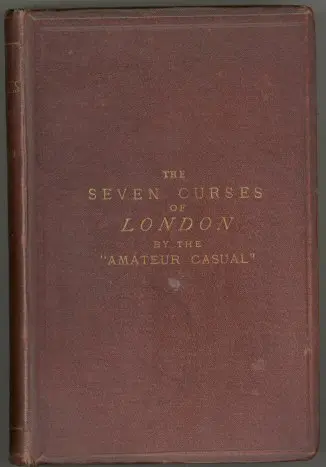
The seven curses of London
James Greenwood
THE CLASSIC COLLECTION · 1865
"Stirring Scenes in Savage Lands" by James Greenwood is a historical account written in the late 19th century. The book provides a detailed exploration of the customs, manners, and habits of various uncivilized societies around the world, highlighting both peaceful and warlike aspects of their cultures. It aims to broaden the reader's understanding of human nature and the diversity of human experience through vivid storytelling. The opening of the book sets the stage by describing the complex relationship between savages and their leaders, exploring the expectations and realities of kingship among various tribes. It delves into the lives of individuals like the King of Dahomey, characterized as someone whose rule is marked by brutality and human sacrifice, showcasing the grotesque display of wealth and power associated with his reign. The narrative discusses the expectations that come with leadership in these savage lands and the often horrifying customs that surround these ancient ways of life, establishing an intriguing tone for the accounts that follow.
Introduction adapted from the source catalogue; source summaries may be automatically generated.
Free to read · English · 191,595 words · No account needed
MAKE TIME FOR A GOOD BOOK
On by default. Untick to stop anonymous reading totals. Each page counts after 10 seconds in view. How this works.
Anonymous counting is on unless you have switched it off.
The tabilai is a link between the camakau and drua, and is made with the outrigger of either. It is often of great length, several feet at each end being solid wood, cut away something like the hull of a ship stern-ward, the sternpost of the ship representing the cut-water of the canoe, which, instead of being sharp, presents a square perpendicular edge to the water. This is the same at both ends, and is distinctive of the class.
The drua, or double canoe, differs from the rest in having
another smaller canoe for its outrigger, and the deck is laid across
both.
When not more than thirty or forty feet long, canoes are often cut out of a single tree, and require comparatively little skill in their construction. When, however, a first-class canoe is to be built, the case is far otherwise, and its creditable completion is a cause of great triumph.
A keel is laid in two or three pieces carefully scarfed together. From this the sides are built up, without ribs, in a number of pieces varying in length from three to twenty feet. The edge of each piece has on the inside a flange; as the large pieces are worked in, openings of very irregular form are left to be filled in, as suitable pieces may be found. When it is recollected that the edges of the planks are by no means straight, it will be seen that considerable skill is required in securing neat joints; yet the native carpenters effect this with surprising success. After the edges are fitted together, holes of about three-eighths of an inch in diameter are bored a hand-breadth apart in them, having an oblique direction inwards, so as to have their outlet in the flange: the holes in the edge of the opposite board are made to answer these exactly. A white pitch from the bread-fruit tree, prepared with an extract from the cocoa-nut kernel, is spread uniformly on both edges, and over this a strip of fine masi is laid, which is burnt through with a small fire-stick where it covers the holes. The piece or vono is now ready for fixing, which is done by what is commonly but wrongly called “sewing;” the native word better describes the process, and means, “to bind.” The vono being lifted to its place, a well dressed but not large sinnet is passed through the hole in the top flange, so as to come out through the lower one: the end is then inserted in the sinnet further on, and the sinnet runs rapidly through the hole, until eight or twelve loose turns are taken: the inserted end is then sought and laid on the round projection formed by the united flanges, and fastened there by drawing one turn of the sinnet tightly over it; the other turns are then tightened, the last but one being made a tie to the last. The spare sinnet is now cut off close, and the operation repeated at the next hole. The bindings, already very strong, have their power increased by fine wedges of hard wood, to the number of six or seven, being driven in opposite directions under the sinnet, whereby the greatest possible pressure is obtained. The ribs seen in canoes are not used to bring the planks into shape, but are the last things inserted, and are for securing the deep side-boards described below, and uniting the deck more firmly with the body of the canoe. The outside of the vono is now carefully adzed into form, and the carpenter has often to look closely to find the joint. When the body of the canoe is cleaned off and rubbed down with pumice stone, the surface is beautifully smooth. Of course no signs of the fastenings are seen outside. This process is not used in fixing the deep planks which support the main deck, or the triangular coverings of the two ends already described. These being on the top of the gunwale, and above the water-mark, the sinnet is seen, at regular intervals, passing, like a band, over a flat bead which runs the whole length of the canoe, covering the joint and making a neat finish. Into the upper edge of planks, two or three feet deep, fixed along the top of the sides perpendicularly, the cross beams which join on the outrigger are let and lashed down, and over these a deck of light wood is laid. The scuttle holes for baling are left at each corner. The deck also has six holes forward, and six aft, through which to work the sculling-oars, used in light winds to help the sail, or when dead calm or foul wind makes the sail useless. A small house or cuddy is built amid-ships, on which boxes or bales are stowed, and on a platform over it persons can sit or lie; a rack behind it receives guns, and spears, and clubs, or baskets are hung upon it. Any aperture inside not filled with the sinnet is tightly caulked with cocoa-nut husk, and such as are next the water are flushed up with the white pitch or resin.
Your reading position is saved on this browser. Take it to another device with a library code. Reading pages adapt to text, rather than matching a printed edition.
James Greenwood
BEHIND THE BOOK
This eBook is for the use of anyone anywhere in the United States and most other parts of the world at no cost and with almost no restrictions whatsoever. You may copy it, give it away or re-use it under the terms of the Project Gutenberg License included with this eBook or online at www.gutenberg.org. If you are not located in the United States, you will have to check the laws of the country where you are located before using this eBook. Read the source licence.
The original source file, including credits and licence, is retained by this library. Request an original-format copy at no charge. Please include the book title and Project Gutenberg identifier #71512.
KEEP YOUR CURIOSITY GOING
Cécile Tormay

Moritz Busch
John L. Ransom
Frances Wright
Cécile Tormay

Mabel Potter Daggett