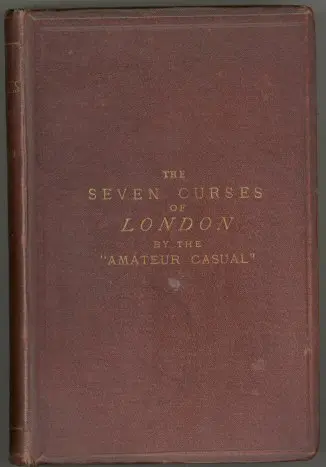
The seven curses of London
James Greenwood
THE CLASSIC COLLECTION · 1865
"Stirring Scenes in Savage Lands" by James Greenwood is a historical account written in the late 19th century. The book provides a detailed exploration of the customs, manners, and habits of various uncivilized societies around the world, highlighting both peaceful and warlike aspects of their cultures. It aims to broaden the reader's understanding of human nature and the diversity of human experience through vivid storytelling. The opening of the book sets the stage by describing the complex relationship between savages and their leaders, exploring the expectations and realities of kingship among various tribes. It delves into the lives of individuals like the King of Dahomey, characterized as someone whose rule is marked by brutality and human sacrifice, showcasing the grotesque display of wealth and power associated with his reign. The narrative discusses the expectations that come with leadership in these savage lands and the often horrifying customs that surround these ancient ways of life, establishing an intriguing tone for the accounts that follow.
Introduction adapted from the source catalogue; source summaries may be automatically generated.
Free to read · English · 191,595 words · No account needed
MAKE TIME FOR A GOOD BOOK
On by default. Untick to stop anonymous reading totals. Each page counts after 10 seconds in view. How this works.
Anonymous counting is on unless you have switched it off.
The gentleman just mentioned furnishes us with an account of the massacre of the teachers which some few years since took place at the Isle of Pines. There were three of them. They were blamed for causing sickness. Mantungu, the chief, ordered them away, and as Captain Ebrill, of the brig “Star,” was there at the time and offered to take them to Samoa, they left in his vessel. Captain Ebrill first went to Sydney, came back, was on his way to Samoa with the teachers, but touched at the Isle of Pines to procure some more sandal-wood. He anchored at Uao, some little distance from the residence of the chief. The natives went off to the vessel. “Where are Mantungu and his sons?” said a person on board. “Dead,” replied the natives in a joke. “Dead, dead; that is good,” said the same person; “let such chiefs be dead, and let the common folk live, and help us cut sandal-wood.” For some reason which we cannot ascertain, Captain Ebrill and his crew were angry with the old chief, and as a further proof of it, when he sent a present of food to the teachers, who he heard were in the vessel, it was not allowed to be received on board. Those who took it had pieces of wood thrown at them and two musket shots fired at them. None were killed, but one man was wounded in the knee. “What can this mean,” said Mantungu, “wishing me and my sons dead in our own land? and why commit such outrages upon my people who went with a present?” Whether he had any intentions previously to take the vessel we know not; but any one who knows the old despot can imagine how such treatment would make his savage heart flame with revenge. Next morning thirty select men were off, determined to kill all on board. They took some sandal-wood with them to sell; and as a further trick did not arm themselves with clubs or axes, but with the adzes which they use in dressing off the bark and sap from the wood. They reached the vessel. The sandal-wood pleased all on board, was immediately bought, and the natives were allowed to go up on deck to grind their adzes on pretence that they were going off for more wood. One of the crew was turning the handle of the grindstone, a native grinding an adze, and the captain close by. Seizing a favourable moment the native swung his adze and hit the captain in the face between the eyes,--this was instant death to Captain Ebrill, and the signal for attack all over the vessel. In a few minutes seventeen of the crew were killed--viz., ten white men, including the captain, two Marquesans, two Mangarans, one Aitutakian, one New Zealander, and a Karotongan teacher. The cook fought desperately for awhile with an axe and killed one man, but was at length overpowered and fell. This occurred on the afternoon of the 1st of November, 1842. A young man named Henry, two Samoan teachers, and a native of the New Hebrides made their escape below. Henry loaded muskets and fired up the companion, but without effect. It only exasperated the natives on deck, who threw down upon them billets of sandal-wood. The teachers then collected their property, six red shirts, eight axes, etc., called up and offered all for their lives, but there was no mercy. Night came on. The natives divided; a party went on shore in the boat, and the rest remained on deck to guard those below. In the morning the natives called down to Henry and the Samoans to come up, take the vessel further in, and then go on shore, as Mantungu had come and declared they were to live. The poor fellows felt they were entirely in the hands of the natives, came up, ran close in shore, and again dropped anchor. They were then taken to the shore. A son of Mantungu, with a tomahawk in his right hand, met Henry as he stepped out of the boat, held out his left hand with a feigned grin of friendship to shake hands; but the moment he got hold of Henry’s right hand, the villain up with his axe and laid the poor fellow dead at his feet. Others were up and at the remaining three. Lengolo, the New Hebrides native, and the Samoan Taniela, were killed at once. Mantangu and a party of natives were sitting under the shade of the cocoa-nuts looking on. Lasalo, the other Samoan teacher, escaped streaming with blood, threw himself at the feet of the old chief and begged for life. Mantungu was silent for a minute or two, but soon gave the wink to a Lifu man. Lasalo was now dragged away to be killed, but he sprang from the fellow as he lifted his axe and darted off to sea. The savages were at his heels, he was hit repeatedly, but escaped to the deep water, struck out and swam off to a little island. Four men jumped into a canoe and after him; he climbed a pine tree and talked for awhile with them; they assured him Mantungu had determined to spare him, and at last he came down. It was treachery again. They sprang upon him like tigers; but again he extricated himself, and rushed to the canoe; there, however, at length the poor fellow was overpowered and fell.
Your reading position is saved on this browser. Take it to another device with a library code. Reading pages adapt to text, rather than matching a printed edition.
James Greenwood
BEHIND THE BOOK
This eBook is for the use of anyone anywhere in the United States and most other parts of the world at no cost and with almost no restrictions whatsoever. You may copy it, give it away or re-use it under the terms of the Project Gutenberg License included with this eBook or online at www.gutenberg.org. If you are not located in the United States, you will have to check the laws of the country where you are located before using this eBook. Read the source licence.
The original source file, including credits and licence, is retained by this library. Request an original-format copy at no charge. Please include the book title and Project Gutenberg identifier #71512.
KEEP YOUR CURIOSITY GOING
Cécile Tormay

Moritz Busch
John L. Ransom
Frances Wright
Cécile Tormay

Mabel Potter Daggett