THE CLASSIC COLLECTION✦Promoting good citizenshipCLASSIC FREE BOOKS
Promoting good citizenship
James Bryce, Viscount Bryce
THE CLASSIC COLLECTION · 1912
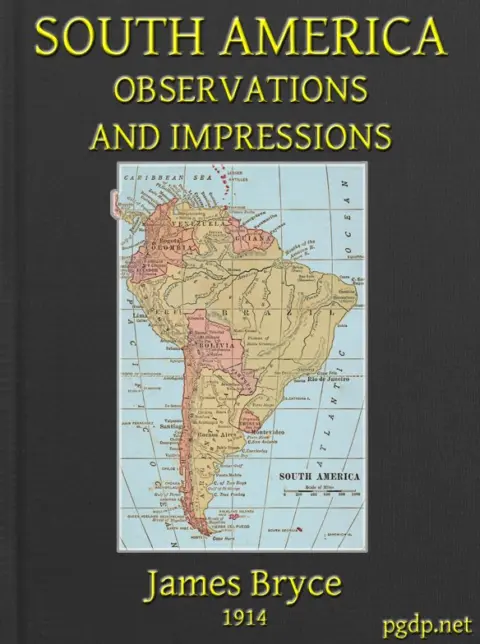
"South America: Observations and Impressions" by Viscount James Bryce is a travelogue written in the early 20th century. This work chronicles Bryce's journey through various countries in South America, including Panama, Peru, and Argentina, providing insights into the landscapes, people, and historical context of the regions explored. The focus of the book is on the author's personal observations and reflections, making it an engaging narrative for readers interested in travel literature and cultural studies. The opening of this travelogue sets the stage for Bryce's exploration of South America, beginning with his preface where he acknowledges the influences that sparked his interest in the continent. He articulates his desire to understand the social, economic, and historical realities of the seven republics he visited. Through vivid descriptions, he introduces the notion of geographical significance, specifically emphasizing the Ismuth of Panama and its pivotal historical role. This part of the text captures Bryce's intent to share firsthand experiences and impressions gained during his travels, highlighting both the unique aspects of South America and the complexities of its societies and natural landscapes.
Introduction adapted from the source catalogue; source summaries may be automatically generated.
Free to read · English · 174,009 words · No account needed
MAKE TIME FOR A GOOD BOOK
On by default. Untick to stop anonymous reading totals. Each page counts after 10 seconds in view. How this works.
Anonymous counting is on unless you have switched it off.
The reality is disappointing, yet it is impressive. One learns more from a little seeing than from reading many books. As our expectations had been unduly raised, it is right to give this reality with some little exactness of detail. The interest of the remains lies entirely in what they tell us about their builders, for there is nothing beautiful, nothing truly artistic to describe. The traces of the Incas[20] to be seen in Cuzco, and, indeed, anywhere in Peru, are all of one kind only. They are Walls. No statue, no painting. No remains of a complete roofed building, either temple or palace; nothing but ruins, and mostly fragmentary ruins. The besom of Spanish destruction swept clean. Everything connected with the old religion had to perish: priests and friars took care of that. As for other buildings, it did not occur to anybody to spare them. Even in Italy, not long before Pizarro's day, a man so cultivated as Pope Julius the Second knocked about the incomparably more beautiful and remarkable buildings of ancient Rome when they interfered with his plans of building.
But the walls at Cuzco are remarkable. They are unique memorials, not only of power and persistence, but in a certain way of skill also, not in decorative art, for of that there is scarcely a trace left, but of a high degree of expertness in the cutting and fitting together of enormous blocks. Most of the streets of the modern city follow the lines of ancient pre-Conquest streets, and in many of these there are long stretches of wall from six or eight to sixteen or eighteen feet in height so entirely unlike Spanish buildings that their Inca origin is unquestionable. They are of various types, each of which probably belongs to an epoch of its own. The most frequent, and apparently the latest type, shews very large blocks of a dark grey rock, a syenite or trachyte, cut to a uniform rectangular oblong form, the outer faces, which are nearly smooth and slightly convex, being cut in towards the joinings of the other stones. The blocks are fitted together with the utmost care, so close to one another that it is no exaggeration to say that a knife can seldom be inserted between them. The walls which they make slope very slightly backward, and, in most cases, the stones are smaller in the upper layers than in the lower. Two such walls enclose a long and narrow street which runs southeastward from the great Plaza. They are in perfect preservation, and sustain in some places the weight of modern houses built upon them. There are very few apertures for doors or windows, but one high gateway furnishes a good specimen of the Inca door and is surmounted by a long slab on which are carved in relief, quite rudely, the figures of two serpents. In other places one finds walls of the same character, but with smaller blocks and less perfect workmanship. Of a third type the wall of the so-called Palace of the Inca Roca is the best instance. It is what we call in Europe a Cyclopean building, the blocks enormous and of various shapes, but each carefully cut and adjusted to the inequalities of outline in the adjoining blocks, so that all fit perfectly together. One famous stone shews twelve angles into which the stones above, below, and at each side of it have been made to fit. This type seems older, perhaps by centuries, than that first described. In none of the walls is any mortar or any other kind of cementing material used: their strength consists in their weight and in the exactness with which they are compacted together. The most beautifully finished piece of all is to be seen in the remains of the great Temple of the Sun on whose site and out of whose ruins have been built the church and convent of St. Dominick. Here, at the west end of the church, there is what was evidently the external wall of the end of the temple. It is rounded, and each of the large squared stones is so cut as to conform perfectly to the curve of the whole. None of the single stones has the convexity which appears in the walls first described, because the surfaces of all have been levelled and polished so that they form one uniformly smooth and uniformly curved surface, as if they were all one block. A more exquisitely finished piece of work cannot be imagined. It is at least as good as anything of the same kind in Egypt, and stands as perfect now as it was when the Spaniards destroyed the superstructure of the temple.
Your reading position is saved on this browser. Take it to another device with a library code. Reading pages adapt to text, rather than matching a printed edition.
James Bryce, Viscount Bryce
James Bryce, Viscount Bryce
James Bryce, Viscount Bryce
BEHIND THE BOOK
This eBook is for the use of anyone anywhere in the United States and most other parts of the world at no cost and with almost no restrictions whatsoever. You may copy it, give it away or re-use it under the terms of the Project Gutenberg License included with this eBook or online at www.gutenberg.org. If you are not located in the United States, you will have to check the laws of the country where you are located before using this eBook. Read the source licence.
The original source file, including credits and licence, is retained by this library. Request an original-format copy at no charge. Please include the book title and Project Gutenberg identifier #45961.
KEEP YOUR CURIOSITY GOING
Wilfrid Scawen Blunt
Wilfrid Scawen Blunt

E. W. (Edgar Watson) Howe
Francis Greenleaf Allinson & Anne C. E. (Anne Crosby Emery) Allinson
Cyrenus Cole

John Martineau