THE CLASSIC COLLECTION✦Promoting good citizenshipCLASSIC FREE BOOKS
Promoting good citizenship
James Bryce, Viscount Bryce
THE CLASSIC COLLECTION · 1912
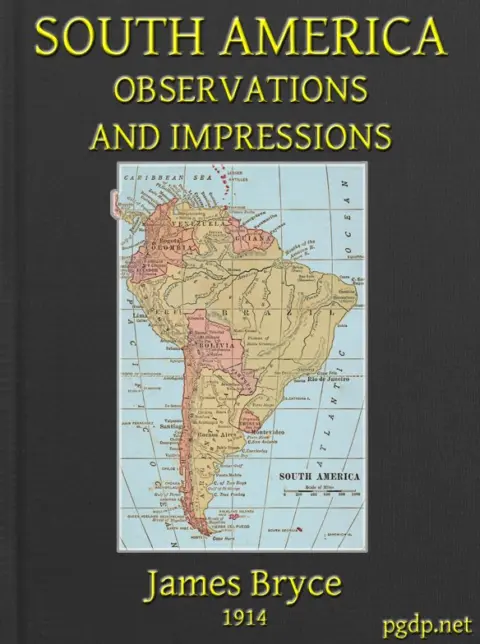
"South America: Observations and Impressions" by Viscount James Bryce is a travelogue written in the early 20th century. This work chronicles Bryce's journey through various countries in South America, including Panama, Peru, and Argentina, providing insights into the landscapes, people, and historical context of the regions explored. The focus of the book is on the author's personal observations and reflections, making it an engaging narrative for readers interested in travel literature and cultural studies. The opening of this travelogue sets the stage for Bryce's exploration of South America, beginning with his preface where he acknowledges the influences that sparked his interest in the continent. He articulates his desire to understand the social, economic, and historical realities of the seven republics he visited. Through vivid descriptions, he introduces the notion of geographical significance, specifically emphasizing the Ismuth of Panama and its pivotal historical role. This part of the text captures Bryce's intent to share firsthand experiences and impressions gained during his travels, highlighting both the unique aspects of South America and the complexities of its societies and natural landscapes.
Introduction adapted from the source catalogue; source summaries may be automatically generated.
Free to read · English · 174,009 words · No account needed
MAKE TIME FOR A GOOD BOOK
On by default. Untick to stop anonymous reading totals. Each page counts after 10 seconds in view. How this works.
Anonymous counting is on unless you have switched it off.
Twenty miles below the pass of La Raya is the town of Sicuani, which we were fortunate enough to see on the market day--Sunday--when the Indians from many miles round come to sell and buy and enjoy themselves. It is a good type of the well-to-do Peruvian village, the surrounding country being fertile and populous. The better houses, a few of them two storied, are of stone, the rest of sun-dried mud--that adobe which one finds all over Spanish America from the pueblos of New Mexico down to Patagonia. Their fronts are covered with a wash of white or light blue, and this, with the red-tiled roofs, gives a pleasant freshness and warmth of tone. The two plazas whose joint area is about equal to half of the whole town, are thronged with Indians, all the men and many of the women wearing the characteristic poncho, a rough woollen or, less often, cotton cloak which comes below the waist, and is usually of some bright hue. To this the women add gaudy petticoats, red or purplish, blue or green or violet, so that there is even more colour in the crowd than on the houses. The greatest variety is in the hats. The women wear round felts or cloth-covered straws, some almost as wide as a cardinal's; many are square, set off by gilt or silvered bands like the academic cap of the English Universities, though the brim is larger. The man's hat is smaller; it is mostly of stiff white felt, and underneath it is a tight fitting cloth cap of some bright colour, usually red, with flaps at each side to protect the ear and cheek from the piercing winds. Strings of glittering beads complete the Sunday dress of the women, and we saw only a few with silver ornaments. Most of the trading seemed to be done by barter, country folk exchanging farm or garden produce with the town dealers for groceries or cloth. The cotton cloths were largely made from the Peruvian plant cultivated in the warm coast valleys, while some of the woollen goods, such as blankets or stuff for petticoats, had come from England, as I saw on them the names of Yorkshire firms. Besides maize and nuts and peppers, together with oranges carried up from the hot valley of Urubamba seventy miles to the north, the most noticeable articles of commerce were a sort of edible seaweed brought from the coast, and dried marine star-fishes, and, above all, small bags of coca leaves, the article which is the one indispensable stimulant of the Indian, more for him than tea or coffee or alcoholic drinks are for the Asiatic or the European. It is a subtropical shrub or low tree which grows on the lower slopes of the Peruvian and Bolivian Andes and is sold to the Indians in small quantities, as indeed all the sales and purchases seemed to be on a small scale, there being among the peasants very little money though very little downright poverty. South American countries are, for the traveller at least, a land of high prices, but here we saw savoury messes of hot stewed meat with chopped onions and potatoes and a small glass of chicha (the common drink of the country brewed from maize), thrown in, offered at the price of five centavos, less than two English pence or a United States five cent piece. It was surprising that in so thick and busy a crowd there should be, instead of the chattering and clattering that one would have heard in Europe, only a steady hum. The Quichua Indians are a comparatively silent race, quiet and well mannered, and inoffensive except when they are drunk. These Sicuani people were small in stature, few exceeding five feet six inches, their faces a reddish brown, the features regular though seldom handsome, for while the nose is often well formed, the mouth is ugly, with no fineness of line in the lips, although these are far less thick than a negro's. Some have a slight moustache, but beards are seen only on the mestizos (half breeds). Among the many diversities of feature which suggest that there has been an intermixture of races, perhaps long ago, there are two prevailing types--the broad, round, short face with full cheeks, and the longer face with an aquiline nose. All have dark brown or black eyes, and long, straight, black, rather coarse, hair, and in all there is a curiously stolid and impassive look as of men accustomed to centuries of monotony and submission. Impassiveness is the characteristic note of the Indian. The Kafir is like a grown-up child; the Chinese have a curious quiet alertness and keenness of observation; the Hindus (and most Orientals) are submissive though watchful as if trying to take the white man's measure: but the Indian is none of these things. In his obedience there is no servility: he is reserved, aloof, seemingly indifferent to the Viracocha[16] and to things in general. The most noticeable in the throng were the Indian village alcaldes, each carrying as the badge of his office a long, heavy staff or cane, with a spike at the bottom and a large round head, bound with silver bands and covered at the top with a silver casing. This dignitary, appointed by the local authority annually, exerts in his little community an undisputed sway, enforced by his power of imprisonment. The post is eagerly sought, so that the wealthier sort will offer money to obtain it. We saw them moving through the crowd, all making way for them. There were, however, no disturbances to quell: the bright sun shone on an orderly and good-humoured crowd. Some groups, drawn a little apart, were enjoying the strains of a guitar or an accordion or those of the true national instrument, the Pandean pipe made of hollow reeds unequal in length, while above, on the hillside, the donkeys on which the wealthier peasants had ridden in and the llamas that had carried their produce stood patiently awaiting the declining light that should turn them homeward.
Your reading position is saved on this browser. Take it to another device with a library code. Reading pages adapt to text, rather than matching a printed edition.
James Bryce, Viscount Bryce
James Bryce, Viscount Bryce
James Bryce, Viscount Bryce
BEHIND THE BOOK
This eBook is for the use of anyone anywhere in the United States and most other parts of the world at no cost and with almost no restrictions whatsoever. You may copy it, give it away or re-use it under the terms of the Project Gutenberg License included with this eBook or online at www.gutenberg.org. If you are not located in the United States, you will have to check the laws of the country where you are located before using this eBook. Read the source licence.
The original source file, including credits and licence, is retained by this library. Request an original-format copy at no charge. Please include the book title and Project Gutenberg identifier #45961.
KEEP YOUR CURIOSITY GOING
Wilfrid Scawen Blunt
Wilfrid Scawen Blunt

E. W. (Edgar Watson) Howe
Francis Greenleaf Allinson & Anne C. E. (Anne Crosby Emery) Allinson
Cyrenus Cole

John Martineau