THE CLASSIC COLLECTION✦Promoting good citizenshipCLASSIC FREE BOOKS
Promoting good citizenship
James Bryce, Viscount Bryce
THE CLASSIC COLLECTION · 1912
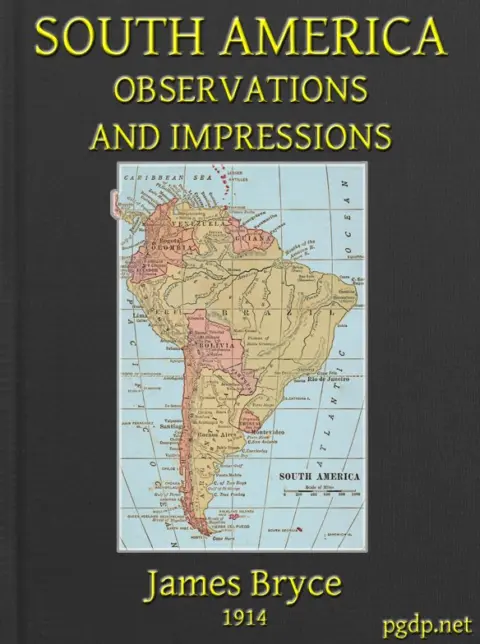
"South America: Observations and Impressions" by Viscount James Bryce is a travelogue written in the early 20th century. This work chronicles Bryce's journey through various countries in South America, including Panama, Peru, and Argentina, providing insights into the landscapes, people, and historical context of the regions explored. The focus of the book is on the author's personal observations and reflections, making it an engaging narrative for readers interested in travel literature and cultural studies. The opening of this travelogue sets the stage for Bryce's exploration of South America, beginning with his preface where he acknowledges the influences that sparked his interest in the continent. He articulates his desire to understand the social, economic, and historical realities of the seven republics he visited. Through vivid descriptions, he introduces the notion of geographical significance, specifically emphasizing the Ismuth of Panama and its pivotal historical role. This part of the text captures Bryce's intent to share firsthand experiences and impressions gained during his travels, highlighting both the unique aspects of South America and the complexities of its societies and natural landscapes.
Introduction adapted from the source catalogue; source summaries may be automatically generated.
Free to read · English · 174,009 words · No account needed
MAKE TIME FOR A GOOD BOOK
On by default. Untick to stop anonymous reading totals. Each page counts after 10 seconds in view. How this works.
Anonymous counting is on unless you have switched it off.
Yet life was not wholly monastic. There was some learning, mostly theological. There was also a good deal of verse making: Arequipa was even famous for its poets. Upon what themes did their Muse employ itself? What sighs were there from nuns behind the convent walls? What sort of a human being was the bishop who walked in solemn processions behind chanting choristers to and from his Cathedral? Must there not have been even here the perpetual play of human passion, and could any weight of conservatism and convention extinguish the possibilities of romance? I heard from a trustworthy source a story which shews that even in grave and rigid Arequipa love would have its way and that the hearts of stately ecclesiastics could melt in pity. I tell it in my informant's words.
In old colonial days there lived in Arequipa a powerful family owning large estates and rich mines which they had inherited from their ancestors among the Conquistadores. They wielded authority both in Church and State. At the time when the incident to be described happened the heads of the family were two brothers, of whom the elder held the landed property and the younger was bishop and ruled the Church. The elder was a widower with two children, a son and a daughter. The great convent of Nuestra Señora de los Dolores, founded and richly endowed by this family, always had one of its members as its Abbess, and at that time the only sister of these two brothers held the post. The family, being a power in Arequipa, sought to preserve their supremacy, and accordingly decided that the young daughter of the elder brother should enter the convent and eventually succeed her aunt as Abbess, while her brother should marry and inherit the estates. The girl had no vocation for a religious life and rebelled against the fate proposed for her, but the father and uncle were inexorable, and after a vain struggle she was forced to yield and take the veil. Her aunt felt sympathy for the poor child, having perhaps passed through a like experience herself, and she made the young sister's religious duties as light as possible, allowing her to lead the choir, as she possessed a fine voice, and giving her the business of the convent to attend to. Embroidery was one of the occupations of the nuns, especially fine work on linen, the designs for which were brought from Spain; and to supervise this work and to take care of it was one of the girl's chief pleasures. She always despatched it to the laundry herself and received it on its return, laying it carefully in the presses perfumed with jasmine flowers, and the laundress was the only person from the outside world (except her own family) with whom she had any communications. This laundress happened to be an alert and intelligent woman, and she gave the nun all the news she had of the world outside the convent walls. After the young sister had been about five years in the convent the Abbess fell ill, and all the old-fashioned remedies known to the nuns failed to help her. She grew steadily worse and they were beginning to think of administering the last offices of the Church when the laundress suggested to the niece of the Abbess that the clever Scotch physician who had lately come to Arequipa should be consulted. To consult a man and a heretic horrified the nuns, but the laundress pressed her advice, and finally the bishop was appealed to and was induced, since his sister's life was at stake, to give his consent. The patient, however, even then refused to see the doctor in person, but the niece, closely veiled, was to be allowed to have an interview with him and to describe the symptoms. Although the doctor was aware that an opinion given under such circumstances was of little use, he consented to this arrangement. Accordingly, at the appointed time he presented himself at the convent gate, under the guidance of the laundress, and was taken to the antechamber of the Abbess's apartment, for a lady of such high rank as the Abbess did not occupy a cell. There the niece received him, closely veiled, and described her aunt's condition. On his asking her if she could count the pulse, she replied, "No, I have never tried." "If you will place your fingers on my wrist, I will teach you," he said. Timidly she did as he bade her, and counted the beats; and, thrilled as he was by the musical softness of her voice, it is possible that he prolonged the lesson, for at length she said, "I understand perfectly, and will now go and count my aunt's pulse," and returned presently with a written report. During her absence the doctor had made enquiries of the laundress in regard to the Abbess's symptoms, and had decided that the old lady was suffering from cancer and had not long to live. But the young sister had made too profound an impression on him to let him give up the case at once, and he prescribed some soothing remedies and offered to return in the morning. These visits continued for several days, and at last he succeeded in seeing the sister's beautiful face and counting her pulse. The laundress could not always be in attendance, and the narcotics administered to the Abbess dulled her vigilance. Realising that his patient's days were numbered and that his work would soon be over, he saw there was no time to lose. The scruples of the young sister were finally overcome. Love won the day, and she promised to fly with her lover after the death of her aunt. With the help of the laundress he devised a plan for escape. The convent was built of stone and the sisters' cells were solidly arched like casemates, the only wood about them being the doors. Obtaining a skeleton from the hospital, the doctor took it to the house of the laundress and she conveyed it in a large linen basket to the convent the day after the funeral of the Abbess, and concealed it in the young sister's bed. That night the girl set fire to her bed, and in the confusion occasioned by the smoke and the alarm she escaped unnoticed into the street, where the laundress awaited her and took her to her house. The frightened nuns sought for her in vain, and when finally a few charred bones were found in her cell, which they imagined in their ignorance to be hers, they mourned her as dead, and buried the bones with all the honour due to her rank and station. Meanwhile the girl herself was in great danger, for had she been discovered she would have been tried for faithlessness to her vows, and she shuddered at the bare possibility of the old punishment of being walled up alive. It was impossible to stay long in the laundress's house, and the doctor implored her to fly with him to the coast, an arduous ride of seventy miles over the desert. Recoiling from such a step, she insisted on first trying to win the pardon and protection of her relatives, and she resolved to throw herself on the mercy of her uncle, the bishop, who had always shewn her much affection and was all-powerful with the rest of the family. Accordingly, just after twilight, and wrapped in her manta, which concealed her face and figure, she stole into the bishop's palace, where she found her uncle at evening prayer, and throwing herself on her knees before him, she implored his protection. He took her at first for her own ghost (for had he not performed the funeral service over her remains?), and when he discovered that it was really she, in flesh and blood, he was horrified and put her from him as he would a viper. But as she still clung to him, telling him her story and imploring his mercy and protection, he at last listened to her, and finally said, "wait a moment," and left the room, returning shortly with a bag containing money and family jewels, emeralds, which he thrust into her hand. "Take this," he whispered, "and fly with your lover to the coast. I will see that you are not followed." She found the doctor with horses at the city gate, and they rode away across the desert, never stopping except to change their mounts and to eat a little food, until they reached the coast, where by an extraordinary piece of luck they found an English frigate lying at anchor. Hurrying on board they told the captain their story, and he at once summoned the chaplain, who married them, and they were soon on their way to England.
Your reading position is saved on this browser. Take it to another device with a library code. Reading pages adapt to text, rather than matching a printed edition.
James Bryce, Viscount Bryce
James Bryce, Viscount Bryce
James Bryce, Viscount Bryce
BEHIND THE BOOK
This eBook is for the use of anyone anywhere in the United States and most other parts of the world at no cost and with almost no restrictions whatsoever. You may copy it, give it away or re-use it under the terms of the Project Gutenberg License included with this eBook or online at www.gutenberg.org. If you are not located in the United States, you will have to check the laws of the country where you are located before using this eBook. Read the source licence.
The original source file, including credits and licence, is retained by this library. Request an original-format copy at no charge. Please include the book title and Project Gutenberg identifier #45961.
KEEP YOUR CURIOSITY GOING
Wilfrid Scawen Blunt
Wilfrid Scawen Blunt

E. W. (Edgar Watson) Howe
Francis Greenleaf Allinson & Anne C. E. (Anne Crosby Emery) Allinson
Cyrenus Cole

John Martineau