THE CLASSIC COLLECTION✦Promoting good citizenshipCLASSIC FREE BOOKS
Promoting good citizenship
James Bryce, Viscount Bryce
THE CLASSIC COLLECTION · 1912
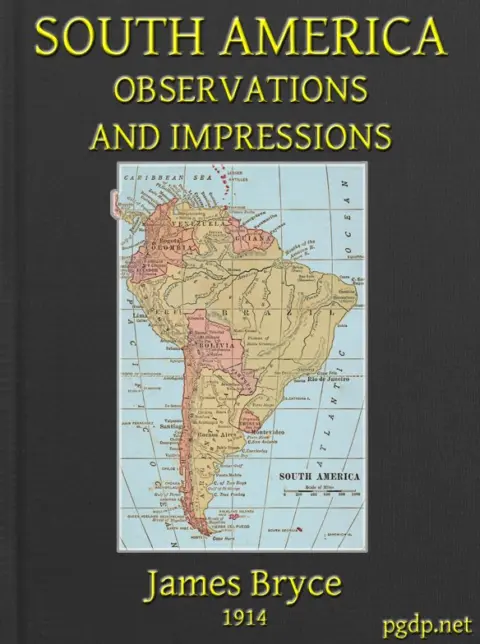
"South America: Observations and Impressions" by Viscount James Bryce is a travelogue written in the early 20th century. This work chronicles Bryce's journey through various countries in South America, including Panama, Peru, and Argentina, providing insights into the landscapes, people, and historical context of the regions explored. The focus of the book is on the author's personal observations and reflections, making it an engaging narrative for readers interested in travel literature and cultural studies. The opening of this travelogue sets the stage for Bryce's exploration of South America, beginning with his preface where he acknowledges the influences that sparked his interest in the continent. He articulates his desire to understand the social, economic, and historical realities of the seven republics he visited. Through vivid descriptions, he introduces the notion of geographical significance, specifically emphasizing the Ismuth of Panama and its pivotal historical role. This part of the text captures Bryce's intent to share firsthand experiences and impressions gained during his travels, highlighting both the unique aspects of South America and the complexities of its societies and natural landscapes.
Introduction adapted from the source catalogue; source summaries may be automatically generated.
Free to read · English · 174,009 words · No account needed
MAKE TIME FOR A GOOD BOOK
On by default. Untick to stop anonymous reading totals. Each page counts after 10 seconds in view. How this works.
Anonymous counting is on unless you have switched it off.
[139] In the days when Louis Napoleon was trying to establish for France a hegemony over the Romance-speaking peoples of Europe, the days when his Life of Julius Cæsar was published and his expedition to Mexico despatched, this term first came into common use. It was the fashion for his literary court to represent the French people as the heirs of ancient Rome, the modern perpetuator of her spirit and her greatness. Yet in reality the character and the conduct of the English government during the eighteenth and nineteenth centuries bear a closer resemblance than ever did the French, both in their strong and in their weak points, to the government of the Roman republic.
[140] Cortes tortured him to compel the disclosure of treasure.
[141] Though Francia had been created dictator for life.
[142] The wild tribal Indians, Indios bravos, have, of course, no
votes.
[143] The Magyars of Hungary, the Finns of Finland, and the Basques of
the western Pyrenees.
[144] Dr. Palacios in his interesting book Raza Chilena.
[145] Remembering Switzerland with its three languages, one cannot make the proposition absolute. But in Switzerland the three races are, as respects intelligence and education, practically on a level, whereas in South America the Indians stand far below.
[146] This was ceasing, under the rule of Diaz, to be true of Mexico.
[147] Though much more ought to have been done towards the solution of land questions and for the promotion of education. [Mexico seems to have now relapsed into a condition as bad as that from which Juarez and Diaz rescued her. Note to edition of 1914.]
[148] There would seem to have been more in Europe within the last fifty years than in any preceding period of equal length since the seventeenth century.
[149] The small cultivator in Argentina is under this disadvantage that a severe drought or a swarm of locusts may ruin him, whereas the large farmer with more capital can bear the loss of one season's crop.
[150] This is Manaos in Brazilian territory. Higher up, in Peruvian, is the smaller town of Iquitos. Ocean-going steamers ply as far as Manaos.
[151] See ante, p. 76. The evil is widespread and horrible.
[152] I include English, Dutch, and French Guiana.
[153] In Victoria the annual rate of increase per cent of population which in 1871 was 3.07 per cent was in 1901 only .48 per cent. In New South Wales it was in 1871, 3.7 per cent, in 1901, 1.8 per cent.
[154] The Italians are chiefly in Argentina, Uruguay, and southern
Brazil.
[155] There are also some East Indian coolies in Guiana, perhaps
100,000.
[156] The negroes are almost all in Brazil, but a few exist on the coasts of Peru, Colombia, Panama, and Venezuela.
Your reading position is saved on this browser. Take it to another device with a library code. Reading pages adapt to text, rather than matching a printed edition.
James Bryce, Viscount Bryce
James Bryce, Viscount Bryce
James Bryce, Viscount Bryce
BEHIND THE BOOK
This eBook is for the use of anyone anywhere in the United States and most other parts of the world at no cost and with almost no restrictions whatsoever. You may copy it, give it away or re-use it under the terms of the Project Gutenberg License included with this eBook or online at www.gutenberg.org. If you are not located in the United States, you will have to check the laws of the country where you are located before using this eBook. Read the source licence.
The original source file, including credits and licence, is retained by this library. Request an original-format copy at no charge. Please include the book title and Project Gutenberg identifier #45961.
KEEP YOUR CURIOSITY GOING
Wilfrid Scawen Blunt
Wilfrid Scawen Blunt

E. W. (Edgar Watson) Howe
Francis Greenleaf Allinson & Anne C. E. (Anne Crosby Emery) Allinson
Cyrenus Cole

John Martineau