THE CLASSIC COLLECTION✦Promoting good citizenshipCLASSIC FREE BOOKS
Promoting good citizenship
James Bryce, Viscount Bryce
THE CLASSIC COLLECTION · 1912
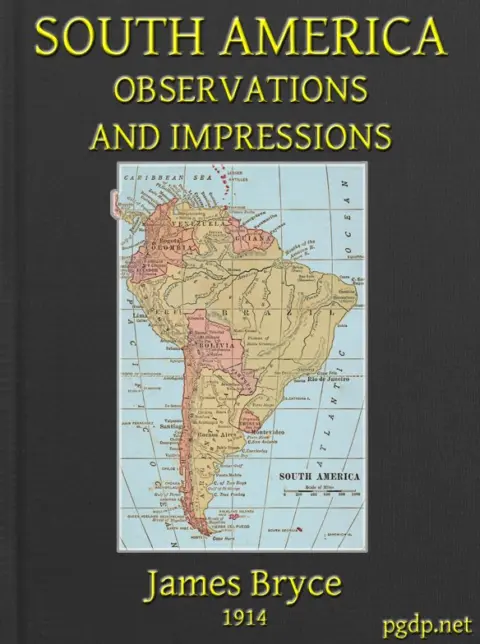
"South America: Observations and Impressions" by Viscount James Bryce is a travelogue written in the early 20th century. This work chronicles Bryce's journey through various countries in South America, including Panama, Peru, and Argentina, providing insights into the landscapes, people, and historical context of the regions explored. The focus of the book is on the author's personal observations and reflections, making it an engaging narrative for readers interested in travel literature and cultural studies. The opening of this travelogue sets the stage for Bryce's exploration of South America, beginning with his preface where he acknowledges the influences that sparked his interest in the continent. He articulates his desire to understand the social, economic, and historical realities of the seven republics he visited. Through vivid descriptions, he introduces the notion of geographical significance, specifically emphasizing the Ismuth of Panama and its pivotal historical role. This part of the text captures Bryce's intent to share firsthand experiences and impressions gained during his travels, highlighting both the unique aspects of South America and the complexities of its societies and natural landscapes.
Introduction adapted from the source catalogue; source summaries may be automatically generated.
Free to read · English · 174,009 words · No account needed
MAKE TIME FOR A GOOD BOOK
On by default. Untick to stop anonymous reading totals. Each page counts after 10 seconds in view. How this works.
Anonymous counting is on unless you have switched it off.
Next to Callao in its importance as a Peruvian port, is the little town of Mollendo, for from it starts the principal railway in the country, that called the Southern of Peru, which climbs the Andes, traverses the central plateau, and sends out branches to Cuzco on the north, and on the southeast to the frontier of Bolivia, on the shore of Lake Titicaca. It is the main avenue to the interior of the country. Unfortunately there is at Mollendo no harbour, only an open roadstead, where vessels lie rolling and pitching in the ocean swell, which is sometimes heavy enough to make landing in boats difficult or even dangerous. A sort of breakwater has been made enclosing a tiny port, but even in its shelter, the sweep of the great billow round the rocky semicircle forces the disembarking passenger to jump hastily ashore and scurry up before the next billow overtakes him. No more dreary spot than this could be imagined. Payta in its desert was doleful enough, but Payta had sun; and this place, under a thick roof of cloud, was far more gloomy. Hills brown and barren rise steeply from the beach, leaving little room for the few houses, brown as the cliff itself. There is not a blade of grass visible, nor a drop of fresh water within many miles, save what a pipe brings from a distant river. Yet, gloomy as the place looked under the grey cloud roof which was hanging over land and sea, the inhabitants find it more tolerable at this season than such an arid and treeless land becomes when the blaze of the sun is reflected from the rocky hill face behind.
The railroad runs south for some miles between the cliffs along a stretch of sand, on which the surf booms in slow thunder, then leaves the shore and turns up into the clouds, mounting in long zigzags the steep acclivities of the mountain, and following here and there what were hardly to be called glens, but rather waterless hollows, down which once in nine or ten years a rain storm may send a torrent. The mists grow thicker and damper as one rises, and with the cooler and damper air there begins to be a little vegetation, some flowers, most of them at this season withered, and low, thorny shrubs, such as are usually found on arid soils. Away off to the south, occasional glimpses are caught of a river valley far below, where the bright green and yellow of crops on the irrigated banks make a pleasant relief to the monotony of the brown or black slopes, up which we keep our way. Curiosity grows more intense to know what lies behind those dreary mountains. At last, after two hours of steady climbing to a height of over four thousand feet, the train reaches what seems to be the top of the range, but proves to be really the edge of a tableland, as it emerges on to level ground, it suddenly passes out of the mists into dazzling sunshine, and stops at a spot called Cachendo. We step out, and have before us a view, the like of which we had never seen before. In front, looking eastward, was a wide plain of sand and pebbles with loose piles and shattered ridges of black rock rising here and there from its surface, all shimmering in the sunlight. Beyond the plain, thirty miles away, is a long line of red and grey mountains, their sides all bare, their crags pierced by deep, dark gorges, so that they seem full of shadows. Behind these mountains again, and some fifty or sixty miles distant, three gigantic mountains stand up and close the prospect. That farthest to the south is a long line of precipices, crowned here and there by spires and towers of rock, seventeen thousand feet in height. This is Pichu Pichu. Its faces are too steep for snow, save in the gorges that scar them here and there, but lower down, where the slopes are less abrupt, every gully is white with desert sand blown up by the winds. Next to the north is a huge purplish black cone, streaked near its top with snow beds, and lower down by lines of red or grey ash and black lava. This is El Misti, a volcano not quite extinct, for though there has been no eruption for centuries, faint curls of steam still rise from the crater. It stands quite alone, evidently of far more recent origin than the third great mass, its neighbour on the north, Chachani, which, though also of volcanic rock, has long since lost its crater, and rises in three great black pinnacles, divided by valleys filled with snow. Both it and Misti exceed nineteen thousand feet. They are not, however, the loftiest ground visible. Far, far away to the north, there tower up two white giants, Ampato, and (farther west) the still grander Coropuna, whose height, not yet absolutely determined, may exceed twenty-two thousand feet and make it the rival of Illampu in Bolivia and Aconcagua in Chile. It stands alone in a vast wilderness, a flat-topped cone at the end of a long ridge, based on mighty buttresses all deep with snow and fringed with glaciers.[11] These five mountains belong to the line of the great Western Cordillera which runs, apparently along the line of a volcanic fissure, all the way north to Ecuador and Colombia.
Your reading position is saved on this browser. Take it to another device with a library code. Reading pages adapt to text, rather than matching a printed edition.
James Bryce, Viscount Bryce
James Bryce, Viscount Bryce
James Bryce, Viscount Bryce
BEHIND THE BOOK
This eBook is for the use of anyone anywhere in the United States and most other parts of the world at no cost and with almost no restrictions whatsoever. You may copy it, give it away or re-use it under the terms of the Project Gutenberg License included with this eBook or online at www.gutenberg.org. If you are not located in the United States, you will have to check the laws of the country where you are located before using this eBook. Read the source licence.
The original source file, including credits and licence, is retained by this library. Request an original-format copy at no charge. Please include the book title and Project Gutenberg identifier #45961.
KEEP YOUR CURIOSITY GOING
Wilfrid Scawen Blunt
Wilfrid Scawen Blunt

E. W. (Edgar Watson) Howe
Francis Greenleaf Allinson & Anne C. E. (Anne Crosby Emery) Allinson
Cyrenus Cole

John Martineau