THE CLASSIC COLLECTION✦Promoting good citizenshipCLASSIC FREE BOOKS
Promoting good citizenship
James Bryce, Viscount Bryce
THE CLASSIC COLLECTION · 1912
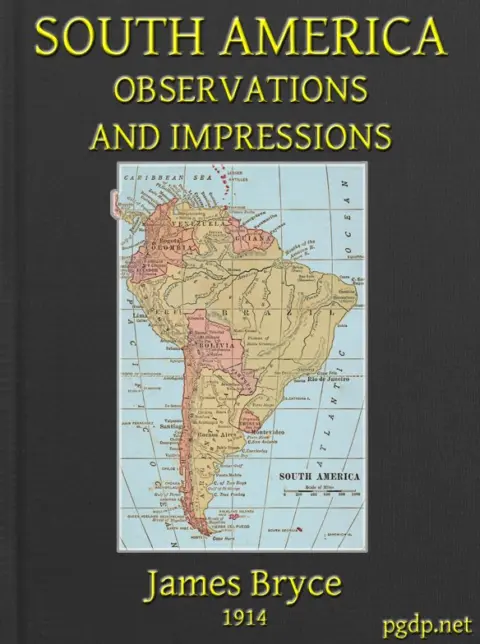
"South America: Observations and Impressions" by Viscount James Bryce is a travelogue written in the early 20th century. This work chronicles Bryce's journey through various countries in South America, including Panama, Peru, and Argentina, providing insights into the landscapes, people, and historical context of the regions explored. The focus of the book is on the author's personal observations and reflections, making it an engaging narrative for readers interested in travel literature and cultural studies. The opening of this travelogue sets the stage for Bryce's exploration of South America, beginning with his preface where he acknowledges the influences that sparked his interest in the continent. He articulates his desire to understand the social, economic, and historical realities of the seven republics he visited. Through vivid descriptions, he introduces the notion of geographical significance, specifically emphasizing the Ismuth of Panama and its pivotal historical role. This part of the text captures Bryce's intent to share firsthand experiences and impressions gained during his travels, highlighting both the unique aspects of South America and the complexities of its societies and natural landscapes.
Introduction adapted from the source catalogue; source summaries may be automatically generated.
Free to read · English · 174,009 words · No account needed
MAKE TIME FOR A GOOD BOOK
On by default. Untick to stop anonymous reading totals. Each page counts after 10 seconds in view. How this works.
Anonymous counting is on unless you have switched it off.
[40] A vast deal still remains to be done both in Mexico and Peru, perhaps even more in the latter than in the former, to examine thoroughly both the accounts given by the early Spanish writers and the existing remains of buildings and graves and the objects found in or near them, so as to lay a foundation for some systematic account of the ancient native civilizations.
[41] Its habitual use may have contributed to give the Aymarás that impassive dulness which characterizes the race.
[42] Mr. Bandelier (Islands of Titicaca and Koati) gives an interesting description of such a ceremony.
[43] Mountain Spirit.
[44] This line has now (December, 1912) been completed.
[45] I take these details from Dr. Romero's Los Lagos de los Altiplanos, translated from the French of Dr. Neveu Lemaire.
[46] The name Cholo properly means the offspring of a mestizo and an Indian, but it seems to be currently used to describe a peasant with a marked Indian strain.
[47] An admirable study of desert scenery may be found in a book by Mr. Van Dyke of Rutgers College (in New Jersey), entitled The Desert.
[48] Pronounced Oyawe.
[49] It is called Yareta, and reminds one a little (though it is larger and harder) of the Cherleria sedoides of the Scottish Highlands.
[50] In the thirty years from 1880 to 1909 the Chilean treasury received £82,637,000 (about $412,000,000) in export duties on nitrates.
[51] Buenos Aires, Rio, and São Paulo are the three larger cities.
[52] It is sometimes said that one hundred families rule Chile.
[53] A distinguished Chilean officer whose presence added greatly to the pleasure of the trip was detailed to accompany us.
[54] Except when Spanish ships of war bombarded Valparaiso in 1866.
[55] The word roto seems originally to have been a term of disparagement; it meant 'a broken man.' Now it merely denotes one of the poorer class, and is opposed to pelucon, one of the upper class (literally a wig wearer).
[56] The Yaquis of Sonora in Northwestern Mexico have never been subdued, but they are a small tribe dwelling in mountain fastnesses difficult of access.
[57] This is the form of the name that was given to me at Temuco. Others call them Moluche or Maluche.
[58] First part written in Chile, where he was fighting, in 1558, and
published in 1569.
Ἀλλ' ἀεὶ Ζεφυροῖο λιγυπνείοντας ἀήτας Ὠκεανὸς ἀνίησιν ἀναψύχειν ἀνθρώπους. --Odyss. IV.
[60] Thuja gigantea.
[61] Many cattle are exported from Argentine to Chile, but these can here, as in the passes of southern Chile, be driven over the top of the ridge, though many now go by rail.
[62] An account of the ascent and of all this region will be found in Mr. E. A. Fitzgerald's High Andes, the author of which was prevented by illness from reaching the summit.
Your reading position is saved on this browser. Take it to another device with a library code. Reading pages adapt to text, rather than matching a printed edition.
James Bryce, Viscount Bryce
James Bryce, Viscount Bryce
James Bryce, Viscount Bryce
BEHIND THE BOOK
This eBook is for the use of anyone anywhere in the United States and most other parts of the world at no cost and with almost no restrictions whatsoever. You may copy it, give it away or re-use it under the terms of the Project Gutenberg License included with this eBook or online at www.gutenberg.org. If you are not located in the United States, you will have to check the laws of the country where you are located before using this eBook. Read the source licence.
The original source file, including credits and licence, is retained by this library. Request an original-format copy at no charge. Please include the book title and Project Gutenberg identifier #45961.
KEEP YOUR CURIOSITY GOING
Wilfrid Scawen Blunt
Wilfrid Scawen Blunt

E. W. (Edgar Watson) Howe
Francis Greenleaf Allinson & Anne C. E. (Anne Crosby Emery) Allinson
Cyrenus Cole

John Martineau