THE CLASSIC COLLECTION✦Promoting good citizenshipCLASSIC FREE BOOKS
Promoting good citizenship
James Bryce, Viscount Bryce
THE CLASSIC COLLECTION · 1912
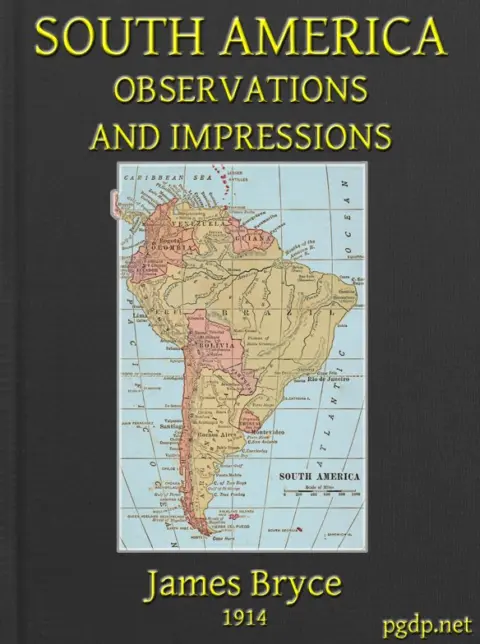
"South America: Observations and Impressions" by Viscount James Bryce is a travelogue written in the early 20th century. This work chronicles Bryce's journey through various countries in South America, including Panama, Peru, and Argentina, providing insights into the landscapes, people, and historical context of the regions explored. The focus of the book is on the author's personal observations and reflections, making it an engaging narrative for readers interested in travel literature and cultural studies. The opening of this travelogue sets the stage for Bryce's exploration of South America, beginning with his preface where he acknowledges the influences that sparked his interest in the continent. He articulates his desire to understand the social, economic, and historical realities of the seven republics he visited. Through vivid descriptions, he introduces the notion of geographical significance, specifically emphasizing the Ismuth of Panama and its pivotal historical role. This part of the text captures Bryce's intent to share firsthand experiences and impressions gained during his travels, highlighting both the unique aspects of South America and the complexities of its societies and natural landscapes.
Introduction adapted from the source catalogue; source summaries may be automatically generated.
Free to read · English · 174,009 words · No account needed
MAKE TIME FOR A GOOD BOOK
On by default. Untick to stop anonymous reading totals. Each page counts after 10 seconds in view. How this works.
Anonymous counting is on unless you have switched it off.
The aspect of the city was rather less affected than might have been expected. Some troops were moving about, here cavalry, there infantry. Few carriages or motor cars and few women were to be seen. Business was slack, and groups of men stood talking at street corners, evidently imparting to one another those tales and suspicions and guesses at unseen causes with which the air was thick. All water traffic from the opposite side of the bay had been stopped by the mutineers, who had also compelled the submission of one of the forts at the entrance. Strolling along to the great Botafogo Esplanade under the palms, I found a battery of field artillery, their guns pointed at the two battleships, the Minas and the São Paulo, against which they would, of course, have been as useless as paper pellets. There the majestic yellow grey monsters lay, fresh from Messrs. Armstrong's yard at Newcastle, flying the ensign of Brazil, but also flying at the fore the red flag of rebellion. So the day wore on, terror abating, but the sense of helplessness increasing. We were lunching at the Ministry of Foreign Affairs--it was a small party, for considerations of safety had kept away the ladies who had been invited--when suddenly the heavy boom of the guns was heard, and continued at intervals all through the repast. When again in the streets, I found that the two Dreadnoughts were shelling some torpedo-boats, manned by crews still loyal, which had approached them. The practice was bad, and none of the boats was hit, but they prudently scurried off up the bay into shallow water where the ironclads could not follow.
So the hours passed and everybody was still asking, "What is to be done?" "The mutineers," so men said, "can't be starved out, because they have threatened to destroy the city if food is refused them, and the city is at their mercy. By this threat they have forced us to give them water. We cannot blow up the ships with torpedoes, first because they have stretched torpedo nets round the hulls, and secondly because it would be a serious thing to destroy property for which we have paid no small part of our annual revenue. Doesn't it look as if we should have to submit to the mutineers? What else can we do?" Later on the firing recommenced and I mounted to the third story of the British Consulate to see what was happening. The ships were shelling the naval barracks on the Isla das Cobras in the harbour, and the island was replying, and we were near enough to see the red flash from the iron lips just before the roar was heard. Lying out in the bay was the British liner by which we were to sail for Liverpool. The lighters that were carrying coal to her had been commandeered by the mutineers, but she had just enough in her bunkers to get to Bahia. The immediate difficulty was for the passengers to reach her across the line of fire. At last, however, a boat was sent out from shore bearing a flag of truce, and the São Paulo consented to cease firing and let the passengers get on board the British vessel. They were accordingly embarked in a launch which, flying the Consulate flag, crossed unharmed the danger zone. It was the only chance, but a sense of relief was visible in every face when we stepped on board, for if a negro gunner had been smitten by the desire to let fly once more at the Isla das Cobras, his ill-aimed shot might very well have sent the launch to the bottom. As we steamed slowly out to the ocean the magnificent São Paulo ran close alongside us, and we could see her decks crowded with negroes and the red flag still flying. "A study in black and red," someone observed. Outside the entrance were lying the Minas Geraes and the Bahia, partly to be out of harm's way from torpedoes, partly to guard the mouth of the bay. In the sober light of a grey sunset, the clouds hanging heavy on the Corcovado, but the lofty watch-tower of the Pan d'Azucar still visible through the gathering shades, we turned northward, and bade farewell to Rio. Two hours later, looking back through a moonless night, we could still see the flash, from beneath the horizon, of the searchlights which the Minas Geraes was casting on the sea all round her to guard against the stealthy approach of a loyal torpedo-boat.
Your reading position is saved on this browser. Take it to another device with a library code. Reading pages adapt to text, rather than matching a printed edition.
James Bryce, Viscount Bryce
James Bryce, Viscount Bryce
James Bryce, Viscount Bryce
BEHIND THE BOOK
This eBook is for the use of anyone anywhere in the United States and most other parts of the world at no cost and with almost no restrictions whatsoever. You may copy it, give it away or re-use it under the terms of the Project Gutenberg License included with this eBook or online at www.gutenberg.org. If you are not located in the United States, you will have to check the laws of the country where you are located before using this eBook. Read the source licence.
The original source file, including credits and licence, is retained by this library. Request an original-format copy at no charge. Please include the book title and Project Gutenberg identifier #45961.
KEEP YOUR CURIOSITY GOING
Wilfrid Scawen Blunt
Wilfrid Scawen Blunt

E. W. (Edgar Watson) Howe
Francis Greenleaf Allinson & Anne C. E. (Anne Crosby Emery) Allinson
Cyrenus Cole

John Martineau