THE CLASSIC COLLECTION✦Promoting good citizenshipCLASSIC FREE BOOKS
Promoting good citizenship
James Bryce, Viscount Bryce
THE CLASSIC COLLECTION · 1912
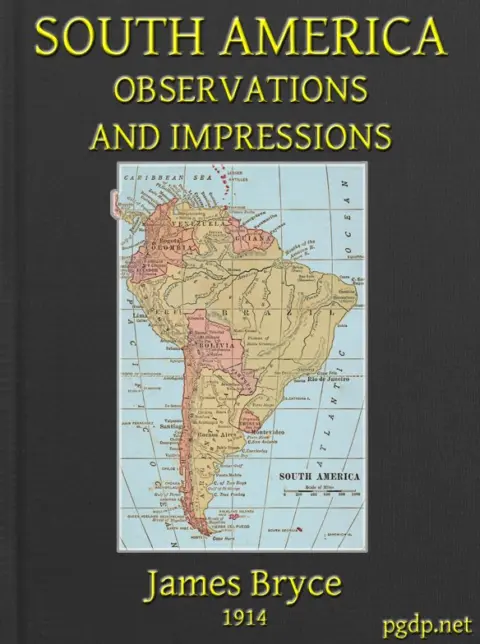
"South America: Observations and Impressions" by Viscount James Bryce is a travelogue written in the early 20th century. This work chronicles Bryce's journey through various countries in South America, including Panama, Peru, and Argentina, providing insights into the landscapes, people, and historical context of the regions explored. The focus of the book is on the author's personal observations and reflections, making it an engaging narrative for readers interested in travel literature and cultural studies. The opening of this travelogue sets the stage for Bryce's exploration of South America, beginning with his preface where he acknowledges the influences that sparked his interest in the continent. He articulates his desire to understand the social, economic, and historical realities of the seven republics he visited. Through vivid descriptions, he introduces the notion of geographical significance, specifically emphasizing the Ismuth of Panama and its pivotal historical role. This part of the text captures Bryce's intent to share firsthand experiences and impressions gained during his travels, highlighting both the unique aspects of South America and the complexities of its societies and natural landscapes.
Introduction adapted from the source catalogue; source summaries may be automatically generated.
Free to read · English · 174,009 words · No account needed
MAKE TIME FOR A GOOD BOOK
On by default. Untick to stop anonymous reading totals. Each page counts after 10 seconds in view. How this works.
Anonymous counting is on unless you have switched it off.
Though Buenos Aires is often described as a cosmopolitan place, its population has far fewer elements than would be found in any of the great cities of the United States. There are English and German colonies, both composed almost wholly of business and railway men, and each keeping, for social purposes, pretty closely to itself. There is a French colony, its upper section including men of intellectual mark, while the humbler members serve pleasure rather than business. From the United States not many persons have come to settle as merchants or ranch owners, but the great meat companies are already at work. Of the so-called "Latin" element in the inhabitants, half or a little more is Argentine born, less than a quarter Spanish or Basque, more than a quarter Italian, largely from Sicily and Calabria. Those Slavonic parts of central and eastern Europe which have recently flooded the United States with immigrants have sent very few to South America. Thus the mass of the population in Buenos Aires is entirely Spanish or Italian in speech, and the two languages are so similar that the Italians easily learn Spanish while also modifying it by their own words and idioms. A mixed, not to say corrupt, Spanish is the result. That there should be an endless diversity of types of face is not surprising, when one remembers how great are the diversities as well in Spain as in Italy among the natives of the various provinces in both those kingdoms.
The growth of a few great cities at a rate more rapid than that of the countries to which they belong is one of the most remarkable facts of recent years and fraught with many consequences. It is especially visible in the newest countries. In New South Wales the population of Sydney is nearly two-fifths that of the whole state, in Victoria that of Melbourne more than two-fifths. In California two great cities, San Francisco and Los Angeles, have one-third of the whole population.[77] The same tendency is apparently in South America. Of the whole population of Argentina, with its immense area of 1,135,000 square miles, one-fifth dwell in the city of Buenos Aires.[78] It is probable that this ratio may be maintained so that when, thirty years hence, Argentina counts twenty millions of inhabitants, Buenos Aires will count four millions. There are other large cities, and one of them, Cordova, has an ancient university and a society of cultivated men. But business life and political life, as well as literary and intellectual life, are so concentrated in Buenos Aires as to make it to dwarf all the other cities and give to it an influence comparable to that of Paris in France. The history of the republic was for many years a history of the struggles between the capital--already pre-eminent in revolutionary days--and the provinces. So the people of Buenos Aires divide the Argentine nation into two classes, themselves, who are called the Porteños (men of the Port), and all the rest, the dwellers in the Campo or open country.[79] And though the wonderful development of the railway system has accelerated the settlement of the interior and brought the comforts of civilization to its towns, Buenos Aires has continued to maintain its supremacy by constantly drawing people from the interior. It is, moreover, the gateway through which all must pass to and from Europe. Thus the Porteño is the type and flower of Argentina,--the type of its character, the flower of its civilization. When we try to understand and appraise the Argentine nation, which for Argentina is the most interesting and indeed (apart from statistics of production) the only subject of study, it is on him that the eye must be fixed. Nevertheless he is far from being the only factor. The nation is spread over a vast space. To conjecture its future we must think of the physical and economic conditions under which it will develop. These, therefore, I will try to sketch briefly, admitting that my own personal knowledge is confined to Buenos Aires and its neighbourhood, and to the region round Mendoza, mentioned in Chapter VII. I shall speak first of the natural features of the country, and then of the natives and of the colonists who came among them, before describing the Argentina of our own time.
Your reading position is saved on this browser. Take it to another device with a library code. Reading pages adapt to text, rather than matching a printed edition.
James Bryce, Viscount Bryce
James Bryce, Viscount Bryce
James Bryce, Viscount Bryce
BEHIND THE BOOK
This eBook is for the use of anyone anywhere in the United States and most other parts of the world at no cost and with almost no restrictions whatsoever. You may copy it, give it away or re-use it under the terms of the Project Gutenberg License included with this eBook or online at www.gutenberg.org. If you are not located in the United States, you will have to check the laws of the country where you are located before using this eBook. Read the source licence.
The original source file, including credits and licence, is retained by this library. Request an original-format copy at no charge. Please include the book title and Project Gutenberg identifier #45961.
KEEP YOUR CURIOSITY GOING
Wilfrid Scawen Blunt
Wilfrid Scawen Blunt

E. W. (Edgar Watson) Howe
Francis Greenleaf Allinson & Anne C. E. (Anne Crosby Emery) Allinson
Cyrenus Cole

John Martineau