THE CLASSIC COLLECTION✦Promoting good citizenshipCLASSIC FREE BOOKS
Promoting good citizenship
James Bryce, Viscount Bryce
THE CLASSIC COLLECTION · 1912
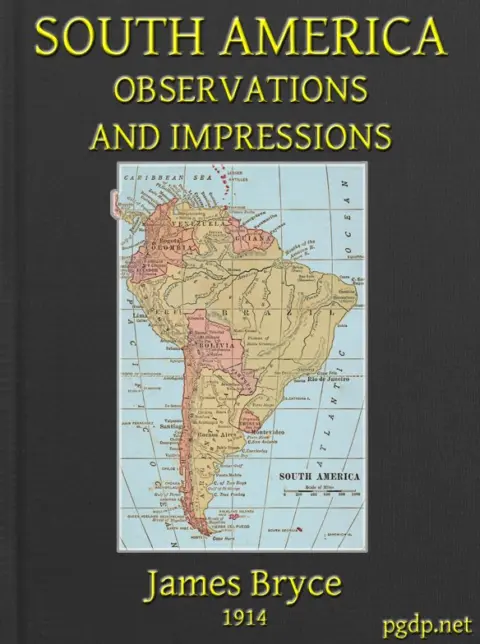
"South America: Observations and Impressions" by Viscount James Bryce is a travelogue written in the early 20th century. This work chronicles Bryce's journey through various countries in South America, including Panama, Peru, and Argentina, providing insights into the landscapes, people, and historical context of the regions explored. The focus of the book is on the author's personal observations and reflections, making it an engaging narrative for readers interested in travel literature and cultural studies. The opening of this travelogue sets the stage for Bryce's exploration of South America, beginning with his preface where he acknowledges the influences that sparked his interest in the continent. He articulates his desire to understand the social, economic, and historical realities of the seven republics he visited. Through vivid descriptions, he introduces the notion of geographical significance, specifically emphasizing the Ismuth of Panama and its pivotal historical role. This part of the text captures Bryce's intent to share firsthand experiences and impressions gained during his travels, highlighting both the unique aspects of South America and the complexities of its societies and natural landscapes.
Introduction adapted from the source catalogue; source summaries may be automatically generated.
Free to read · English · 174,009 words · No account needed
MAKE TIME FOR A GOOD BOOK
On by default. Untick to stop anonymous reading totals. Each page counts after 10 seconds in view. How this works.
Anonymous counting is on unless you have switched it off.
Up this valley runs the railway past little farm-houses, surrounded by stiff poplars, which thrive well here, though the tree is not a native, but brought from Europe. Fields, irrigated from the rushing stream beneath, are green with young corn; weeping willows droop over the watercourses, vines trail along the fronts of the cottages, and the pastures are bright with spring flowers. A cart road runs parallel to the line, and here one sees better than in the cities the true Chilean roto (peasant of mixed Spanish and Indian blood), in his rough coat and cotton shirt, baggy trousers and high boots fitted with large spurs, his low-crowned, narrow-brimmed felt or straw hat, and on his shoulders the thick homespun poncho characteristic of South America. His horse is usually near him, for they are all riders, a sturdy little animal with many saddle-cloths and a heavy, high-peaked saddle and heavy bit.
After eight or ten miles the valley narrows, and at its bottom there is only the torrent with sometimes a few yards of grass on one or other bank. The rock walls begin to rise more steeply, and the trees give place to shrubs. At a spot called the Soldier's Leap, the train runs on a shelf in the rock through a gorge over which the converging crags almost touch one another and shut out the light, the torrent roaring sixty feet below. One considerable stream, the Rio Blanco, descends from the south, but otherwise there are no side glens. Vast black precipices rise on the northern bank six or seven thousand feet above the river. Slender streamlets, perhaps the children of unseen snows behind, fall slowly from ledge to ledge, some of them lost in mid-air when a gust of the west wind sweeps them along.
At last, vegetation having now disappeared, a great black ridge rises in front across the end of the valley and seems to bar further progress. On its steep face, however, one can presently discover a sort of track, winding up it in zigzags. This is the old mule path by which travellers used to climb slowly to the pass, itself still far behind. The spot at its foot, where there are a few houses, is Juncal, the last place where the wayfarer halted to rest before he started for the formidable passage of the mountains. Here two glens opening from opposite sides meet at the foot of the great ridge. The glen to the north is short, descending abruptly from a semicircle of savage black peaks, the hollows between them filled with snow and ice. That to the south is long, narrow, and nearly level; it is a deep cleft which runs into the heart of the mountains as far as the west side of the mighty Tupungato, whose glaciers feed its torrent. Up this southern valley the railway, turning at right angles from its previous easterly direction, runs for some miles, then crosses and leaves the torrent, turns north and mounts along a narrow shelf cut out in the side of the great black ridge of Juncal, already mentioned. The slope rising above the line and falling below it to the valley is of terrific steepness. The grade is also steep and the locomotive toils and pants slowly upward by the aid of the cog-wheel, passing through tunnel after tunnel till at last it comes out, two thousand feet above Juncal, into a wide hollow surrounded by sharp peaks, those to the north streaked with beds of snow, those on the south of bare rock, because the snow has been melted off their sunward turned slopes. The bottom of this hollow is covered with enormous blocks that have fallen from the cliffs, and its northern end is filled by a small lake, part of whose surface was covered with ice. The fanciful name of Lago del Inca has been given to it. A scene more savage in its black desolation it would be hard to imagine. Compared to this frozen lake, the glacier lakes of the Swiss Alps, like the Märjelen See on the Aletsch glacier, are gentle and smiling. The strong sunlight and brilliant blue of the sky seemed to make the rocks blacker and bring out their absolute bareness with not so much as a moss or a lichen to relieve it. From the lake the railway, making another great sweep, climbs another slope and enters another still higher hollow, where it stops at the base of a steep ridge. Here a cluster of huts of corrugated iron, more than usually hideous in such a landscape, marks the mouth of the great tunnel, at a point 10,486 feet above the sea. In winter everything is covered deep with snow and now, in October, patches were still lying about and the cold, except in the sun, was severe. Big icicles were hanging from the eaves of the iron hut roofs.
Your reading position is saved on this browser. Take it to another device with a library code. Reading pages adapt to text, rather than matching a printed edition.
James Bryce, Viscount Bryce
James Bryce, Viscount Bryce
James Bryce, Viscount Bryce
BEHIND THE BOOK
This eBook is for the use of anyone anywhere in the United States and most other parts of the world at no cost and with almost no restrictions whatsoever. You may copy it, give it away or re-use it under the terms of the Project Gutenberg License included with this eBook or online at www.gutenberg.org. If you are not located in the United States, you will have to check the laws of the country where you are located before using this eBook. Read the source licence.
The original source file, including credits and licence, is retained by this library. Request an original-format copy at no charge. Please include the book title and Project Gutenberg identifier #45961.
KEEP YOUR CURIOSITY GOING
Wilfrid Scawen Blunt
Wilfrid Scawen Blunt

E. W. (Edgar Watson) Howe
Francis Greenleaf Allinson & Anne C. E. (Anne Crosby Emery) Allinson
Cyrenus Cole

John Martineau