THE CLASSIC COLLECTION✦Promoting good citizenshipCLASSIC FREE BOOKS
Promoting good citizenship
James Bryce, Viscount Bryce
THE CLASSIC COLLECTION · 1912
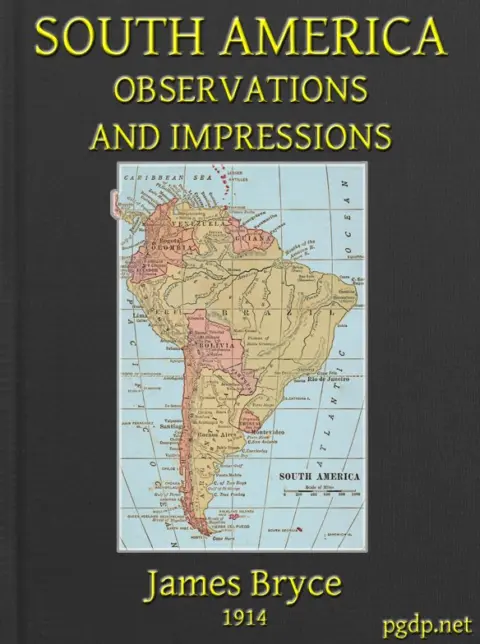
"South America: Observations and Impressions" by Viscount James Bryce is a travelogue written in the early 20th century. This work chronicles Bryce's journey through various countries in South America, including Panama, Peru, and Argentina, providing insights into the landscapes, people, and historical context of the regions explored. The focus of the book is on the author's personal observations and reflections, making it an engaging narrative for readers interested in travel literature and cultural studies. The opening of this travelogue sets the stage for Bryce's exploration of South America, beginning with his preface where he acknowledges the influences that sparked his interest in the continent. He articulates his desire to understand the social, economic, and historical realities of the seven republics he visited. Through vivid descriptions, he introduces the notion of geographical significance, specifically emphasizing the Ismuth of Panama and its pivotal historical role. This part of the text captures Bryce's intent to share firsthand experiences and impressions gained during his travels, highlighting both the unique aspects of South America and the complexities of its societies and natural landscapes.
Introduction adapted from the source catalogue; source summaries may be automatically generated.
Free to read · English · 174,009 words · No account needed
MAKE TIME FOR A GOOD BOOK
On by default. Untick to stop anonymous reading totals. Each page counts after 10 seconds in view. How this works.
Anonymous counting is on unless you have switched it off.
Returning to the railway at Uyuni, we set off in the afternoon on our southward way across the desert floor, here perfectly flat and about 12,000 feet above the sea. A deep red soil promised fertility if water could be brought to it, but there was not a tree nor a house, though many a mirage shewed shining water pools and trees around them. Rocky hillocks rising here and there like islands strengthened the impression that this had been in some earlier age the bed of a great inland sea, larger than Lake Superior in North America, stretching from here all the way to the Vilcañota peaks north of Titicaca, and including, besides Titicaca itself, the salt lagoon of Poopo and the white salt marsh we had seen from the heights of Pulucayo. Subterranean forces which, as we know, have been recently at work all over these regions, may have altered the levels, and alterations of level may, in their turn, have induced climatic changes, which, by reducing rainfall, caused the inland sea to dry up, as the Great Salt Lake of Utah and the Aral Sea are drying up now. Looking eastward, we could see heavy clouds brooding over the eastern ranges, which shewed that beyond it lay valleys, watered by the rains which the trade-wind brings up from the far-distant Atlantic. Presently the sweetest hour of the day came as the grey sternness of the heights to the south softened into lilac, and a pale yellow sunset, such as only deserts see, flooded the plain with radiance. The night was intensely cold, and next morning, even at eight o'clock, the earth was frozen hard in the deep, dark hollow where the train had halted.
We were now just inside the Chilean frontier, in the heart of the Western Cordillera, among some of the loftiest volcanic mountains of the Continent. On one side a branch line of railway, the highest in the world, begins its long climb to the Collahuasi copper mine. On the other side, there rose above us the huge black mass of Ollague,[48] snow patches on its southern side and steam rising in wreaths from a cleft not far below the summit. We guessed the height at 19,000 feet. The Collahuasi mine is nearly 16,000. Beside us was what seemed a frozen lake, which glittered white when the welcome sun began to overtop the heights and warm our shivering bodies. Although the height is only 12,200 feet, this is a particularly cold spot, and the one place on the line which is liable to severe snowstorms. We had reached the smaller of the two famous lakes of borax, parts of which are water holding borax in solution, while the rest is mud covered with the valuable substance. They have neither influent nor outlet. This place, and a similar lake in Peru, not far from Arequipa, furnish the world with a large part of its supply, the rest coming from California and Siberia and Tibet, where the conditions of a rainlessness that keeps the deposit from being washed away out of the soil are somewhat similar. Presently we reached the larger lake, which is twelve miles long and two to five wide, and stopped to see the method of gathering and preparing the mineral. One end of the (so-called) lake is dry, a thin stratum of whitish earth covering the bed of borax, which is about three feet thick. When dug out, the mineral is spread out on the ground round the works to dry, and then calcined in furnaces, forming a white mass of crystals, which are packed in sacks and sent down to the coast to be shipped to Europe and there turned into the borax of commerce. A large number of labourers are employed in this lonely and cheerless spot fifty miles from the nearest village. When I asked what fuel was used for the furnaces, they pointed to a long wire cable stretched through the air from the works to a point high on the mountain side opposite Ollague. Down this rope small cars were travelling, containing masses of a kind of very hard, stiff plant with whitish flowers so inconspicuous that it is usually taken for a sort of moss.[49] It grows abundantly on the slopes between eight and fourteen thousand feet, and its thick hard cushions have to be cut out with a pickaxe. Being very resinous, it burns with a fierce flame, but so quickly that large masses must be constantly thrown in to keep the fire going. Hardly anything else grows on the mountains, but they are inhabited by the little chinchilla, whose light grey fur, exquisitely soft, fetches a high price in Europe.
Your reading position is saved on this browser. Take it to another device with a library code. Reading pages adapt to text, rather than matching a printed edition.
James Bryce, Viscount Bryce
James Bryce, Viscount Bryce
James Bryce, Viscount Bryce
BEHIND THE BOOK
This eBook is for the use of anyone anywhere in the United States and most other parts of the world at no cost and with almost no restrictions whatsoever. You may copy it, give it away or re-use it under the terms of the Project Gutenberg License included with this eBook or online at www.gutenberg.org. If you are not located in the United States, you will have to check the laws of the country where you are located before using this eBook. Read the source licence.
The original source file, including credits and licence, is retained by this library. Request an original-format copy at no charge. Please include the book title and Project Gutenberg identifier #45961.
KEEP YOUR CURIOSITY GOING
Wilfrid Scawen Blunt
Wilfrid Scawen Blunt

E. W. (Edgar Watson) Howe
Francis Greenleaf Allinson & Anne C. E. (Anne Crosby Emery) Allinson
Cyrenus Cole

John Martineau