THE CLASSIC COLLECTION✦Promoting good citizenshipCLASSIC FREE BOOKS
Promoting good citizenship
James Bryce, Viscount Bryce
THE CLASSIC COLLECTION · 1912
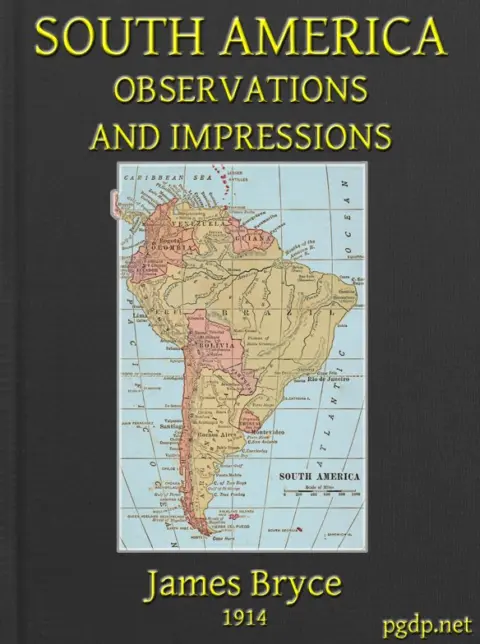
"South America: Observations and Impressions" by Viscount James Bryce is a travelogue written in the early 20th century. This work chronicles Bryce's journey through various countries in South America, including Panama, Peru, and Argentina, providing insights into the landscapes, people, and historical context of the regions explored. The focus of the book is on the author's personal observations and reflections, making it an engaging narrative for readers interested in travel literature and cultural studies. The opening of this travelogue sets the stage for Bryce's exploration of South America, beginning with his preface where he acknowledges the influences that sparked his interest in the continent. He articulates his desire to understand the social, economic, and historical realities of the seven republics he visited. Through vivid descriptions, he introduces the notion of geographical significance, specifically emphasizing the Ismuth of Panama and its pivotal historical role. This part of the text captures Bryce's intent to share firsthand experiences and impressions gained during his travels, highlighting both the unique aspects of South America and the complexities of its societies and natural landscapes.
Introduction adapted from the source catalogue; source summaries may be automatically generated.
Free to read · English · 174,009 words · No account needed
MAKE TIME FOR A GOOD BOOK
On by default. Untick to stop anonymous reading totals. Each page counts after 10 seconds in view. How this works.
Anonymous counting is on unless you have switched it off.
Scarcely any are educated. In Titicaca Island, with a population of about three hundred, there was a few years ago only one man who could read. In all Bolivia only 30,000 children were in the schools out of a population of 2,000,000. The sparseness of the population makes the provision of instruction difficult; nor do the aborigines seem to care for education, being so far satisfied with their lot as to have no notion of other pleasures than those which their fairs and festivals supply, and those derived from the use of alcohol at these festivals, and at all times of the coca leaf, which is for an Indian the first necessity of life. He is never without his bag containing a bundle of leaves, which he masticates (usually with a little clay) while walking or working, finding in them a support which enables him to endure fatigue without food for long periods. The leaf when chewed is tasteless, and whether taken thus or in a decoction produces no directly pleasurable feeling of stimulus. I have experimented with it in both forms without being able to discover any result except that of arresting hunger. Taken by chewing the leaf, as the Indians take it, it cannot have the highly deleterious effects of cocaine, which is a concentrated essence; indeed, if it had those effects, the aborigines of the plateau must have been long ago ruined by it.[41] Possibly there is something in the physical conditions of their life rendering it comparatively or altogether innocuous. It does not seem to be much used by the whites, nor in the lowlands by any class of the population. Perhaps, therefore, it is "indicated" in the mild form of a chewed leaf, as a stimulant suitable to those who take continuous exertion at great altitudes.
What has been said here refers generally to the aborigines of the high Andean regions, but there are two great divisions of them, the characteristics of which are not altogether the same. In very early times there were probably many diverse tribes, and every valley spoke a language, or at least a dialect, of its own. This is still the case in the Montaña region (the forests at the east foot of the Andes), where adjoining tribes are sometimes wholly unlike one another in speech and aspect. The conquests of the Incas, with their levelling and unifying rule, effaced most of these distinctions. There was a tongue called Mochica spoken by the coast people of Chimu, the race to whose artistic talent reference was made in last chapter, which seems to have been quite unlike the speech of the plateau. It is now extinct, but a grammar, made by a learned ecclesiastic, has fortunately survived. There is also another distinct tongue which remains among a half-savage tribe called the Urus, who dwell, now very few in number, among the rushy lagoons on the Desaguadero River, near the southwest end of Lake Titicaca. With these exceptions, the Spaniards seem to have found on their arrival only two forms of speech prevailing over Peru, corresponding to two racial divisions, the Quichuas to which the Incas apparently belonged, and the Aymarás. The latter held all the Collao, i.e. the country round Titicaca, and south of it round La Paz. The former occupied the northern valleys of Peru and the coast regions south of Lima, and a part of what is now southern Bolivia around Oruro and Uyuni. As these two languages are of the same type, it is generally held that the Quichua and Aymará races are cognate. Those who know both declare that the Quichuas are the gentler and the less forcible. The Aymarás, by the testimony of European as well as Peruvian observers, are ruder in manners, more sullen and vindictive in disposition. Both races are alike secretive and suspicious of the whites, and for this sentiment they have had good reason. The impressions of a passing traveller are of no value, but it seemed to me, in noting the faces and deportment of the Indians whom we saw, that while both races had less intelligence and rather less look of personal dignity than the Indians of Mexico, the Aymarás seemed both a more dogged and a less cheerful race than the Quichuas. We might, perhaps, expect to find little buoyancy of spirit in those to whom Nature turns on this wind-swept roof of the world so stern a countenance. Yet the Icelander, whose far-distant isle is surrounded by a melancholy ocean, is of a lively and cheerful temper.
Your reading position is saved on this browser. Take it to another device with a library code. Reading pages adapt to text, rather than matching a printed edition.
James Bryce, Viscount Bryce
James Bryce, Viscount Bryce
James Bryce, Viscount Bryce
BEHIND THE BOOK
This eBook is for the use of anyone anywhere in the United States and most other parts of the world at no cost and with almost no restrictions whatsoever. You may copy it, give it away or re-use it under the terms of the Project Gutenberg License included with this eBook or online at www.gutenberg.org. If you are not located in the United States, you will have to check the laws of the country where you are located before using this eBook. Read the source licence.
The original source file, including credits and licence, is retained by this library. Request an original-format copy at no charge. Please include the book title and Project Gutenberg identifier #45961.
KEEP YOUR CURIOSITY GOING
Wilfrid Scawen Blunt
Wilfrid Scawen Blunt

E. W. (Edgar Watson) Howe
Francis Greenleaf Allinson & Anne C. E. (Anne Crosby Emery) Allinson
Cyrenus Cole

John Martineau