
Last letters from the living dead man
David Patterson (Spirit) Hatch
THE CLASSIC COLLECTION · 1799
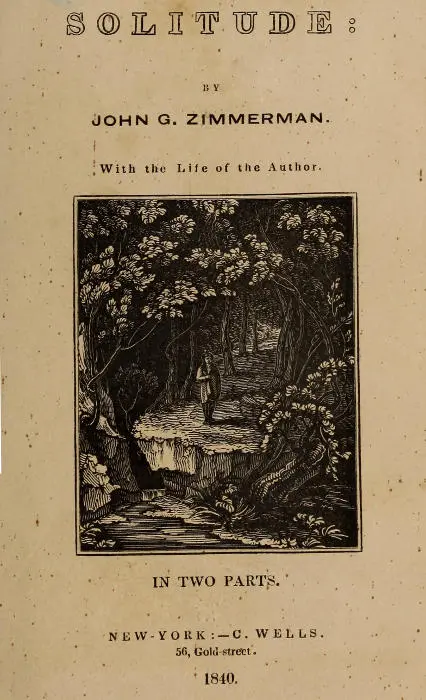
"Solitude" by Johann Georg Zimmermann is a philosophical treatise written in the late 18th century. This work explores the theme of solitude, emphasizing its impact on the human mind and heart while analyzing its benefits and drawbacks. Zimmermann aims to enlighten readers on how occasional retirement can foster happiness, intellectual clarity, and a deeper understanding of oneself and society. At the start of the book, Zimmerman introduces the concept of solitude as an intellectual state where the mind retreats into self-reflection, asserting that true solitude can exist even amidst social gatherings. He observes that modern society often undervalues solitude, mistaking it for misery or isolation, while arguing that it is essential for genuine happiness and intellectual growth. The opening chapters set the stage for a detailed exploration of solitude's influences on human emotions, well-being, and the creative mind, positioning it as a powerful means to achieve true felicity.
Introduction adapted from the source catalogue; source summaries may be automatically generated.
Free to read · English · 115,833 words · No account needed
MAKE TIME FOR A GOOD BOOK
On by default. Untick to stop anonymous reading totals. Each page counts after 10 seconds in view. How this works.
Anonymous counting is on unless you have switched it off.
He who would be master of his appetites, must not only avoid temptation, but vigilantly restrain the earliest shoots of fancy, and destroy the first blooms of a warm imagination. It is the very nature of confidence to be always in danger. To permit the mind to riot in scenes of fancied delights, under an idea that reason will be able to extinguish the flames of desire, is to nurse and foster the sensual appetites, which, when guided by the cool and temperate voice of nature alone, are seldom raised to an improper height. The natural current of the blood, even in the warmest constitutions, and under the most torrid zone, would keep an even, temperate course, were it not accelerated by such incentives. Youth indeed despises this species of reasoning, and imputes it to the sickness of satiety, or the coldness of old age. I have, however, in general, observed, that those who seek these incitements to what they improperly call love, possess a rayless eye, a hollow cheek, a palsied hand, a pallid countenance; and these symptoms of faded splendour and withered strength, unquestionably prove that they have not consulted nature in their gay pursuits; for nature has not planted any propensities in the human frame which lead it to early ruin, or premature decay. The blame which is so unjustly thrown upon temperament and constitution, belongs to the indulgence of false and clamorous passions, those which sensual fancies, and lascivious ideas have raised to the destruction of chastity and health.
Monastic institutions produce, in this respect, incalculable mischiefs. The sexes, whom these religious prisons seclude from the free and unconfined intercourses of society, suffer their imaginations to riot without restraint or discipline, in proportion to the violence imposed on their actions. A thousand boyish fancies, eager appetites and warm desires, are perpetually playing truant, and the chastity of the soul is corrupted. To effect the conquest of the passion of love, it is absolutely necessary that the evil suggestions of the imagination should be first silenced; and he who succeeds in quelling the insurrections of that turbulent inmate, or in quieting its commotions, achieves an enterprise at once difficult and glorious. The holy Jerome checked the progress of many disorderly passions which he found rising in his breast; but the passion of love resisted all his opposition, and followed him, with increasing fury, even into the frightful cavern to which he retired to implore, in humble prayer and solitary abstraction, the mercies of his God. The solitude, however remote, to which the demon of sensuality is admitted, is soon crowded with legions of tormenting fiends. John, the anchorite of the deserts of Thebais, wisely addressed his solitary brethren, “If there be any among you who in his pride, conceives that he has entirely renounced the devil and all his works, he should learn that it is not sufficient to have done this merely by his lips, by having resigned his worldly dignities, and by dividing his possessions among the poor; for, unless he has also abandoned his sensual appetites, his salvation cannot be secure. It is only by purifying our bosoms from the pernicious influence of this master passion, that we can ever hope to counteract the machinations of satan, and to guard our hearts from his dangerous practices. Sin always introduces itself under the guidance of some guilty passion; some fond desire; some pleasing inclination, which we willingly indulge, and by that means suffer the enemy of peace to establish his unruly dominion in our souls. Then tranquillity and real happiness quit their abode in our hearts, and all is uproar and anarchy within. This must be the fate of all who permit an evil spirit to seat itself on the throne of their hearts, and to scatter around the poisonous seeds of wild desire and vicious inclinations.” But love once indulged in bright and rapturous fancies, fills the mind with such high and transporting ideas of supreme bliss, that the powers of reason are seldom, if ever, capable of making head against its fascinations. The hermit and the monk, who, from the nature of their situations, cannot taste its real charms, ought, if it were for that reason alone, to stifle at their birth the earliest emotions of this inspiring passion; for the indulgence of it must prove fatal to the virtue, and of course destructive to the peace of every recluse. The impossibility that such characters can listen with any propriety to the dictates of this delightful passion, shows in the strongest manner the impolicy and absurdity of those institutions, on the members of which celibacy is enjoined. The happiness of every individual, as well as the civil and religious interests of society, are best promoted by inducing the endearments of sense to improve the sympathies, tenderness, and affections of the human heart. But these blessings are denied to the solitary fanatic, who is condemned to endure the suppression of his passions, and prevented from indulging without endangering his principles, both the desires of sense, and the dreams of fancy. He cannot form that delightful union of the sexes, where sentiments of admiration are increased by prospects of personal advantage; where private enjoyment arises from a sense of mutual merit; and the warmest beams of love are tempered by the refreshing gales of friendship. The grosser parts of this innate and glowing passion can alone occupy his fancy; and the sentiments it instils, instead of refining his desires, and meliorating his affections, tend, through the operation of his soul and corrupted imagination, to render his appetites still more depraved. He is as ignorant of its benefits as he is of its chaste and dignified pleasures; and totally unacquainted with its fine sensibilities, and varied emotions, his bosom burns with the most violent rage; his mind wallows in images of sensuality; and his temper frets itself, by unjustly accusing the tempter as the author of his misery. If the luxurious cogitations of such a character were dissipated by the pleasures and pursuits of busy life; if the violence of his passions were checked by laborious exercises; and if habits of rational study enabled him to vary the uniformity of retirement, and to substitute the excursions of mental curiosity, and moral reflections, instead of that perpetual recurrence of animal desire by which he is infected, the danger we have described would certainly be reduced; but without such aids, his self-denials, his penitence, his prayers, and all the austere discipline of the monkish and ascetic school, will be ineffectual. Celibacy, indeed, instead of assisting, as their disciples mistakingly conceive, to clear the soul from its earthly impurities, and to raise it to divine brightness and sublimity, drags it down to the basest appetites and lowest desires. But matrimony, or that suitable and appropriate union of the sexes which prevails under different circumstances, according to the manner and custom of different societies, leads, when properly formed, to the highest goal of human bliss.
Your reading position is saved on this browser. Take it to another device with a library code. Reading pages adapt to text, rather than matching a printed edition.
BEHIND THE BOOK
This eBook is for the use of anyone anywhere in the United States and most other parts of the world at no cost and with almost no restrictions whatsoever. You may copy it, give it away or re-use it under the terms of the Project Gutenberg License included with this eBook or online at www.gutenberg.org. If you are not located in the United States, you will have to check the laws of the country where you are located before using this eBook. Read the source licence.
The original source file, including credits and licence, is retained by this library. Request an original-format copy at no charge. Please include the book title and Project Gutenberg identifier #55898.
KEEP YOUR CURIOSITY GOING
David Patterson (Spirit) Hatch
Coulson Kernahan

Ralph Waldo Emerson
Frances Wright

Edwin Abbott Abbott

Joseph Droz