
Last letters from the living dead man
David Patterson (Spirit) Hatch
THE CLASSIC COLLECTION · 1799
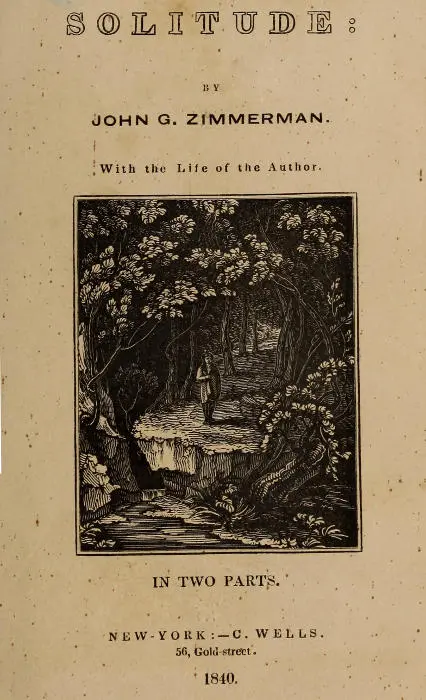
"Solitude" by Johann Georg Zimmermann is a philosophical treatise written in the late 18th century. This work explores the theme of solitude, emphasizing its impact on the human mind and heart while analyzing its benefits and drawbacks. Zimmermann aims to enlighten readers on how occasional retirement can foster happiness, intellectual clarity, and a deeper understanding of oneself and society. At the start of the book, Zimmerman introduces the concept of solitude as an intellectual state where the mind retreats into self-reflection, asserting that true solitude can exist even amidst social gatherings. He observes that modern society often undervalues solitude, mistaking it for misery or isolation, while arguing that it is essential for genuine happiness and intellectual growth. The opening chapters set the stage for a detailed exploration of solitude's influences on human emotions, well-being, and the creative mind, positioning it as a powerful means to achieve true felicity.
Introduction adapted from the source catalogue; source summaries may be automatically generated.
Free to read · English · 115,833 words · No account needed
MAKE TIME FOR A GOOD BOOK
On by default. Untick to stop anonymous reading totals. Each page counts after 10 seconds in view. How this works.
Anonymous counting is on unless you have switched it off.
The love which inspired the lays of Petrarch was a pure and perfect passion of the heart; and his sufferings were rendered peculiarly poignant by a melancholy sense of the impossibility of ever being united with the object of it; but the love of Abelard and Eloisa was a furious heat of wild desire. This passion flows clear or muddied, peaceful or violent, in proportion to the sources from which it springs. When it arises from pure and unpolluted sources, its stream is clear, peaceful, and surrounded with delights: but when its source is foul, and its course improperly directed, it foams and rages, overswells its banks, and destroys the scenes which nature intended it to fertilize and adorn. The different effects produced by the different kinds of this powerful passion, have, on observing how differently the character of the same person appears when influenced by the one or the other of them, given rise to an idea that the human species are possessed of two souls; the one leading to vice, and the other conducting to virtue. A celebrated philosopher has illustrated this notion by the following story:
A virtuous young prince, of an heroic soul, capable of love and friendship, made war upon a tyrant, who was in every respect his reverse. It was the happiness of our prince to be as great a conqueror by his clemency and bounty, as by his arms and military virtue. Already he had won over to his party several potentates and princes, who had before been subject to the tyrant. Among those who still adhered to the enemy there was a prince, who, having all the advantages of person and merit, had lately been made happy in the possession and mutual love of the most beautiful princess in the world. It happened that the occasion of the war called the new married prince to a distance from his beloved princess. He left her secure as he thought, in a strong castle, far within the country; but, in his absence, the place was taken by surprise, and the princess brought a captive to the quarters of the heroic prince. There was in the camp a young nobleman the favorite of the prince; one who had been educated with him, and was still treated by him with perfect familiarity. Him he immediately sent for, and with strict injunctions, committed the captive princess to his charge; resolving she should be treated with that respect which was due to her rank and merit. It was the same young lord who had discovered her disguised among the prisoners, and learnt her story; the particulars of which he now related to the prince. He spoke in ecstacy on this occasion; telling the prince how beautiful she appeared even in the midst of sorrow; and though disguised under the meanest habit, yet how distinguished by her air and manner from every other beauty of her sex. But what appeared strange to our young nobleman was, that the prince, during this whole relation, discovered not the least intention of seeing the lady, or satisfying that curiosity which seemed so natural on such an occasion. He pressed him, but without success. “Not see her, sir!” said he wondering, “when she is so much handsomer than any woman you have yet seen!” “For that very reason,” replied the prince, “I would rather decline the interview; for should I, upon this bare report of her beauty, be so charmed as to make the first visit at this urgent time of business, I may upon sight, with better reason, be induced, perhaps, to visit her when I am more at leisure; and so again and again, until at last I may have no leisure left for my affairs.” “Would you, sir, persuade me then,” said the young nobleman, smiling, “that a fair face can have such power as to force the will itself, and constrain a man in any respect to act contrary to what he thinks becoming him? Are we to hearken to the poets, in what they tell us of that incendiary love and his irresistible flames? A real flame, we see, burns all alike; but that imaginary one of beauty hurts only those that are consenting. It affects no otherwise than as we ourselves are pleased to allow it. In many cases we absolutely command it, as when relation and consanguinity are in the nearest degree. Authority and law we see can master it; but it would be vain, as well as unjust, for any law to intermeddle or prescribe, was not the case voluntary, and our will entirely free.” “How comes it then,” replied the prince, “that if we are thus masters of our choice, and free at first to admire and love where we approve, we cannot afterward as well cease to love whenever we see cause? This latter liberty you will hardly defend; for I doubt not you have heard of many who, though they were used to set the highest value on liberty before they loved, yet, afterward, were necessitated to serve in the most abject manner, finding themselves constrained, and bound by a stronger chain than any of iron or of adamant.” “Such wretches,” replied the youth, “I have often heard complain, who, if you will believe them, are wretched indeed, without means or power to help themselves. You may hear them in the same manner complain grievously of life itself; but though there are doors enough at which to go out of life, they find it convenient to keep still where they are. They are the very same pretenders who, through this plea of irresistible necessity, make bold with what is another’s, and attempt unlawful beds; but the law, I perceive, makes bold with them in its turn, as with other invaders of property. Neither is it your custom, sir, to pardon such offences. So that beauty itself, you must allow, is innocent and harmless, and cannot compel any one to do amiss. The debauched compel themselves, and unjustly charge their guilt on love. They who are honest and just can admire and love whatever is beautiful, without offering at any thing beyond what is allowed. How then is it possible, sir, that one of your virtue should be in pain on any such account, or fear such a temptation? You see, sir, I am sound and whole after having beheld the princess. I have conversed with her; I have admired her in the highest degree; yet I am myself still, and in my duty, and shall be ever in the same manner at your command.” “It is well,” replied the prince; “keep yourself so: be ever the same man, and look to your fair charge carefully, as becomes you; for it may so happen, in the present situation of the war that this beautiful captive may stand us in good stead.” The young nobleman then departed to execute his commission; and immediately took such care of the captive princess that she seemed as perfectly obeyed, and had every thing which belonged to her in as great splendor as in her own principality, and in the height of her fortune. He found her in every respect deserving, and saw in her a generosity of soul exceeding even her other charms. His studies to oblige her and to soften her distress, made her, in return, desirous to express her gratitude. He soon discovered the feelings of her mind; for she showed, on every occasion, a real concern for his interest; and when he happened to fall ill, she took such tender care of him herself, and by her servants, that he seemed to owe his recovery entirely to her friendship. From these beginnings, insensibly, and by natural degrees, as may easily be conceived, the youth fell desperately in love. At first he offered not to make the least mention of his passion to the princess, for he scarce dared believe it himself. But time, and the increasing ardor of his passion, subdued his fears, and she received his declaration with an unaffected trouble, and real concern. She reasoned with him as a friend, and endeavored to persuade him to subdue so improper and extravagant a flame. But in a short time he became outrageous, and talked to her of force. The princess was alarmed by his audacity, and immediately sent to the prince to implore his protection. The prince received the information with the appearance of more than ordinary attention; sent instantly for one of his first ministers, and directed him to return with the princess’ domestic, and tell the young nobleman that force was not to be used to such a lady; but that he might use persuasion, if he thought it was proper so to do. The minister, who was of course the inveterate enemy of his prince’s favorite, aggravated the message, inveighed publicly against the young nobleman for the grossness of his misconduct, and even reproached him to his face with having been a traitor to the confidence of his prince, and a disgrace to his nation. The minister, in short, conveyed the message of his master in such virulent and angry terms, that the youth looked on his case as desperate; fell into the deepest melancholy; and prepared himself for that fate which he was conscious he well deserved. While he was thus impressed with a sense of his misconduct, and the danger to which it had exposed him, the prince commanded him to attend a private audience. The youth entered the closet of the prince covered with the deepest confusion. “I find,” said he, “that I am now become dreadful to you indeed, since you can neither see me without shame, nor imagine me to be without resentment. But away with all these thoughts from this time forward! I know how much you have suffered on this occasion. I know the power of love; and am no otherwise safe myself, than by keeping out of the way of beauty. I alone am to blame; for it was I who unhappily matched you with that unequal adversary; who gave you that impracticable task; who imposed on you that hard adventure, which no one yet was ever strong enough to accomplish.” “In this, sir, as in all else,” replied the youth, “you express that goodness which is so natural to you. You have compassion, and can allow for human frailties; but the rest of mankind will never cease to upbraid me: nor shall I ever be forgiven, even were I able ever to forgive myself. I am reproached by my nearest friends; and I must be odious to all mankind wherever I am known. The least punishment I can think due to me is banishment for ever from your presence; for I am no longer worthy of being called your friend.” “You must not think of banishing yourself for ever,” replied the prince: “but trust me, if you will retire only for a while, I shall so order matters, that you shall return with the applause even of those who are now your enemies, when they find what a considerable service you shall have rendered both to them and me.” Such a hint was sufficient to revive the spirits of the despairing youth. He was transported to think that his misfortunes could be turned in any way to the advantage of his prince. He entered with joy into the scheme his royal friend had contrived for the purpose of restoring him to his former fame and happiness, and appeared eager to depart and execute the directions that were given to him. “Can you then,” said the prince, “resolve to quit the charming princess?” “O, sir,” replied the youth, with tears in his eyes, “I am now well satisfied that I have in reality within me two distinct separate souls. This lesson of philosophy I have learnt from that villanous sophister love; for it is impossible to believe that, having one and the same soul, it should be actually both good and bad; passionate for virtue and vice, desirous of contraries. No; there must of necessity be two; and when the good soul prevails, we are happy; but when the bad prevails, we are miserable. Such was my case. Lately the ill soul was wholly master, and I was miserable; but now the good prevails, by your assistance, and I am plainly a new creature, with quite another apprehension, another reason, and another will.”
Your reading position is saved on this browser. Take it to another device with a library code. Reading pages adapt to text, rather than matching a printed edition.
BEHIND THE BOOK
This eBook is for the use of anyone anywhere in the United States and most other parts of the world at no cost and with almost no restrictions whatsoever. You may copy it, give it away or re-use it under the terms of the Project Gutenberg License included with this eBook or online at www.gutenberg.org. If you are not located in the United States, you will have to check the laws of the country where you are located before using this eBook. Read the source licence.
The original source file, including credits and licence, is retained by this library. Request an original-format copy at no charge. Please include the book title and Project Gutenberg identifier #55898.
KEEP YOUR CURIOSITY GOING
David Patterson (Spirit) Hatch
Coulson Kernahan

Ralph Waldo Emerson
Frances Wright

Edwin Abbott Abbott

Joseph Droz