
Last letters from the living dead man
David Patterson (Spirit) Hatch
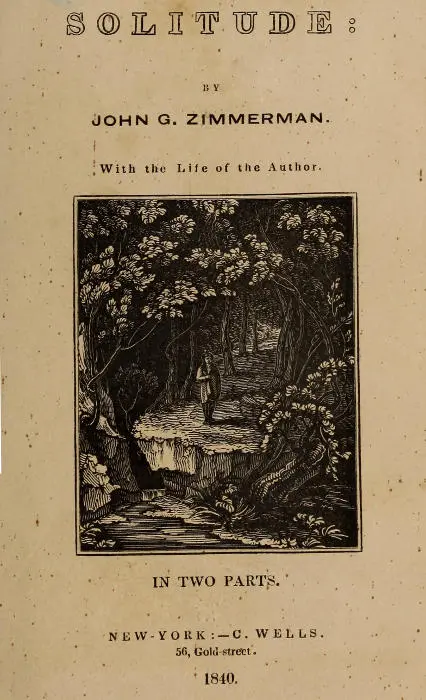
THE CLASSIC COLLECTION · 1799
"Solitude" by Johann Georg Zimmermann is a philosophical treatise written in the late 18th century. This work explores the theme of solitude, emphasizing its impact on the human mind and heart while analyzing its benefits and drawbacks. Zimmermann aims to enlighten readers on how occasional retirement can foster happiness, intellectual clarity, and a deeper understanding of oneself and society. At the start of the book, Zimmerman introduces the concept of solitude as an intellectual state where the mind retreats into self-reflection, asserting that true solitude can exist even amidst social gatherings. He observes that modern society often undervalues solitude, mistaking it for misery or isolation, while arguing that it is essential for genuine happiness and intellectual growth. The opening chapters set the stage for a detailed exploration of solitude's influences on human emotions, well-being, and the creative mind, positioning it as a powerful means to achieve true felicity.
Introduction adapted from the source catalogue; source summaries may be automatically generated.
Free to read · English · 115,833 words · No account needed
MAKE TIME FOR A GOOD BOOK
On by default. Untick to stop anonymous reading totals. Each page counts after 10 seconds in view. How this works.
Anonymous counting is on unless you have switched it off.
Idleness is truly said to be the root of all evil; and solitude certainly encourages in the generality of its votaries this baneful disposition. Nature has so framed the character of man, that his happiness essentially depends on his passions being properly interested, his imagination busied, and his faculties employed; but these engagements are seldom found in the vacant scenes and tedious hours of retirement from the world, except by those who have acquired the great and happy art of furnishing their own amusements; an art which, as we have already shown, can never be learnt in the irrational solitude of caves and cells.
The idleness which solitude is so apt to induce, is dangerous in proportion to the natural strength, activity, and spirit of the mind; for it is observed, that the highest characters are frequently goaded by that restlessness which accompanies leisure, to acts of the wildest outrage and greatest enormity. The ancient legislators were so conscious that indolence, whether indulged in solitude or in society, is the nurse of civil commotion, and the chief instigator of moral turpitude, that they wisely framed their laws to prevent its existence. Solon, observing that the city was filled with persons who assembled from all parts on account of the great security in which the people lived in Attica, that the country withal was poor and barren, and being conscious that merchants, who traffic by sea, do not use to transport their goods where they can have nothing in exchange, turned the attention of the citizens to manufactures; and for this purpose made a law, that he who was three times convicted of idleness, should be deemed infamous; that no son should be obliged to maintain his father if he had not taught him a trade; that trade should be accounted honorable; and that the council of the Areopagus should examine into every man’s means of living, and chastise the idle with the greatest severity. Draco conceived it so necessary to prevent the prevalency of a vice to which man is by nature prone, and which is so destructive to his character, and ruinous to his manners, that he punished idleness with death. The tyrant Pisistratus, as Theophrastus relates, was so convinced of the importance of preventing idleness among his subjects, that he made a law against it, which produced at once industry in the country, and tranquillity in the city. Pericles, who, in order to relieve Athens from a number of lazy citizens, whose lives were neither employed in virtuous actions, nor guarded from guilt by habits of industry, planted colonies in Chersonesus, Naxos, Andros, Thrace, and even in Italy, and sent them thither; for this sagacious statesman saw the danger of indulging this growing vice, and wisely took precautions to prevent it. Nothing, indeed, contributes more essentially to the tranquillity of a nation, and to the peaceful demeanor of its inhabitants, than those artificial wants which luxury introduces; for, by creating a demand for the fashionable articles, they engage the attention, and employ the hands of a multitude of manufacturers and artificers, who, if they were left in that restless indolence which the want of work creates, would certainly be unhappy themselves, and in all probability would be fomenting mischief in the minds of others. To suspend only for one week, the vast multitudes that are employed in the several mechanical trades and manufactories in Great Britain, would be to run the risk of involving the metropolis of that great, flourishing, and powerful country, once more in flames; for it would be converting the populace into an aptly disposed train of combustible matter, which being kindled by the least spark of accidental enthusiasm, by the heat of political faction, or, indeed, by their own internal fermentation, would explode into the most flagrant enormities. Nature, it is said, abhors a vacuum; and this old peripatetic principle may be properly applied to the intellect, which will embrace any thing, however absurd or criminal, rather than be wholly without an object. The same author also observes, that every man may date the predominance of those desires that disturb his life, and contaminate his conscience, from some unhappy hour when too much leisure exposed him to their incursions; for that he has lived with little observation, either on himself or others, who does not know that to be idle is to be vicious. “Many writers of eminence in physic,” continues this eminent writer, whose works not only disclose his general acquaintance with life and manners, but a profound knowledge of human nature, “have laid out their diligence upon the consideration of those distempers to which men are exposed by particular states of life; and very learned treatises have been produced upon the maladies of the camp, the sea, and the mines. There are, indeed, few employments which a man accustomed to academical inquiries and medical refinements, would not find reason for declining, as dangerous to health, did not his learning or experience inform him, that almost every occupation, however inconvenient or formidable, is happier and safer than a life of sloth. The necessity of action is not only demonstrable from the fabric of the body, but evident from observation of the universal practice of mankind; who for the preservation of health in those whose rank or wealth exempts them from the necessity of lucrative labors, have invented sports and diversions, though not of equal use to the world with manual trades, yet of equal fatigue to those who practice them, and differing only from the drudgery of the husbandman or manufacturer, as they are acts of choice, and therefore performed without the painful sense of compulsion. The huntsman rises early, pursues his game through all the dangers and obstructions of the chase, swims rivers, and scales precipices, till he returns home, no less harassed than the soldier, and has, perhaps, sometimes incurred as great hazard of wounds and death; yet he has no motive to excite his ardor; he is neither subject to the command of a general, nor dreads the penalties of neglect or disobedience: he has neither profits nor honors to expect from his perils and conquests: but acts with the hope of mural or civic garlands, and must content himself with the praise of his tenants and companions. But such is the constitution of man, that labor is its own reward; nor will any external incitements be requisite, if it be considered how much happiness is gained, and how much misery escaped, by frequent and violent agitation of the body. Ease is the most that can be hoped from a sedentary and inactive habit; but ease is a mere neutral state, between pain and pleasure. The dance of spirits, the bound of vigor, readiness of enterprise, and defiance of fatigue, are reserved for him that braces his nerves, and hardens his fibres; that keeps his limbs pliant with motion; and, by frequent exposure fortifies his frame against the common accidents of cold and heat. With ease, however, if it could be secured, many would be content; but nothing terrestrial can be kept at a stand. Ease, if it is not rising into pleasure, will be settling into pain; and whatever hopes the dreams of speculation may suggest, of observing the proportion between retirement and labor, and keeping the body in a healthy state by supplies exactly equal to its weight, we know that, in effect, the vital powers, unexcited by motion, grow gradually languid, decay, and die. It is necessary to that perfection of which our present state is capable, that the mind and body should both be kept in action; that neither the faculties of the one nor the other should be suffered to grow lax or torpid for want of use; that neither health can be purchased by voluntary submission to ignorance, nor knowledge cultivated at the expense of that health, which must enable it either to give pleasure to its possessor, or assistance to others. It is too frequently the pride of students, to despise those amusements which give to the rest of mankind strength of limbs and cheerfulness of heart. Solitude and contemplation are, indeed, seldom consistent with such skill in common exercises or sports, as is necessary to make them practised with delight; and no man is willing to do that of which the necessity is not pressing, when he knows that his awkwardness but makes him ridiculous. I have always admired the wisdom of those by whom our female education was instituted, for having contrived that all women, of whatever condition, should be taught some arts of manufacture, by which the vacuities of recluse and domestic leisure may be filled up. These arts are more necessary, as the weakness of their sex, and the general system of life, debar ladies from many enjoyments, which, by diversifying the circumstances of men, preserve them from being cankered by the rust of their own thoughts. I know not how much of the virtue and happiness of the world may be the consequence of this judicious regulation. Perhaps the most powerful fancy might be unable to figure the confusion and slaughter that would be produced by so many piercing eyes and vivid understandings, turned loose upon mankind, with no other business than to sparkle and intrigue, to perplex and destroy. For my own part, whenever chance brings within my observation a knot of misses busy at their needles, I consider myself as in the school of virtue; and though I have no extraordinary skill in plain work, or embroidery, look upon their operations with as much satisfaction as their governess, because I regard them as providing a security against the most dangerous ensnarers of the soul, by enabling them to exclude idleness from their solitary moments, and with idleness, her attendant train of passions, fancies, chimeras, fears, sorrows, and desires. Ovid and Cervantes will inform them that love has no power but on those whom he catches unemployed: and Hector, in the Iliad, when he sees Andromache overwhelmed with tears, sends her for consolation to the loom and the distaff. Certain it is, that wild wishes, and vain imaginations, never take such firm possession of the mind, as when it is found empty and unemployed.”
Your reading position is saved on this browser. Take it to another device with a library code. Reading pages adapt to text, rather than matching a printed edition.
BEHIND THE BOOK
This eBook is for the use of anyone anywhere in the United States and most other parts of the world at no cost and with almost no restrictions whatsoever. You may copy it, give it away or re-use it under the terms of the Project Gutenberg License included with this eBook or online at www.gutenberg.org. If you are not located in the United States, you will have to check the laws of the country where you are located before using this eBook. Read the source licence.
The original source file, including credits and licence, is retained by this library. Request an original-format copy at no charge. Please include the book title and Project Gutenberg identifier #55898.
KEEP YOUR CURIOSITY GOING
David Patterson (Spirit) Hatch
Coulson Kernahan

Ralph Waldo Emerson
Frances Wright

Edwin Abbott Abbott

Joseph Droz