
Last letters from the living dead man
David Patterson (Spirit) Hatch
THE CLASSIC COLLECTION · 1799
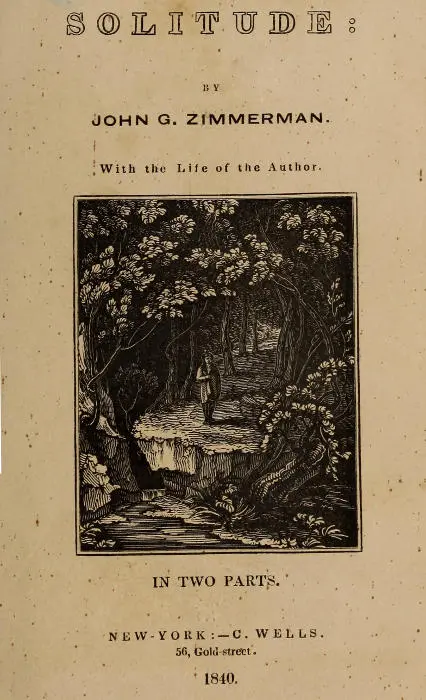
"Solitude" by Johann Georg Zimmermann is a philosophical treatise written in the late 18th century. This work explores the theme of solitude, emphasizing its impact on the human mind and heart while analyzing its benefits and drawbacks. Zimmermann aims to enlighten readers on how occasional retirement can foster happiness, intellectual clarity, and a deeper understanding of oneself and society. At the start of the book, Zimmerman introduces the concept of solitude as an intellectual state where the mind retreats into self-reflection, asserting that true solitude can exist even amidst social gatherings. He observes that modern society often undervalues solitude, mistaking it for misery or isolation, while arguing that it is essential for genuine happiness and intellectual growth. The opening chapters set the stage for a detailed exploration of solitude's influences on human emotions, well-being, and the creative mind, positioning it as a powerful means to achieve true felicity.
Introduction adapted from the source catalogue; source summaries may be automatically generated.
Free to read · English · 115,833 words · No account needed
MAKE TIME FOR A GOOD BOOK
On by default. Untick to stop anonymous reading totals. Each page counts after 10 seconds in view. How this works.
Anonymous counting is on unless you have switched it off.
Solitude, to a mind laboring under these erroneous notions of religion, operates like a rack, by which the imagination inflicts the severest tortures on the soul. A native of Geneva, a young man of very elegant manners, and a highly cultivated mind, some time since consulted me upon the subject of a nervous complaint, which I immediately discovered to be the consequence of a mistaken zeal for religion, a disposition naturally sedentary, and a habit which is too frequently indulged in solitude by unthinking youth. These circumstances had already made the most dreadful inroads both on his body and his mind. His emaciated frame was daily enfeebled by his paralyzed intellects, and he at length fell into a settled melancholy, which continued four years to defy the power of medicine, and finally destroyed his nervous system. A strong conviction of the heinous sin into which the blindness of his passion and evil example, had led him, at length flashed suddenly on his mind, and he felt, with the keenest compunctions of a wounded conscience, how impious he must appear to the all-seeing eye of the great Creator. Consternation and dismay seized his guilty mind; and the sense of virtue and religion, which he was naturally disposed to entertain, served only to increase his horror and distraction. He would have sought a refuge from the arrows of remorse under the protecting shields of penitence and prayer, but a scrupulous apprehension interposed the idea that it would be profanation in so guilty a sinner to exercise the offices of a pure and holy religion. He at length, however, proceeded to confession; but recollecting, after every disclosure, that he had still omitted many of his transgressions, additional horror seized upon his mind and tortured his feelings on the irrecoverable condition of his guilty soul. At intervals, indeed, he was able to perceive that the perturbations of his mind were the produce of his disorganized frame and disordered spirit; and he endeavored to recruit the one by air and exercise, and to dissipate the other by scenes of festivity and mirth: but his disorder had fixed his fibres too deeply in his constitution to be eradicated by such slight and temporary remedies. From the inefficacious antidotes of social pleasure and worldly dissipation, he was induced to try the calm and sedentary effects of solitary study; but his faculties were incapable of tasting the refined and elegant occupations of learning and the muse; his powers of reasoning were destroyed; his sensibilities, excepting on the subject of his complaint, were dried up; and neither the sober investigations of science, nor the more lively charms of poetry, were capable of affording him the least consolation. Into so abject a state, indeed, did his intellectual faculties at length fall, that he had not, during one period, sufficient ability to compute the change due to him from any piece of coin in the common transactions of life; and he confessed that he had been frequently tempted, by the deepness of his distress, to release both his body and his mind from their cruel sufferings, and “to shake impatiently his great affliction off” by self destruction; but the idea of heaping new punishment on his soul, by the perpetration of this additional crime, continually interposed, and saved him from the guilty deed. During this state of mental derangement, he fortunately met with a liberal minded and rational divine, who, free from the errors of priestcraft, and possessed of a profound knowledge of the virtues of religion and the structure of the human mind, undertook the arduous but humane and truly philosophic task, of endeavoring to bring back his mind to a rational sense of its guilt, and to a firm hope of pardon through the intercession of our Saviour. Religion, that sweet and certain comforter of human woes, at length effected a partial recovery, and restored him to a degree of tranquillity and repose; but he still continued to suffer, for years afterward, so great a misery from the shattered condition of his nerves, that he could not even compose a letter upon the most trifling and indifferent subject without the greatest labor and pain. As his feelings had never been hurt by any sense of injury received from mankind, he entertained no antipathy to his species; but as he was conscious that his reduced state of health prevented him from keeping up any rational or pleasing intercourse with them, he felt a sort of abhorrence to society, and refused, even when advised by his physicians and intimate friends, to mingle in its pleasures, or engage in its concerns. The proposal, indeed, appeared as extravagant and absurd to his feelings, as if a man, almost choking under the convulsion of a confirmed asthma, had been told that it was only necessary for him to breathe freely in order to acquire perfect ease. This deplorable state of health induced him to consult several Italian and English physicians; and being advised to try the effects of a sea voyage, he set sail for Riga, where he safely arrived; but, after a residence of six months, found himself unaltered, and precisely in the same dreadful condition in which he had set sail. On his return, I was called in to his assistance. There were at this period but very few of those gloomy and noxious vapors of superstition which had so tormented his mind, remaining; but his body, and particularly his nervous system, was still racked with agonizing pains. I had the good fortune to afford him great relief; and when at times his sufferings were suspended, and his spirits enlivened by pleasing conversation, he was certainly one of the most entertaining men, both as to the vivacity of his wit, the shrewdness of his observations, the powers of his reasoning, and the solidity of his judgment, that I had ever known.
Your reading position is saved on this browser. Take it to another device with a library code. Reading pages adapt to text, rather than matching a printed edition.
BEHIND THE BOOK
This eBook is for the use of anyone anywhere in the United States and most other parts of the world at no cost and with almost no restrictions whatsoever. You may copy it, give it away or re-use it under the terms of the Project Gutenberg License included with this eBook or online at www.gutenberg.org. If you are not located in the United States, you will have to check the laws of the country where you are located before using this eBook. Read the source licence.
The original source file, including credits and licence, is retained by this library. Request an original-format copy at no charge. Please include the book title and Project Gutenberg identifier #55898.
KEEP YOUR CURIOSITY GOING
David Patterson (Spirit) Hatch
Coulson Kernahan

Ralph Waldo Emerson
Frances Wright

Edwin Abbott Abbott

Joseph Droz