
Last letters from the living dead man
David Patterson (Spirit) Hatch
THE CLASSIC COLLECTION · 1799
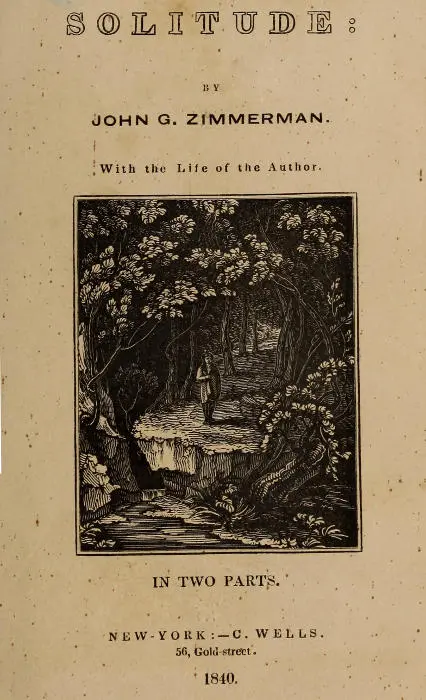
"Solitude" by Johann Georg Zimmermann is a philosophical treatise written in the late 18th century. This work explores the theme of solitude, emphasizing its impact on the human mind and heart while analyzing its benefits and drawbacks. Zimmermann aims to enlighten readers on how occasional retirement can foster happiness, intellectual clarity, and a deeper understanding of oneself and society. At the start of the book, Zimmerman introduces the concept of solitude as an intellectual state where the mind retreats into self-reflection, asserting that true solitude can exist even amidst social gatherings. He observes that modern society often undervalues solitude, mistaking it for misery or isolation, while arguing that it is essential for genuine happiness and intellectual growth. The opening chapters set the stage for a detailed exploration of solitude's influences on human emotions, well-being, and the creative mind, positioning it as a powerful means to achieve true felicity.
Introduction adapted from the source catalogue; source summaries may be automatically generated.
Free to read · English · 115,833 words · No account needed
MAKE TIME FOR A GOOD BOOK
On by default. Untick to stop anonymous reading totals. Each page counts after 10 seconds in view. How this works.
Anonymous counting is on unless you have switched it off.
This grievous malady, indeed, is not the exclusive offspring of mistaken piety and religious zeal; for it frequently invades minds powerful by nature, improved by science, and assisted by rational society. Health, learning, conversation, highly advantageous as they unquestionably are to the powers both of the body and the mind, have, in particular instances, been found incapable of resisting the influence of intense speculation, an atrabilarius constitution, and a superstitious habit. I have already mentioned the thick cloud of melancholy which obscured the latter days of the great and justly celebrated Haller, which were passed under the oppression of a religious despondency, that robbed him not only of all enjoyment, but almost of life itself. During the long period of four years, immediately antecedent to his death, he lived (if such a state could be called existence) in continual misery; except, indeed, at those short intervals when the returning powers of his mind enabled him, by the employment of his pen, to experience a temporary relief. A long course of ill health had forced him into an excessive use of opium, and by taking gradually increased quantities of that inspissated juice, he kept himself continually fluctuating between a state of mind naturally elevated and deeply dejected; for the first effects of this powerful drug are like those of a strong stimulating cordial, but they are soon succeeded by universal langour, or irresistable propensity to sleep, attended with dreams of the most agitated and enthusiastic nature. I was myself an eyewitness of the dreary melancholy into which this great and good man was plunged about two years before the kind, but cold, and though friendly, yet unwelcome hand of death, released him from his pains. The society, which, during that time, he was most solicitous to obtain, was that of priests and ecclesiastics of every description: he was uneasy when they were not with him: nor was he always happy in his choice of these spiritual comforters; for though, at times, he was attended by some of the most enlightened and orthodox divines of the age and country in which he lived, he was at others surrounded by those whom nothing but the reduced and abject state of his faculties would have suffered him to endure. But during even this terrible subversion of his intellectual powers, his love of glory still survived in its original radiance, and defied all the terrors both of hell and earth to destroy or diminish their force. Haller had embraced very deep and serious notions of the importance of Christianity to the salvation of the soul, and the redemption of mankind, which, by the ardency of his temper, and the saturnine disposition of his mind, were carried into a mistaken zeal and apprehension; and, instead of affording the comfort and consolation its tenets and principles are so eminently calculated to inspire, aggravated his feelings and destroyed his repose. In a letter which he wrote a few days before his death, to his great and good friend, the celebrated Heyne, of Gottingen, in which he announces the deep sense he entertained from his great age and multiplied infirmities, of his impending dissolution, he expressed his firm belief of revelation, and his faith in the mercy of God, and the intercession of Jesus Christ; but hints his fears lest the manifold sins, and the various errors and transgressions which the natural frailty of man must have accumulated during a course of seventy years, should have rendered his soul too guilty to expect the promised mercy to repentant sinners, and earnestly requests of him to inquire of his acquaintance Less, the virtuous divine of that place, whether he could not furnish him with some pious work that might tend to decrease the terrors he felt from the idea of approaching death, and relieve his tortured spirit from the apprehension of eternal punishment. The sentiments which occupied the mind of this pious philosopher when the dreaded hour actually arrived, whether it was comforted by the bright rays of hope, or dismayed into total eclipse by the dark clouds of despair, those who surrounded his dying couch have not communicated to the world. Death, while it released both his body and his mind from the painful infirmities and delusions under which they had so long and so severely suffered, left his fame, which, while living, he had valued much dearer than his life, exposed to the cruel shafts of slander and malevolence. A young nobleman of the canton of Berne, either moved by his own malice, or made an instrument of the malice of others, asserted in a letter, which was for a long time publicly exhibited in the university of Gottingen, that Haller had in his last moments denied his belief of the truth of Christianity. But those by whom he was then surrounded, betray, by the propagation of this falsehood, the fears they entertain of the firm support which his approbation would have given to that pure and pious system of religion, which they, it is well known, are so disposed to destroy. For certain it is, that Haller never doubted any of the attributes of the Deity, except his mercy; and this doubt was not the offspring of infidelity, but a crude abortion of that morbid melancholy which, during his latter days, settled so severely on his distempered mind. The same dread which he entertained of death, has been felt with equal if not greater horror, by minds as powerful and less superstitious. He candidly confessed the important and abstruse point upon which he had not been able to satisfy himself. His high sense of virtue made even his own almost exemplary and unblemished life appear, in his too refined speculations, grossly vicious. Mercy, he knew, must unavoidably, be correlative with justice; and he unfortunately conceived that no repentance, however sincere, could so purify the sinful, and, as he imagined, deplorable corruption of his soul, as to render it worthy of divine grace. So utterly had the melancholy dejection of his mind deprived him of a just sense of his character, and perfect knowledge of the nature of the Almighty. The mournful propensity of this great man must, if he had passed his days either in pious abstinence, or irrational solitude, have hurried him rapidly into irrecoverable frenzy; but Haller enjoyed the patronage of the great, the conversation of the learned, the company of the polite; and he not only suspended the effects of his malady, and of the medicines by which he attempted to relieve it, by these advantages, but by the sciences, which he so dearly loved and so successfully cultivated. The horrible evil, however, bowed him down in spite of all his efforts, and particularly oppressed him whenever he relaxed from his literary pursuits, or consulted his ghostly comforters on the lost condition of his soul.
Your reading position is saved on this browser. Take it to another device with a library code. Reading pages adapt to text, rather than matching a printed edition.
BEHIND THE BOOK
This eBook is for the use of anyone anywhere in the United States and most other parts of the world at no cost and with almost no restrictions whatsoever. You may copy it, give it away or re-use it under the terms of the Project Gutenberg License included with this eBook or online at www.gutenberg.org. If you are not located in the United States, you will have to check the laws of the country where you are located before using this eBook. Read the source licence.
The original source file, including credits and licence, is retained by this library. Request an original-format copy at no charge. Please include the book title and Project Gutenberg identifier #55898.
KEEP YOUR CURIOSITY GOING
David Patterson (Spirit) Hatch
Coulson Kernahan

Ralph Waldo Emerson
Frances Wright

Edwin Abbott Abbott

Joseph Droz