THE CLASSIC COLLECTION✦Human nature and the social orderCLASSIC FREE BOOKS
Human nature and the social order
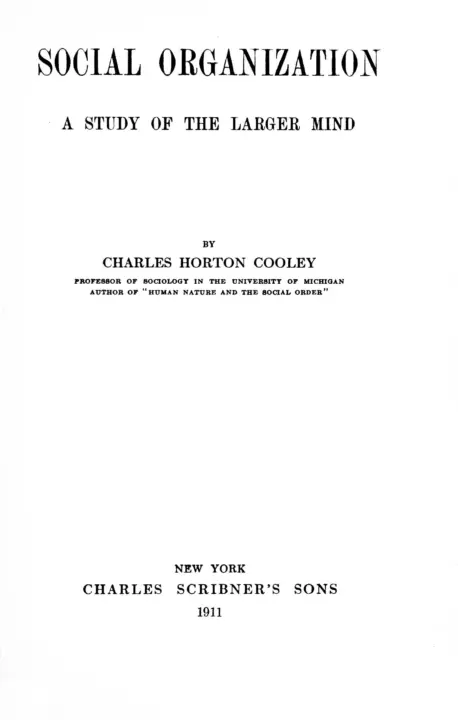
Charles Horton Cooley
THE CLASSIC COLLECTION · 1918
"Social Process" by Charles Horton Cooley is a scholarly work on sociology written in the early 20th century. The book explores the intricate dynamics of human interactions and social structures, emphasizing the organic growth and interconnectedness of individual and collective experiences. Cooley analyzes how personal and impersonal forms of life evolve, adapt, and influence one another, ultimately shaping society as a whole. At the start of "Social Process," Cooley introduces the concept of adaptive growth in human life, where individual development is seen as a continuous interaction with others and their conditions. He highlights the interplay between personal and impersonal forms, such as myths and language, demonstrating that even collective ideas and social institutions have a significant impact on individual identity. Cooley emphasizes the importance of the tentative process of social growth, where varied individual experiences contribute to the broader social fabric. Through examples, he illustrates how personal aspirations, social roles, and institutional changes work together to shape the ongoing evolution of society.
Introduction adapted from the source catalogue; source summaries may be automatically generated.
Free to read · English · 117,857 words · No account needed
MAKE TIME FOR A GOOD BOOK
On by default. Untick to stop anonymous reading totals. Each page counts after 10 seconds in view. How this works.
Anonymous counting is on unless you have switched it off.
Groups, social, process of, 7, 9, 11;
organization of, 19 f., 28;
in education, 62, 73;
cultural, influence of upon fame, 120 ff.;
necessary to emulation, 138 ff.;
primary, 180 f.;
complication of, 247;
as a factor in valuation, 336 ff.;
need of specialized, 364, 369;
technical, 390, 391
Growth, adaptive, 3 ff.;
reciprocal, 9;
downward, 154 ff.
Guizot, 126
Hamerton, P. G., 373
Handicaps to success, 96 f., 172
Hardy, Thomas, 411
Hawaiian Islands, 190
Hayes, E. C., 44
Hegel, 418
Hereditary degeneracy, 156
Heredity and environment, 154 f., 197 ff.
History, does it repeat itself?, 34
Hobhouse, L. T., 352
Honor, national, 262 ff.;
as a value, 312, 313
Horace, 121
Human nature, motivation of, 125–143 passim;
in degeneracy, 155 ff.;
“depravity” of, 176 f.;
in nations, 260 ff.
Human-nature values, 285 ff., 295, 300, 342
Humanism, modern, 249
Idealism, social, and art, 410 ff.
Ideals, the basis of discipline, 147 f.;
primary, 258;
national, 261 ff.;
of the upper class, 304 ff.;
in production, 343
Ideas, their social process, 3 ff., 12 ff., 16, 19; diversification and conflict of, 363–377 (See the synopsis on p. 363)
Illusion of centrality, 50
Imagination, social, 90, 94, 158
Imitation, 51
Immigrants, 204 ff., 232, 234, 412
Immigration, of alien races, 277 ff., 370 f.
Impersonal forms of life, 4 f., 6, 12 ff., 22 ff., 251
Income, of classes, 303
India, 190
Individual, as a factor in valuation, 289, 299 ff., 322 f.
See also Persons
Individualism, 29, 189, 190, 246, 418
Individuality, in education, 61 ff.;
in modern life, 249 f.;
national, 265, 369;
in relation to art, 413 f.
Industrial revolution, 45 f.
Infancy, prolongation of, 59
Inheritance, right of, 335 f.
Initiative, 91 ff., 95;
in valuation, 300, 338 ff.
Insanity, 161 f.
Instinct, 198 f.
Institutional values, 285 ff., 295, 333 ff., 342
Institutions, essential to intelligence, 355
Intelligence, 8, 9, 58 ff.;
as a factor in success, 90 f., 199;
in social function, 351–362
Internationalism, 255 ff.
Invention, 17
Inventions, valuation of, 338 f.
Inventors, not remembered, 115, 119
Investment, and class-conflict, 271
Isolation, moral, 181, 242, 246;
social value of, 368 ff.
Italy, 415
James, William, 286, 331
Japan, 190
Japanese, 274, 277 f.
Jesus, 35;
his fame an institution, 116, 139, 360
Jews, 7, 33, 99, 121, 183
Johnson, A. S., 344
Johnson, Doctor Samuel, 115
Kafirs, 188
Keller, A. G., 47, 375
Kidd, Dudley, 188
King, W. I., 218, 303
Kingsley, Miss, 189
Labor, 37, 60, 65;
motivation of, 131, 133 ff., 142 f.;
and degeneration, 184;
as a class, 268 ff.;
valuation of, 325, 347 f.
See also Classes
Language, as impersonal organism, 4, 6, 8, 14, 23, 284, 383;
analogous to pecuniary valuation, 310, 332 f.;
in assimilation, 371
Lanier, Sidney, 377
Law and culture, 70
Leadership, fame as, 112, 365
Leisure and art, 414
Librarians, motives of, 131
Liebknecht, 381
Lincoln, 93, 113, 116, 128
Literary class, influence of upon fame, 117 ff.
Literature, as culture, 68 f.;
and class, 304;
valuation of, 319 f.
Logan, James, 133
Lowell’s Ode, 419 f.
Luther, 10, 22
Macaulay, 114
Machiavelli, 105
Maladjustment, 180 ff.
Malthus, 13, 237
Marcus Aurelius, 366
Market, as an institution, 296 ff., 309 ff.
Marriage, selection in, 214 ff., 223;
statistics of, 400
Mastery, requisite for culture, 72
Maternal instinct, 213
Mendel, 116
Meredith, George, 383
Method, tentative, 3 ff., 30;
in the study of degeneration, 165 f.;
of sociology, 395–404
Metternich, 255
Middle Ages, values in, 289, 367
Might and Right, 109 ff., 242
Militarism, as impersonal organism, 5, 47, 111, 148, 242, 246, 258
Military training, compulsory, 145 f., 149
Millet (the painter), 411
Milton, 174
Minimum standards, 385 f.
Minorities, 380 f.
Misery, distinguished from poverty, 234;
and survival, 237
Missionaries, 187 ff., 190
Mitchell, Wesley C., 32
Monastic system, 203
Montaigne, 102, 122
Monte Carlo, 32
Montesquieu, 344
Moral unity of nations, 242 f., 260, 262
Morality, and success, 99–111, 203 f., 242, 358, 406
Mores, 23;
of maintenance, 47, 187, 217, 245, 289;
harmful, 375, 385
Motion-pictures, 415
Motiv, of social forms, 12
Motivation, 125–143;
by pecuniary values, 309 ff.;
by self-expression, 321 ff.
Myth, 4, 6;
in relation to fame, 116, 122
Nansen, 189
Your reading position is saved on this browser. Take it to another device with a library code. Reading pages adapt to text, rather than matching a printed edition.
Charles Horton Cooley
Charles Horton Cooley
BEHIND THE BOOK
This eBook is for the use of anyone anywhere in the United States and most other parts of the world at no cost and with almost no restrictions whatsoever. You may copy it, give it away or re-use it under the terms of the Project Gutenberg License included with this eBook or online at www.gutenberg.org. If you are not located in the United States, you will have to check the laws of the country where you are located before using this eBook. Read the source licence.
The original source file, including credits and licence, is retained by this library. Request an original-format copy at no charge. Please include the book title and Project Gutenberg identifier #75188.
KEEP YOUR CURIOSITY GOING

Charles G. (Charles Griffith) Ross
Hannah Webster Foster

Emily Lawless
Edwin Hamlin Carr

Charles De Lano Hine
Andrew Ure