THE CLASSIC COLLECTION✦Human nature and the social orderCLASSIC FREE BOOKS
Human nature and the social order
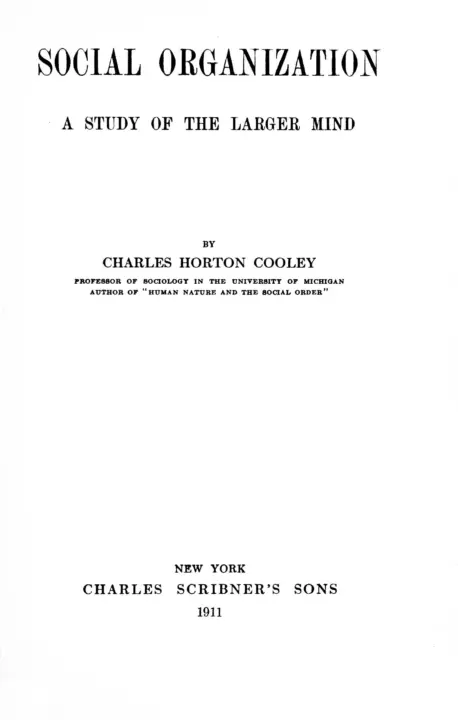
Charles Horton Cooley
THE CLASSIC COLLECTION · 1918
"Social Process" by Charles Horton Cooley is a scholarly work on sociology written in the early 20th century. The book explores the intricate dynamics of human interactions and social structures, emphasizing the organic growth and interconnectedness of individual and collective experiences. Cooley analyzes how personal and impersonal forms of life evolve, adapt, and influence one another, ultimately shaping society as a whole. At the start of "Social Process," Cooley introduces the concept of adaptive growth in human life, where individual development is seen as a continuous interaction with others and their conditions. He highlights the interplay between personal and impersonal forms, such as myths and language, demonstrating that even collective ideas and social institutions have a significant impact on individual identity. Cooley emphasizes the importance of the tentative process of social growth, where varied individual experiences contribute to the broader social fabric. Through examples, he illustrates how personal aspirations, social roles, and institutional changes work together to shape the ongoing evolution of society.
Introduction adapted from the source catalogue; source summaries may be automatically generated.
Free to read · English · 117,857 words · No account needed
MAKE TIME FOR A GOOD BOOK
On by default. Untick to stop anonymous reading totals. Each page counts after 10 seconds in view. How this works.
Anonymous counting is on unless you have switched it off.
Constructive method of reform, 177 f.
Control, rational, 41 f., 65, 317 ff., 382–394;
in relation to progress, 405 f.
Control, social, of propagation and the survival of types, 205,
209–317, 226–238;
of poverty, 227;
of group conflict, 247 f.;
in international relations, 255–267
Co-operation, in relation to conflict, 35–42.
See also Community spirit and Team-work
Courage, 91 ff., 95
Crime, 203 f., 207
Crisis, commercial, 25, 32
Criticism, 392 f.
Crusades, 253
Culture, 67–77, 369
Custom, in valuation, 294
Cycles, social, 30–34;
business, 32 ff.
Czechs, 276
Dante, 123
Darwin, 20, 29, 95, 115, 206, 353, 373, 395 f., 400, 407
Darwinism, and war, 241, 373
Degenerate Process, Some Factors in, 180–194
Degeneration, social, 25 f.;
of nations, 33 f., 126;
of groups, 106;
organic view of, 153–168;
and will, 169–179;
hereditary, in relation to poverty, 226 ff.;
to fecundity, 230 f.
Delinquency, juvenile, 155, 159
Democracy, 17, 118;
discipline in, 144–149;
and race exhaustion, 220 f.;
modern growth of, 248 f.;
favorable to internationalism, 257 ff.;
and classes, 269 ff., 348;
must be differentiated, 364 ff.;
in relation to art, 410–422 passim
Democratic spirit, 62, 73
Depravity of human nature, 176
Determinism, 44, 47 f., 401
Devine, E. T., 234
Discipline, 132 ff., 144–149, 183;
of women, 346 f.
Discussion, 357, 361, 363, 367, 371, 378 ff.
Displacement, a cause of degeneracy, 180 ff.
Dissipation, and fecundity, 231
Distribution, theory of, 302
Doggedness, 92
Drama, the, an interpretation of social process, 359 ff.;
community, 419
Dramatic, the, in relation to fame, 114, 121
Dramatic character, of intelligence, 358 ff.;
of public opinion, 378;
of social science, 395 ff.
Dugdale, Richard, 205, 224
Dürkheim, E., 400
Economic determinism, 44, 47 f.
Economic discipline, 147
Economic factors in biological survival, 218–238
Economic internationalism, 266
Economic man, 135, 356
Economic motives, 128 ff.
Economists, their narrow view of motivation, 135 f.
See also Political Economy
Education, and opportunity, 61 ff.;
individuality in, 61 ff.;
in relation to culture, 68 ff.;
should provide formative social groups, 73, 132, 146, 149, 206, 245,
421
Ellis, Havelock, 229
Ellwood, C. A., 44
Elmira Reformatory, 185
Emerson, 22, 50, 94, 100, 113, 117
Emulation in service, 128 ff., 137–143
England, 33, 45, 245, 246, 264;
poverty in, 233
English, the, 274
Environment, economic, 46 f., 101, 107;
in relation to heredity, 197–208;
as source of poverty, etc., 227, 236;
in modern life, 249 f.
Equality, of opportunity, 61 ff., 82 ff., 86;
as a social ideal, 81, 82, 86 f.
Esprit de corps. See Team-work, Community Spirit
Eugenic ideals, 212 f.
Eugenics, 166, 206, 216, 219 ff., 232, 317, 347, 385
Europe, modern unity of, 264;
caste in, 273
Evolution, doctrine of, its social growth, 13, 19. See also Tentative Process, Selection, Survival, Progress, Darwinism
Experiment, 8 ff., 30, 55 ff.
Faith, 93, 94, 107, 408
Fame, 112–124
Family, social continuity of, 7;
in relation to opportunity, 80 f.;
discipline in, 146, 148;
normal, size of, 210 f.;
sentiment of, needed, 213;
degenerate, 224;
fecundity of degenerate, 230 f., 244;
place of in modern life, 251
Fashion, 12, 31 f., 299, 346
Fear, a poor motive, 132 f., 135
Feeble-minded, report on, 167
Finns, 276
Folkways, 244
Foods, valuation of, 293
Force, international, 267
Ford, Henry, 133
Formalism, in education, 62 f., 145, 168, 386 ff.
France, 33, 237, 258, 344, 415
Free speech, 365 ff.
Freedom, organic, 28 f.;
negative idea of, 143;
and discipline, 144 ff.;
of the will, 170 f., 182;
of women, 215 f.
Funerals, valuation of, 294
Galton, 203;
his scheme of eugenics, 219 f., 386 f.
Gangs, 176, 178
Garibaldi, 114, 261
Genius, 17, 104 f., 203, 220, 229, 339, 387
Germans, 144, 276, 277, 366
Germany, 148, 241, 245, 246, 258, 263, 264, 265, 274, 418
Gibbon, 114
Gillin, J. L., 44
God, 5, 14, 43, 93, 94, 107, 108, 134, 140, 253, 262, 365, 373, 418,
420
Goethe, 36, 69, 70, 117, 264, 389, 392, 402, 406
Golf-clubs, valuation of, 337
Grant, General, 197
Great epochs, 121
“Greatest good of the greatest number,” 417
Group play, 421
Your reading position is saved on this browser. Take it to another device with a library code. Reading pages adapt to text, rather than matching a printed edition.
Charles Horton Cooley
Charles Horton Cooley
BEHIND THE BOOK
This eBook is for the use of anyone anywhere in the United States and most other parts of the world at no cost and with almost no restrictions whatsoever. You may copy it, give it away or re-use it under the terms of the Project Gutenberg License included with this eBook or online at www.gutenberg.org. If you are not located in the United States, you will have to check the laws of the country where you are located before using this eBook. Read the source licence.
The original source file, including credits and licence, is retained by this library. Request an original-format copy at no charge. Please include the book title and Project Gutenberg identifier #75188.
KEEP YOUR CURIOSITY GOING

Charles G. (Charles Griffith) Ross
Hannah Webster Foster

Emily Lawless
Edwin Hamlin Carr

Charles De Lano Hine
Andrew Ure