THE CLASSIC COLLECTION✦Human nature and the social orderCLASSIC FREE BOOKS
Human nature and the social order
Charles Horton Cooley
THE CLASSIC COLLECTION · 1918
"Social Process" by Charles Horton Cooley is a scholarly work on sociology written in the early 20th century. The book explores the intricate dynamics of human interactions and social structures, emphasizing the organic growth and interconnectedness of individual and collective experiences. Cooley analyzes how personal and impersonal forms of life evolve, adapt, and influence one another, ultimately shaping society as a whole. At the start of "Social Process," Cooley introduces the concept of adaptive growth in human life, where individual development is seen as a continuous interaction with others and their conditions. He highlights the interplay between personal and impersonal forms, such as myths and language, demonstrating that even collective ideas and social institutions have a significant impact on individual identity. Cooley emphasizes the importance of the tentative process of social growth, where varied individual experiences contribute to the broader social fabric. Through examples, he illustrates how personal aspirations, social roles, and institutional changes work together to shape the ongoing evolution of society.
Introduction adapted from the source catalogue; source summaries may be automatically generated.
Free to read · English · 117,857 words · No account needed
MAKE TIME FOR A GOOD BOOK
On by default. Untick to stop anonymous reading totals. Each page counts after 10 seconds in view. How this works.
Anonymous counting is on unless you have switched it off.
Napoleon I, 103, 116, 261, 264, 353
Napoleon III, 259
Nationality, principle of, 256 ff.
Nations, organization of by conflict, 38, 40, 245;
decay of, 33 f.;
morality of, 105, 187;
loyalty to, 141;
and discipline, 147 f.;
progress of, 241;
society of, 255 ff., 277, 356
Negroes, 188 f., 232, 275, 276, 278
Nomenclature, of inheritance, 207 f.
Non-conformity, 106 ff., 300, 338, 367, 373, 380 f.
Novicow, J., 37
Nucleation, of groups and persons in modern life, 252
Opportunity, 11, 55–66, 78–87, 125, 181, 220, 221, 237 f., 250, 307 f.
Organic view, as opposed to particularism, 43–51;
of degeneration, 153 ff.
Organism, impersonal, 4 ff.;
international, 5, 255 ff.;
meaning of social, 26 ff.;
in relation to freedom, 28 f.;
valuation by an impersonal, 284
Organization, social, unconscious, 16, 20 ff.;
as a process, 19–29, 36, 55 ff.;
cyclical character of, 30 ff.;
and culture, 67 f.;
and success, 89 f.;
must support human nature, 176 f.;
large-scale modern, 246 ff.;
international, 255 ff.;
and valuation, 309 ff., 329 ff., 336 ff.;
and art, 413
Organizing capacity, 259
Originality, 390
Overlapping, of social forms, 6, 27 f.
Ox, diverse values of, 289 f.
Painting, schools of, 23
Palissy, 115
Panama Canal, 143
Paris, 12, 32
Parmelee, Maurice, 44
Particularism, intellectual, 43–51;
in social reform, 160 ff.;
biological, 205 ff., 226 f.;
state-conflict, 241 ff., 394
Patriotism, and discipline, 145;
in modern life, 252 f.;
nature of, 261 ff.;
and religion, 418 ff.
Peace. See Control, Social
Pecuniary motive, 129 f., 143
Personality, in relation to groups, 7, 8;
a factor in culture, 69;
in success, 89 ff.;
great, alleged decline of, 123;
standards of, 153 f.;
and modern groups, 249 ff., 387
Persons, general relation of to social process, 3, 6, 8, 10 f., 16, 19, 20, 21 f., 27, 55 ff., 67 ff., 112, 154 ff.
Physical factors, 44, 46 f., 51
Plato, 50, 99, 102, 124
Play, organized, 146, 148
Poles, 271, 276
Political economy, 297 ff., 397, 403
Pons asinorum of sociology, 207
Poverty, 48;
organized, might be abolished, 85 f., 161 f.;
and propagation, 226–238
Pragmatism, 8
Primary ideals, 249
Primary or intimate groups, 62, 73 ff., 137, 148 ff., 421
Privilege. See Classes
Professional spirit, 131 f., 138, 140
Progress, 35, 41;
group conflict theory of, 241 f.;
of pecuniary valuation, 326 f., 329–348;
tentative character of, 405–409
Progress-values, 341 ff.
Propagation, impulse to, 211 ff.;
and poverty, 226 ff.
Prostitution, 184
Psalms, on success and morality, 99
Psychological tests, 64, 235, 389
Public opinion, 270, 378–381
Punishment, 132, 160
Race, 202;
questions of, 274 ff., 358, 379
Race exhaustion, 220 f.
Race suicide, 211 ff., 218 f.
Races, contact of backward and civilized, 187 ff.;
loosed by communication, 247
Radicalism, value of, 368, 374
Reform, organic, 157 f.
Religion, 5, 14, 75;
and patriotism, 75 f., 253, 266, 76, 253 f., 289, 330 f., 377, 408
f., 420 f.
See also Christianity, Church
Rembrandt, 116
Responsibility, organic view of, 158 f.
Revolution, industrial, 45 f.;
and class, 268;
Russian, 271
Rhythm, in social process, 32 f.
Richelieu, 94
Roman Empire, 126
Ross, E. A., 209
Rousseau, 373
Rural culture, 74 f.
Rural degeneracy, 192
Ruskin, 15, 324
Russia, 271
Ruysdael, 410
Saint Louis (the King), 103
Sainte-Beuve, 118, 392
Savage peoples, demoralization of, 187, 209
Scott, Sir W., 114, 118
Seager, Henry R., 78, 308
Seasonal workers, 185
Security, sense of, in motivation, 139 ff.
Selection, in social process, 8 ff., 55 ff., 112, 117, 155, 181, 201
f.;
in marriage, 214 ff.;
artificial, 235 f., 284 f.;
of ideas, 371 ff.
Self-consciousness, merged in the group, 137
Self-development and success, 88 f., 100
Self-expression, as motive, 321 ff., 410, 416 f.
Self-possession, an American trait, 144
Self-reliance, 90, 93, 95, 107, 113, 182
Self-respect, loss of, 173
Self-seeking, lower and higher, 128
Sensualism, 176
Sentiment, organization of, 25;
a factor in discussion, 357
Service, social, a condition of success, 88 f., 100;
emulation in, 128 ff., 145
Sexes, conflict of, 36; choice of, 214 ff., 361
Sexual impulses, 175, 177, 211 f.
Sexual vice, 191 f., 269
Shakespeare, 99, 114
Small, Albion W., 28
Sociability, may lead to degeneration, 176, 194
Your reading position is saved on this browser. Take it to another device with a library code. Reading pages adapt to text, rather than matching a printed edition.
Charles Horton Cooley
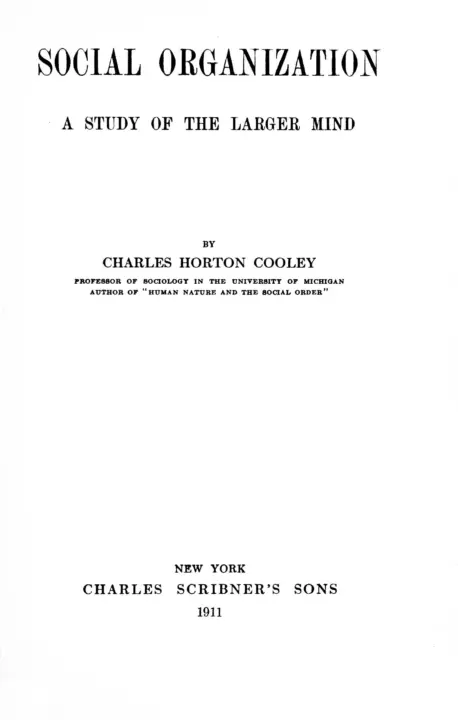
Charles Horton Cooley
BEHIND THE BOOK
This eBook is for the use of anyone anywhere in the United States and most other parts of the world at no cost and with almost no restrictions whatsoever. You may copy it, give it away or re-use it under the terms of the Project Gutenberg License included with this eBook or online at www.gutenberg.org. If you are not located in the United States, you will have to check the laws of the country where you are located before using this eBook. Read the source licence.
The original source file, including credits and licence, is retained by this library. Request an original-format copy at no charge. Please include the book title and Project Gutenberg identifier #75188.
KEEP YOUR CURIOSITY GOING

Charles G. (Charles Griffith) Ross
Hannah Webster Foster

Emily Lawless
Edwin Hamlin Carr

Charles De Lano Hine
Andrew Ure