THE CLASSIC COLLECTION✦Human nature and the social orderCLASSIC FREE BOOKS
Human nature and the social order
Charles Horton Cooley
THE CLASSIC COLLECTION · 1918
"Social Process" by Charles Horton Cooley is a scholarly work on sociology written in the early 20th century. The book explores the intricate dynamics of human interactions and social structures, emphasizing the organic growth and interconnectedness of individual and collective experiences. Cooley analyzes how personal and impersonal forms of life evolve, adapt, and influence one another, ultimately shaping society as a whole. At the start of "Social Process," Cooley introduces the concept of adaptive growth in human life, where individual development is seen as a continuous interaction with others and their conditions. He highlights the interplay between personal and impersonal forms, such as myths and language, demonstrating that even collective ideas and social institutions have a significant impact on individual identity. Cooley emphasizes the importance of the tentative process of social growth, where varied individual experiences contribute to the broader social fabric. Through examples, he illustrates how personal aspirations, social roles, and institutional changes work together to shape the ongoing evolution of society.
Introduction adapted from the source catalogue; source summaries may be automatically generated.
Free to read · English · 117,857 words · No account needed
MAKE TIME FOR A GOOD BOOK
On by default. Untick to stop anonymous reading totals. Each page counts after 10 seconds in view. How this works.
Anonymous counting is on unless you have switched it off.
On the other side we see the church and the institutions connected with it reaching out toward social ideals and functions, recognizing that the salvation of the individual, possible only through that of society, calls for co-operation and service, without which worship is partial and unreal.
Indeed this spirit, whether we call it religious or social, is by no means confined to the visible institutions of the state or the church. It belongs to the spirit of the time, and may be felt in the several branches of learning, in philanthropy, in socialism, in the labor movement, and in the world of industry and trade. The conditions of life favor it, and in spite of all setbacks we may expect it to have an irresistible growth.
Actors, fame of, 119
Adaptation, mutual, 9, 202;
intelligent, 351 ff.
See also Tentative Process and Selection
Addams, Jane, 182, 193
Address, a factor in success, 96
Advertising, 291
Agreement not essential to public opinion, 378 ff.
Alma mater, all should have one, 73 ff.
Anderson, B. M., Jr., 291, 298
Architecture, 15, 49
Art, 15, 16, 23, 49, 288, 291;
valuation of, 320, 333, 337;
suppression of originality in, 373;
and social idealism, 344, 410–422
Art spirit, in motivation, 142, 321;
rise of, 345
Art-work, as culture, 68, 71
Artists, fame of, 119
Athletics, 130, 146
Austria-Hungary, 279
Babies, natural selection among, 229
Bacon, Francis, 114
Bacon, Roger, 116
Bagehot, W., 370
Beethoven, 412
Belgium, 262, 271
Beliefs, in relation to degeneration, 186 f.
Bible, 10, 360
Biological process, 197–208
Biologists, particularism of, 205 ff., 226 f.
Biology, as study of process, 396
Birth-control, 212 f., 237
Bismarck, 264
Blackmar and Gillin, 44
Bohemians, 271
Boy Scouts, 149
Boyle, 115
Bristol, Lucius M., 37, 44
Browne, Sir T., 108, 123, 174
Bryce, James, 402
Bücher, Karl, 273
Burke, 70, 383
Burroughs, J., 123
Cancellation of impracticable ideas, 374
Caste, 57.
See also Classes
Cathedrals, building of, 416
Causation, in social process, 43 ff.;
in degeneration, 161 ff.
Centralization, under the influence of war, 245 f.
Change, social, as a source of degeneracy, 180 ff.
Character, is what “works,” 14;
judged by little things, 100
Charity, in relation to survival of types, 226 ff.
Children, in relation to opportunity, 57 ff.;
discipline of, 148 ff.
China, 190
Chinese, 279
Christianity, 31, 35, 110, 177, 189 f., 222
Church, mediæval, 24, 25, 109, 113, 132, 139, 187, 286, 288, 291, 301,
339, 367, 390, 421.
See also Religion
Cities, badly governed, 205
City, as an impersonal organism, 24
Civil War, American, 40, 42, 197, 258, 266
Civilization, modern, why it does not enervate, 126 f.;
and race exhaustion, 220 f.
Clan system, disintegration of, 188
Class-conflict, 268 ff.
Class-consciousness, 274
Classes, social, in relation to opportunity, 78–87;
in relation to propagation, 218–238, 249;
as a factor in valuation, 302 ff., 316, 334 ff., 347 f., 369 f.;
study of, 402, 418
Climate, as a social institution, 46
Collier, John, 419
Commercialism, 23, 192 f., 298, 304, 316, 325, 339, 391, 418
Communication, 198, 248, 255, 269, 361 f.
Community culture, 74
Community spirit, in education, 62;
in relation to culture, 72 ff., 130, 137 ff., 419 ff.
See also Team-work
Competition, 40 f., 55 ff., 83 ff., 125 ff., 294, 384, 385 f.
Competitive spirit, 125–136
Composure, a factor in success, 94
Conflict, 15;
place of in social process, 35–42, 56;
of standards, 106, 126, 127, 175, 179, 181;
between social and biological processes, 202 f.;
selection by, 228;
group, in relation to modern integration, 241–254;
of classes, 268 ff.;
in the drama, 360 f.;
of ideas, 371 ff.
Conformity, 109
Consciousness, in social process, 5, 6, 8, 10, 14, 15, 16, 20 ff.;
national, 257.
See also Intelligence
Conservatism, 383
Your reading position is saved on this browser. Take it to another device with a library code. Reading pages adapt to text, rather than matching a printed edition.
Charles Horton Cooley
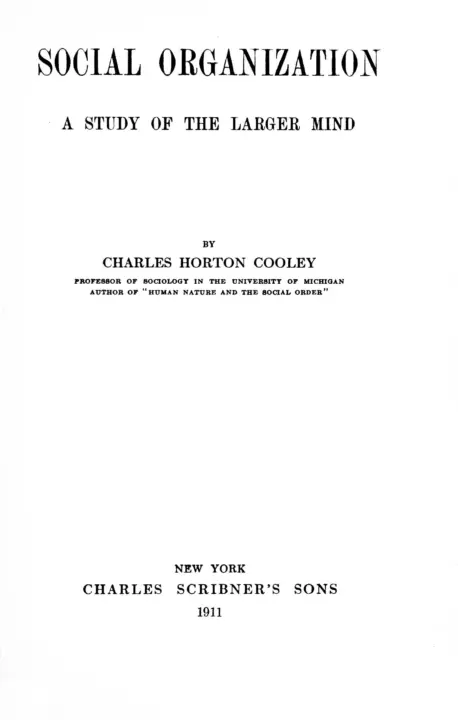
Charles Horton Cooley
BEHIND THE BOOK
This eBook is for the use of anyone anywhere in the United States and most other parts of the world at no cost and with almost no restrictions whatsoever. You may copy it, give it away or re-use it under the terms of the Project Gutenberg License included with this eBook or online at www.gutenberg.org. If you are not located in the United States, you will have to check the laws of the country where you are located before using this eBook. Read the source licence.
The original source file, including credits and licence, is retained by this library. Request an original-format copy at no charge. Please include the book title and Project Gutenberg identifier #75188.
KEEP YOUR CURIOSITY GOING

Charles G. (Charles Griffith) Ross
Hannah Webster Foster

Emily Lawless
Edwin Hamlin Carr

Charles De Lano Hine
Andrew Ure