THE CLASSIC COLLECTION✦Social processCLASSIC FREE BOOKS
Social process
Charles Horton Cooley
THE CLASSIC COLLECTION · 1909
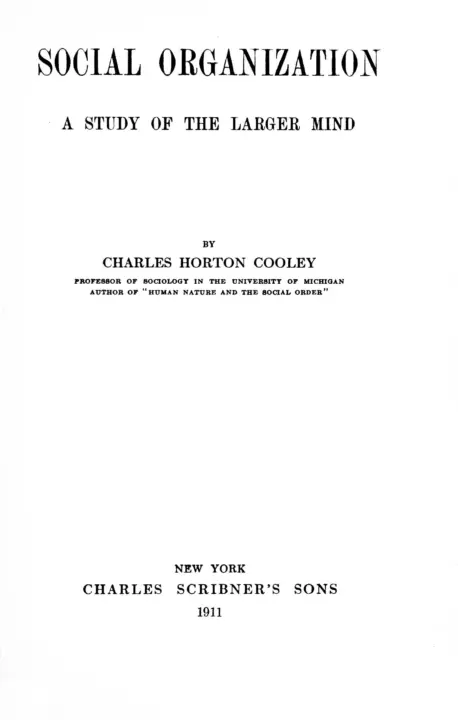
"Social Organization: A Study of the Larger Mind" by Charles Horton Cooley is a scholarly publication written in the early 20th century. This work focuses on the relationship between the individual mind and social dynamics, emphasizing how personal consciousness is shaped by social interactions and relationships. It delves into the intricacies of social organization, collective consciousness, and the interplay between individual thoughts and societal influences. The opening of the book outlines Cooley's perspective on social organization, positing that the mind functions as an organic whole influenced by interpersonal relations. He highlights the interconnectedness of self-consciousness and social consciousness, arguing that they emerge simultaneously. Cooley also critiques traditional views that prioritize individual self-awareness, instead advocating for a vision of the mind as fundamentally communal. His introduction sets the stage for a deeper exploration of social ideals, communication, and the moral fabric of society, positing that human nature and social structures evolve together as integrated components of social life.
Introduction adapted from the source catalogue; source summaries may be automatically generated.
Free to read · English · 110,332 words · No account needed
MAKE TIME FOR A GOOD BOOK
On by default. Untick to stop anonymous reading totals. Each page counts after 10 seconds in view. How this works.
Anonymous counting is on unless you have switched it off.
Check-book, in social reform, 415 f.
Chicago, 212;
recreation centres in, 408.
Child, the, his relation to the world, 315 ff.
Children, development of social consciousness in, 7 ff., 72;
reforms in the interest of, 318 f.;
“spoiled,” 358 ff.
China, lack of communication in, 86.
Chinese, 186, 198.
Chivalry, 224.
Choice, excessive, 172;
versus mechanism, 323;
spirit of, 359 ff., 365 ff.
Christianity, 52, 73, 136, 166, 203 ff., 253, 304, 373 ff.
Church, the, 204, 322, 342, 347, 370;
disorganization in, 372 ff.
City life, 94, 178 f., 409.
Class animosity, 301 ff.
Class atmosphere, 272.
Class-consciousness, 240 ff., 275, 284 ff., 305.
Class struggle, the, 241, 277, 286.
Classes, social, 179 f., 209-309;
open, 239 ff.;
open, in relation to wealth, 248 ff.;
capitalist, 256 ff.;
organization of the ill-paid, 284 ff.;
hostile feeling between, 301.
Classical culture, 388 f.
Clergymen, facial expression of, 67.
Commercialism, 167;
in relation to art, 173 f., 261, 346, 383 ff.
Commons, J. R., 286.
Communication, 54;
significance of, 61 ff.;
growth of, 66 ff.;
modern, a cause of enlargement and animation, 80 ff.;
modern, in relation to individuality, 91 ff.;
in relation to superficiality and strain, 98 ff.;
in relation to crowds, 151, 180, 191;
in relation to caste, 226 f., 338 f.
Community ideal, the, 33 ff., 52, 305.
See also We-feeling and Moral unity.
Compensation, principle of, in social organization, 55 ff., 115, 118.
Competition, 35, 56, 158, 199 ff., 210, 226 f., 235, 239 f., 244, 323. See also Survival of the fittest.
Comte, 237.
Conflict. See Competition.
Confusion, in relation to art and literature, 162 ff.;
to sentiment, 193.
See also Disorganization.
Conquest, a cause of caste, 221.
Conscience, public, 387.
Consciousness, growth of in history, 107 ff.
Consciousness, public, 10 ff., 82, 411 ff.
Consciousness, social, 4 ff.;
development of in children, 7 ff., 71, 350.
Conservatism, 327 ff.
Constitution of the United States, 314, 398.
Convention and tradition, 335 ff.
Conventionalism, 339 ff.
Cornish, F. W., 224.
Cost of change, 418 f.
Country life, effects of, 93 f., 178 f.
Courage, 187.
Creeds, 375 ff., 418.
Crime, 202 f.
Crises, commercial, 418.
Crowd excitement, in relation to democracy, 149 ff.
Crowds, psychology of, 149 ff.
Cuba, 322.
Culture groups and types, 163 ff., 243, 388 f.
Dante, 36, 70, 165, 173, 190, 388.
Darwin, 29, 67, 189, 295, 321.
Dead-level theory, 93, 159 ff.
Declaration of Independence, 48, 134.
Dellenbaugh, F. S., 108.
Demand, economic, often degrading, 141.
Democracy, among children, 45;
source of its ideals, 51;
dependent upon printing, 75;
relation to modern communication, 85 ff.;
an inadequate name, 86;
as mental organization, 105-205;
a discipline in self-control, 152;
and distinction, 157 ff.;
in relation to wealth, 278 ff.;
to childhood, 318, 329, 334, 398.
Descartes, 5 ff.
Determinism, moral value of, 19 f.
De Tocqueville, Alexis, 27, 92, 99, 101, 116, 159, 172, 175, 235,
329, 398.
Devine, E. T., 297.
Dialects, revival of, 96.
Diffusion, a result of modern communication, 81;
possibilities of, 87;
not opposed to selection, 88;
zeal for, 174;
the age of, 175.
Dill, Samuel, 114.
Discussion. See Opinion.
Disorganization, spiritual, 162 ff., 347 ff.;
in the family, 356 ff.;
in the church, 372 ff.;
in industry, 383 ff.;
in education and culture, 386 ff.;
in fine art, 389 ff.
Distinction, apt to cause isolation, 138 f.;
in relation to democracy 157 ff.
Divorce, 365 ff.
Domestic service, 367.
Donovan, J., 109.
Dorsey, J. O., 111.
Dress, 305.
Drink, 293 f.
Economic Interpretation of History, 255.
Economic system, confusion in, 383.
Education, 48, 87, 117, 227, 234;
formalism in, 345 f., 349;
of women, 363 ff.;
disorganization in, 386 ff.;
public, 406.
Efficiency, social, depends upon freedom, 234 f.
Ellis, H., 364.
Emerson, 125, 167, 176, 246, 342, 385.
Emulation, 307.
Energy, persistence of, 328.
England, 274, 281, 301, 302, 340, 358, 397 f.
Ennui, 99.
Environment, 214 f., 230, 291 ff., 316 f.
Equality, 180, 257, 301 f.
Ethics. See Morality.
Eugenics, 296.
Facial Expression, 66 f.
Your reading position is saved on this browser. Take it to another device with a library code. Reading pages adapt to text, rather than matching a printed edition.
BEHIND THE BOOK
This eBook is for the use of anyone anywhere in the United States and most other parts of the world at no cost and with almost no restrictions whatsoever. You may copy it, give it away or re-use it under the terms of the Project Gutenberg License included with this eBook or online at www.gutenberg.org. If you are not located in the United States, you will have to check the laws of the country where you are located before using this eBook. Read the source licence.
The original source file, including credits and licence, is retained by this library. Request an original-format copy at no charge. Please include the book title and Project Gutenberg identifier #72636.
KEEP YOUR CURIOSITY GOING

Charles G. (Charles Griffith) Ross
Hannah Webster Foster

Emily Lawless
Edwin Hamlin Carr

Charles De Lano Hine
Andrew Ure