THE CLASSIC COLLECTION✦Social processCLASSIC FREE BOOKS
Social process
Charles Horton Cooley
THE CLASSIC COLLECTION · 1909
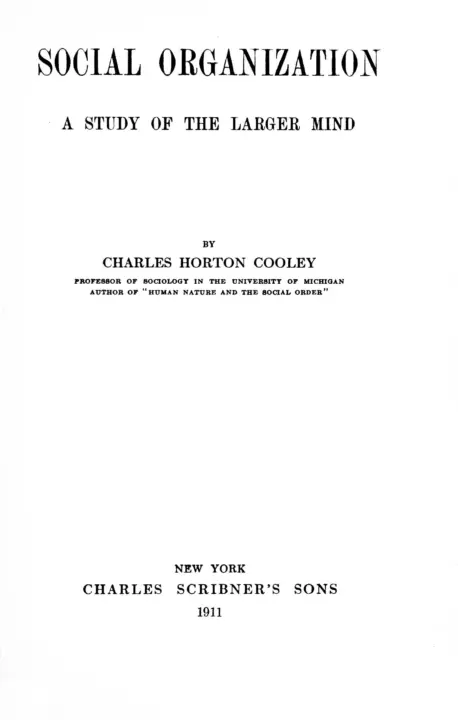
"Social Organization: A Study of the Larger Mind" by Charles Horton Cooley is a scholarly publication written in the early 20th century. This work focuses on the relationship between the individual mind and social dynamics, emphasizing how personal consciousness is shaped by social interactions and relationships. It delves into the intricacies of social organization, collective consciousness, and the interplay between individual thoughts and societal influences. The opening of the book outlines Cooley's perspective on social organization, positing that the mind functions as an organic whole influenced by interpersonal relations. He highlights the interconnectedness of self-consciousness and social consciousness, arguing that they emerge simultaneously. Cooley also critiques traditional views that prioritize individual self-awareness, instead advocating for a vision of the mind as fundamentally communal. His introduction sets the stage for a deeper exploration of social ideals, communication, and the moral fabric of society, positing that human nature and social structures evolve together as integrated components of social life.
Introduction adapted from the source catalogue; source summaries may be automatically generated.
Free to read · English · 110,332 words · No account needed
MAKE TIME FOR A GOOD BOOK
On by default. Untick to stop anonymous reading totals. Each page counts after 10 seconds in view. How this works.
Anonymous counting is on unless you have switched it off.
Public will, like individual will, has the purpose of effecting an adaptation to conditions that is rational and economical instead of haphazard and wasteful. In general it should greatly diminish, though it can hardly obviate, the cost of social change. In commerce, for instance, it has already rendered crises less sudden and destructive—in spite of the enormous scale of modern transactions—and the time should not be very far away when trouble of this sort will be so foreseen and discounted and so provided against by various sorts of insurance as to do but little damage. In the same way the vast problem of poverty, and of the degeneracy that springs from it, can be met and in great part conquered by a long-sighted philanthropy and education. In religion there is apparently no more need of that calamitous overthrow of the foundations of belief from which many suffered in the passing generation. In the state violent revolution seems likely to disappear as fast as democracy is organized; while in international relations it will be strange if we do not see a rapid diminution of war. In all these matters, and in many others, social costs are capable of being foreseen and provided against by rational measures expressing an enlightened public will.
The guiding force back of public will, now as ever, is of course human nature itself in its more enduring characteristics, those which find expression in primary groups and are little affected by institutional changes. This nature, familiar yet inscrutable, is apparently in a position to work itself out more adequately than at any time in the past.
[177] This line of thought is developed by Professor E. A. Ross in his
book, Sin and Society.
[178] The New Basis of Civilization, 61.
Abbott, Lyman, 187.
Achilles, 110.
Addams, Jane, 25, 137, 190, 191, 244, 350, 385.
Agreement, not essential to public opinion, 122.
Alphabet, 417.
Amenomori, 331.
Anarchism, 196;
in the church, 374.
Anarchy and spoliation, fear of, 276.
Anderson, W. L., 83.
Ann Arbor, school carnival in, 408.
Architecture, as communication, 79, 172;
disorganization in, 390 ff.
Aristocracy, hereditary, 210, 257, 282 f.
Army, German, 324;
American, 325.
Art, visible society a work of, 21;
collective judgments on, 125;
in relation to democracy, 157 ff.;
spirit of, 244 f., 321;
disorganization in, 390 ff.
Arts, non-verbal, as communication, 77 ff.
Assemblage, public, 109.
Athletic sports, 163, 199.
Attenuation of sentiment, 178.
Augustine, 374.
Austen, Jane, 102.
Autocratic control of industry, 262 ff.
Average-theory of group action, 123 ff.
Bacon, Francis, 76, 318.
Bagehot, W., 178.
Baring-Gould, 325.
Biological type, the, 315 f.
Birth-rate, decline of, 358 ff.
Blame, 15 ff., 201 ff.
Bourget, Paul, 160, 171.
Brooks, John G., 45.
Brotherhood, sentiment of, 189 ff.
Browne, Sir T., 70, 153.
Brownell, W. C., 161, 166, 321, 332 ff.
Bryce, James, 85, 136, 182, 276, 280, 369, 381.
Buck, Winifred, 43.
Burckhardt, 354.
Burke, 330.
Burne-Jones, 168.
Burroughs, John, 93.
Camp-fire, Assembly around, 109 f.
Carlyle, 167, 323.
Carnegie, A., views of on wealth, 281.
Capitalist class, ascendency of, 256 ff.
Caste, 209 ff.
Change, social, in relation to caste, 217, 225, 231.
Your reading position is saved on this browser. Take it to another device with a library code. Reading pages adapt to text, rather than matching a printed edition.
BEHIND THE BOOK
This eBook is for the use of anyone anywhere in the United States and most other parts of the world at no cost and with almost no restrictions whatsoever. You may copy it, give it away or re-use it under the terms of the Project Gutenberg License included with this eBook or online at www.gutenberg.org. If you are not located in the United States, you will have to check the laws of the country where you are located before using this eBook. Read the source licence.
The original source file, including credits and licence, is retained by this library. Request an original-format copy at no charge. Please include the book title and Project Gutenberg identifier #72636.
KEEP YOUR CURIOSITY GOING

Charles G. (Charles Griffith) Ross
Hannah Webster Foster

Emily Lawless
Edwin Hamlin Carr

Charles De Lano Hine
Andrew Ure