THE CLASSIC COLLECTION✦Social processCLASSIC FREE BOOKS
Social process
Charles Horton Cooley
THE CLASSIC COLLECTION · 1909
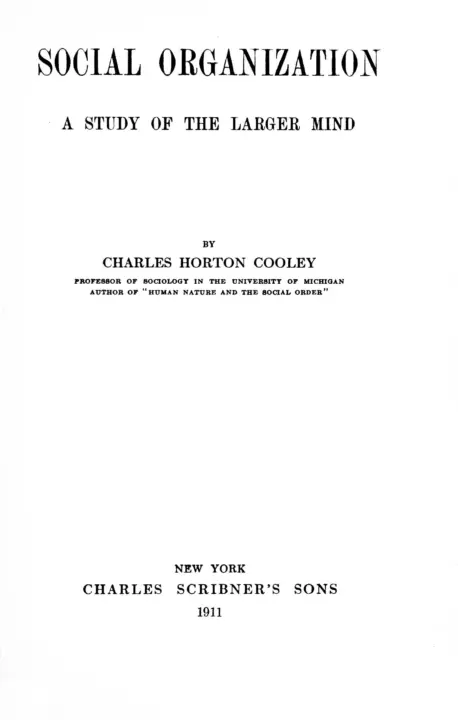
"Social Organization: A Study of the Larger Mind" by Charles Horton Cooley is a scholarly publication written in the early 20th century. This work focuses on the relationship between the individual mind and social dynamics, emphasizing how personal consciousness is shaped by social interactions and relationships. It delves into the intricacies of social organization, collective consciousness, and the interplay between individual thoughts and societal influences. The opening of the book outlines Cooley's perspective on social organization, positing that the mind functions as an organic whole influenced by interpersonal relations. He highlights the interconnectedness of self-consciousness and social consciousness, arguing that they emerge simultaneously. Cooley also critiques traditional views that prioritize individual self-awareness, instead advocating for a vision of the mind as fundamentally communal. His introduction sets the stage for a deeper exploration of social ideals, communication, and the moral fabric of society, positing that human nature and social structures evolve together as integrated components of social life.
Introduction adapted from the source catalogue; source summaries may be automatically generated.
Free to read · English · 110,332 words · No account needed
MAKE TIME FOR A GOOD BOOK
On by default. Untick to stop anonymous reading totals. Each page counts after 10 seconds in view. How this works.
Anonymous counting is on unless you have switched it off.
Family, 10 f.;
as a primary group, 24;
as a source of primary ideals, 24, 48, 52;
traditional careers in, 236 f.;
disorganization in, 356 ff.
Fashion, 336 ff.
Fellowship, 174 f., 242 ff.
Ferguson, on architecture, 391.
Feudal system, 223 ff.
Formalism, 56, 198, 342 ff., 376 ff., 418.
Fort Sumter, attack on, 154.
France, 155, 166, 275, 330, 331 ff., 398, 408.
Frederick the Great, 86.
Freedom, as a primary ideal, 46;
two aspects of in relation to classes, 245 f., 275, 325.
Free-will, 20.
Galton, Francis, 214, 317.
“Gangs” of boys, as primary groups, 49.
Garibaldi, 325.
Genius, 348.
Germany, 27, 248, 306, 324.
Gesture, 66, 69.
Gibbon, Edward, 73, 77.
God, 188, 196, 203, 205, 352, 353, 354, 372, 373, 380.
Goethe, 78, 165, 367, 401.
Gossip, organized, 84 f.
Government, as public will, 402 ff.;
sphere of, 403 ff.;
transformation of, 411.
Greece, refinement in, 180.
Greed of gain, 36, 254.
Green, J. R., 108.
Groups, primary, 23 ff.
See also Types, Classes and Institutions.
Gummere, F. B., 107, 222.
Hamerton, P. G., 140, 356, 390.
Hartt, R. L., 94.
Haste, 170 ff.
Heine, 95.
Herbert, Geo., 287.
Heredity and environment, 294 f., 316.
Higginson, T. W., 127, 136, 282.
History, organic view of, 255.
Holbein, 67.
Honesty and policy, 184.
Hopefulness, 187.
Horace (Q. Horatius Flaccus), 110.
Hostile feeling, 199 ff., 301 ff.
House of Commons, 341.
Howard, Geo. E., 24.
Howells, W. D., 271.
Human nature, relation to primary groups, 28 ff.;
dependent upon communication, 62 f., 419.
Humanism of sentiment, 178, 180 ff.
Huxley, 190.
Idealism, Organic, 412 f.
Ideals, primary, 32 ff., 51 ff., 113;
of groups, 126 f., 165 f.
Imitation, two kinds of, 336.
Immigrants, 294, 295.
Immigration, 169, 220 f., 369.
India, caste in, 224.
Indians, American, kindness among, 41;
individuality among, 110 f.
Individual, in relation to institutions, 313 ff.
Individualism, in art, 166, 243, 347 ff.;
domestic, 357 ff.
See also Disorganization.
Individuality, how affected by modern communication, 91 ff.;
in tribal life, 110;
development of in history, 112, 116 ff.;
in relation to democracy, 160 ff.;
moral, 201 f.;
enjoyment of, 307;
in harness, 324, 332 ff.
Inheritance principle, 209 ff.
Institutions, in relation to privileged classes, 140 f., 186, 313-392; and the individual, 313 ff.
Intolerance, 344.
Introspection, sympathetic, 7.
Italy, 167, 185, 186, 347, 348.
James, Henry, 84, 171, 174.
James, William, 20, 138, 253.
Japan, 328, 330.
Jesus, 16, 203 ff., 377.
Jevons, W. S., 407.
Johnson, Doctor, 93.
Johnson, Samuel (the orientalist), 225.
Justice, sentiment of, 181.
Keller, Helen, 62 f.
Kempis, Thomas à, 137, 138.
Kindness, 40 ff., 189 ff.
Kropotkin, P. A., 41, 189.
Labor Movement, 196, 242, 243, 258, 275, 284 ff.
Labor troubles, 308.
Lamb, Charles, 88.
Latin language, 74.
Law students, 141.
Lawfulness as a primary ideal, 42 ff.
Lawyers, 269.
Leadership, 135 f., 402.
LeBon, G., 149, 153.
Lecky, W. H. H., 96, 144.
Lee, H. C., 75.
Lee, Joseph, 34, 43.
Lincoln, 76.
Lindsey, Judge, 39.
Literature, in relation to democracy, 157 ff.;
growth of refinement in, 179;
disorganization in, 390;
of social knowledge, 411 f.
Lloyd, A. H., 319.
Lloyd, H. D., 140, 263, 264.
Longinus, 115.
Lowell, J. R., 101, 378.
Loyalty, 38 f., 182.
Luther, 75.
Luxury, 306, 359.
Macaulay, on democracy, 143 f.
Macchiavelli, 184.
Mackenzie, J. S., 92.
Maladjustment, as a cause of poverty, 293 f.
Malthus, 295.
Manners, tendency of, 197 ff.
Mantegna, 320.
Manual training, 304.
Marriage, 282, 356 ff.
See also Family.
Masses, in relation to public opinion, 135 ff.
Middle ages, caste in, 222 ff., 267.
Might and right, 320.
Milton, 76.
Mind, organic view of, 3 ff.;
democratic, 107-207.
Mind-cure doctrines, 297.
Mir, Russian, 26.
Mob. See Crowd.
Money-value, nature of, 265 f.
Montesquieu, 86, 116, 142, 261, 302.
Moral aspect, of the organic view of mind, 13 ff.;
of institutions, 322;
of public will, 397.
Moral principles, need of settled, 200 f., 307.
Moral unity, 33, 133, 182, 385.
Your reading position is saved on this browser. Take it to another device with a library code. Reading pages adapt to text, rather than matching a printed edition.
BEHIND THE BOOK
This eBook is for the use of anyone anywhere in the United States and most other parts of the world at no cost and with almost no restrictions whatsoever. You may copy it, give it away or re-use it under the terms of the Project Gutenberg License included with this eBook or online at www.gutenberg.org. If you are not located in the United States, you will have to check the laws of the country where you are located before using this eBook. Read the source licence.
The original source file, including credits and licence, is retained by this library. Request an original-format copy at no charge. Please include the book title and Project Gutenberg identifier #72636.
KEEP YOUR CURIOSITY GOING

Charles G. (Charles Griffith) Ross
Hannah Webster Foster

Emily Lawless
Edwin Hamlin Carr

Charles De Lano Hine
Andrew Ure