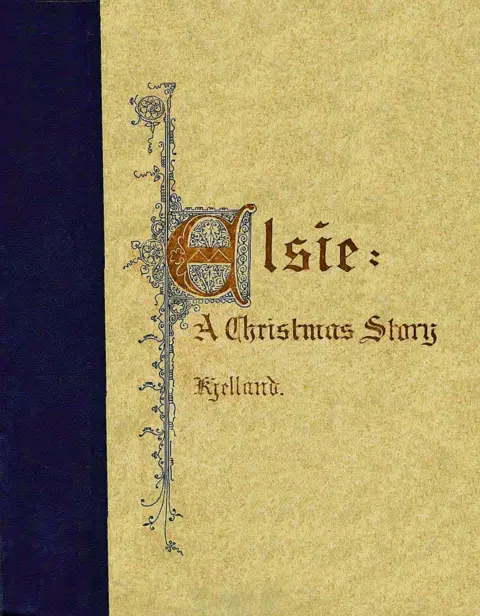
Elsie
Alexander Lange Kielland
THE CLASSIC COLLECTION · 1886
"Skipper Worse" by Alexander Lange Kielland is a novel written in the late 19th century. The story is centered around the character Jacob Worse, an accomplished sailor who returns home after a long voyage to Rio de Janeiro. The novel explores his interactions with the local community, his struggles with his past, and the complexities of societal norms that are intertwined with the religious revival movements prevalent on the Norwegian west coast. The opening of "Skipper Worse" introduces us to the titular character as he navigates his homecoming aboard his vessel, the "Hope of the Family". Upon arrival, he is met with a mixture of joy and tension, particularly with regard to his employer, Consul Garman, who is anxious about the financial state of his business amidst societal and personal losses. The narrative captures the contrast between the lively welcome from the crew's families and the somber relations that Worse has with others, highlighting themes of alienation and ambition. As Worse acclaimed his past achievements, we also glimpse his vulnerabilities and the expectations from the community that may weigh heavily on him as he seeks to find his place amidst changing social dynamics.
Introduction adapted from the source catalogue; source summaries may be automatically generated.
Free to read · English · 53,479 words · No account needed
MAKE TIME FOR A GOOD BOOK
On by default. Untick to stop anonymous reading totals. Each page counts after 10 seconds in view. How this works.
Anonymous counting is on unless you have switched it off.
Late in the autumn, when the sun set in lurid clouds full of storm and rain, the little town was shrouded in a darkness which was only relieved by a small lantern, which glimmered on the wall at the door of the town hall.
Otherwise it was dark, pitch dark, in the narrow, crooked streets, and down by the wharves, where one might fall headlong into the sea if tipsy, or a stranger.
In the small shops train-oil lamps or tallow candles were burning, in
the larger ones suspended "moderator" lamps were beginning to be
used.
A faint light was thus thrown upon the puddles, and those who were well acquainted with the street could pick their way dryshod.
Most people, however, wore long boots, and came tramping along, so that they could be heard splashing through the mud.
Here and there a small lantern might be observed swinging along, at one moment lowered carefully in order to seek a path in the worst places, at others casting its inquisitive light in the faces of the passers-by, or against the sides of the low wooden buildings.
Ladies with cap baskets, from which knitting needles were sticking out, might be seen going to evening parties; or servant maids carrying lanterns, and followed by little girls with thin white legs and big goloshes on their feet, on their way to the dancing-school.
After seven o'clock there was scarcely any light in the shops, and the streets seemed deserted. Now and then a ray of light was cast upon the mud and puddles when the door of a tavern, where sailors and topers quarrelled and rioted, was thrown open.
About this time the night watch would sally out of the town hall, in order to take up its beat. It was composed generally of old seamen or ship carpenters, who were past their work, men with hoarse, thick voices, bent with age and hard of hearing.
They crept along very slowly, clad in long, thick, frieze coats, bearing lanterns in their left hands, and thumping along the pavement with their ponderous staves.
At certain appointed corners they cried out the hour and the state of the weather, each in his own peculiar fashion, so that he could be understood in his own beat, but nowhere else in the whole world.
When those who had been at parties came home at the usual respectable hour of about ten o'clock, the lanterns reappeared in the streets. When they fell in with a watchman, they wished him good night, the young people asking the hour in order to tease him, the older ones inquiring seriously about the direction of the wind.
Your reading position is saved on this browser. Take it to another device with a library code. Reading pages adapt to text, rather than matching a printed edition.
Alexander Lange Kielland
Alexander Lange Kielland
Alexander Lange Kielland
BEHIND THE BOOK
This eBook is for the use of anyone anywhere in the United States and most other parts of the world at no cost and with almost no restrictions whatsoever. You may copy it, give it away or re-use it under the terms of the Project Gutenberg License included with this eBook or online at www.gutenberg.org. If you are not located in the United States, you will have to check the laws of the country where you are located before using this eBook. Read the source licence.
The original source file, including credits and licence, is retained by this library. Request an original-format copy at no charge. Please include the book title and Project Gutenberg identifier #30530.
KEEP YOUR CURIOSITY GOING
Coulson Kernahan

Maurice Baring
Frances Wright
Cécile Tormay

Frederic Jesup Stimson

W. H. P. (William Henry Pope) Jarvis