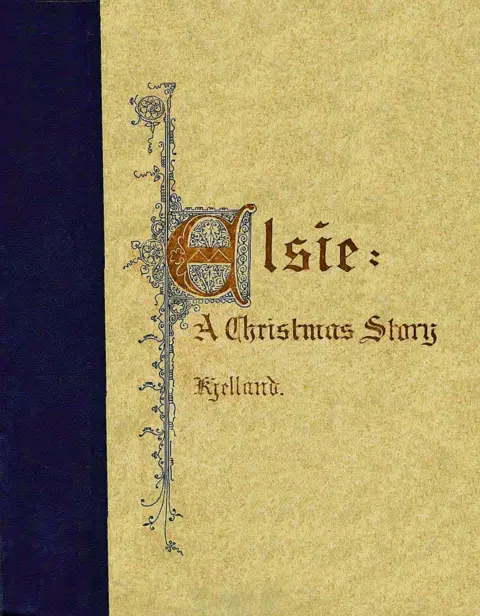
Elsie
Alexander Lange Kielland
THE CLASSIC COLLECTION · 1886
"Skipper Worse" by Alexander Lange Kielland is a novel written in the late 19th century. The story is centered around the character Jacob Worse, an accomplished sailor who returns home after a long voyage to Rio de Janeiro. The novel explores his interactions with the local community, his struggles with his past, and the complexities of societal norms that are intertwined with the religious revival movements prevalent on the Norwegian west coast. The opening of "Skipper Worse" introduces us to the titular character as he navigates his homecoming aboard his vessel, the "Hope of the Family". Upon arrival, he is met with a mixture of joy and tension, particularly with regard to his employer, Consul Garman, who is anxious about the financial state of his business amidst societal and personal losses. The narrative captures the contrast between the lively welcome from the crew's families and the somber relations that Worse has with others, highlighting themes of alienation and ambition. As Worse acclaimed his past achievements, we also glimpse his vulnerabilities and the expectations from the community that may weigh heavily on him as he seeks to find his place amidst changing social dynamics.
Introduction adapted from the source catalogue; source summaries may be automatically generated.
Free to read · English · 53,479 words · No account needed
MAKE TIME FOR A GOOD BOOK
On by default. Untick to stop anonymous reading totals. Each page counts after 10 seconds in view. How this works.
Anonymous counting is on unless you have switched it off.
After that the town became dark and silent. A drunken man would reel from one side to the other until he fell down a cellar trap-door, into the gutter, or into the sea. If by chance he stumbled upon the watch, he soon found himself in the lock-up.
But it was not so easy to stumble upon the watch; for they had their secret sleeping-corners, from which they only issued in case of emergency, when they thought the time was come for crying out something, or when the shuffling sound of leather boots was heard approaching.
This was the watch which went the rounds, the fire watch of the town consisting of four or five ancient watchmen, who had no voices left.
They wore their coat collars turned up, and their fur caps drawn down, so that they could hardly notice a fire until it singed their very beards. Nevertheless the town reposed in perfect security.
Perchance, however, some one would wake up and begin to think of the quantity of rye which lay in the warehouses, or there came a series of visions, clear and definite, such as appear to us in the darkness of the night; first, an ember somewhere smouldering, spreading, and then setting fire to the walls, seizing and enveloping the house, and consuming the rye, salt, barrels, the store, and everything.
Then a shuffling noise of stiff leather boots and staves along the
pavement, all coming nearer every moment, and then passing out of
hearing.
Ah! the fire-watch going the rounds. All right, one can sleep now in
peace and comfort.
Or perhaps a child would wake up in a troubled dream, and would lay and listen, terrified by hideous imaginations of thieves and robbers climbing in at the kitchen window to kill father and mother with long knives. But outside the watchman cries: "Two o'clock, and a still night."
Ah! the watch; yes, of course, that was the watch; so no thieves or robbers can come in at the kitchen window. All bad people must stay at home, or the watch will take them to the lock-up. Yes, it was not bad people, only good and kind folks and watchmen.
So it sleeps on again in peace and dreams no more.
But when they did come, those three terrible cannon shots which announced a fire, shaking and even bursting in the windows, unbounded terror prevailed. High above the dark streets the hazy sky was glowing like a sea of fire.
The drummer, Long Jorgen, beat furiously with the thicker ends of his drumsticks; men with hoarse voices, and boys with shrill notes like those of sea-gulls, rushed through the streets shouting: "Fire! fire!"
Your reading position is saved on this browser. Take it to another device with a library code. Reading pages adapt to text, rather than matching a printed edition.
Alexander Lange Kielland
Alexander Lange Kielland
Alexander Lange Kielland
BEHIND THE BOOK
This eBook is for the use of anyone anywhere in the United States and most other parts of the world at no cost and with almost no restrictions whatsoever. You may copy it, give it away or re-use it under the terms of the Project Gutenberg License included with this eBook or online at www.gutenberg.org. If you are not located in the United States, you will have to check the laws of the country where you are located before using this eBook. Read the source licence.
The original source file, including credits and licence, is retained by this library. Request an original-format copy at no charge. Please include the book title and Project Gutenberg identifier #30530.
KEEP YOUR CURIOSITY GOING
Coulson Kernahan

Maurice Baring
Frances Wright
Cécile Tormay

Frederic Jesup Stimson

W. H. P. (William Henry Pope) Jarvis