THE CLASSIC COLLECTION✦An outlaw’s diary: the CommuneCLASSIC FREE BOOKS
An outlaw’s diary: the Commune
Cécile Tormay
THE CLASSIC COLLECTION · 1892
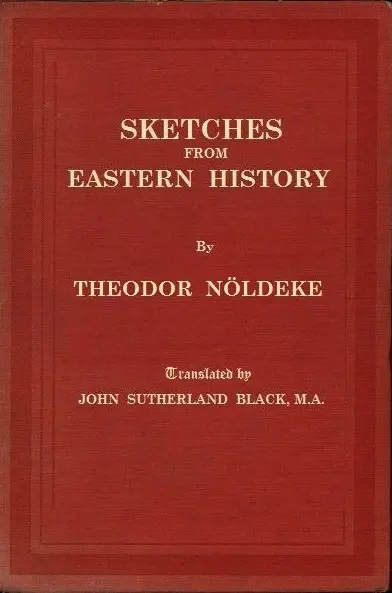
"Sketches from Eastern History" by Theodor Nöldeke is a historical account written in the late 19th century. This work provides a series of essays that explore key aspects of Eastern history, particularly focused on the Semitic races and the rise of Islam. The author, a noted orientalist, aims to provide insights into the culture, religion, and political dynamics of the region, enhancing the understanding of historical figures such as the Islamic prophet Mohammed and his works. At the start of the text, Nöldeke presents the complex task of depicting the moral and psychological characteristics of the Semitic races, acknowledging the challenges and contradictions involved. He critiques previous scholars who have portrayed these traits and outlines his intent to contribute meaningfully to the discourse. The opening engages the reader by elaborating on how geography, religion, and history have shaped the characteristics and civilizations of the Semitic peoples, and it sets the stage for a deeper examination that will unfold in subsequent chapters. Through his rigorous analysis, Nöldeke's work promises to be a valuable resource for both specialists and general readers interested in the history and influence of the Eastern world.
Introduction adapted from the source catalogue; source summaries may be automatically generated.
Free to read · English · 93,547 words · No account needed
MAKE TIME FOR A GOOD BOOK
On by default. Untick to stop anonymous reading totals. Each page counts after 10 seconds in view. How this works.
Anonymous counting is on unless you have switched it off.
The active superintendence which Mansúr gave to the building of his capital is only an instance of the whole system of his government, which was, as far as possible, personal. Posts were still conferred on a certain number of Arab nobles, who still sometimes showed the insubordination and tribal patriotism of their race, but he took care that they never overgrew himself. At the same time, he conferred the most important governorships upon various members of his own family, and made ample provision for all of them; but he kept them in strict subjection, and on occasion chastised them severely. He had absolutely trustworthy tools in his freedmen and clients of foreign extraction, to whom, to the horror of the aristocratic Arabs, he sometimes gave even the most important administrative offices. The governors and other high officials of the provinces were strictly overseen by special officers, entirely independent of them, who sent an uninterrupted series of couriers with their reports to the Caliph.[36] When, for example, Mansúr on one occasion learned through this channel that the governor of Hadramaut (in the extreme south of Arabia) was more attentive to the pleasures of the chase than to the duties of his office, he deposed him at once. Even the actions of Mahdí, the heir-apparent, in his capacity as governor of the lands of the east were subjected to this kind of control. Thus, the Caliph having on one occasion learned that Mahdí had given to a certain poet much too great a reward for a laudatory copy of verses, he compelled the recipient to repay the greater part of the sum.[37] These officers, in addition to their special duties, reported all the more important law cases, and all occurrences of any particular interest; they further apprised the Caliph of the price of provisions; for, with a view to public peace and security, it was judged necessary to take prompt measures for the prevention of dearths.[38] So well was Mansúr informed as to the state of the provinces, that it was whispered he had a magic mirror in which he could see all his enemies. Still better is he characterised by his own words to his son: “Sleep not, for thy father has not slept since he came to the caliphate; when sleep fell upon his eyes, his spirit remained awake.” He was an excellent financier. He is frequently reproached with avarice even; he was surnamed “the father of farthings,”—a reproach which presumably came chiefly from those whose interests would have been served by that prodigality to favourites which has procured a very undeserved reputation for many Oriental sovereigns. In the same way other eminently good rulers, such as the Omayyads Abdalmelik and Hishám, have the reputation of avarice. Mansúr was certainly strict in money matters. The vast expenditures on the building of Bagdad he caused to be accounted for down to the last farthing, and he compelled his officials to refund little profits which they had made for themselves. He looked sharply after his tax collectors. In payment of the land tax he commanded that only certain kinds of the gold coins of the Omayyads which were quite of full weight should be received. Of course he followed also the old established principle of Oriental princes, according to which high officers who had gorged themselves were compelled to give back their accumulations.[39] Even one of such exalted position, and of such conspicuous service in the establishment and support of the Abbásid dynasty, as was the Persian[40] Khálid, son of Barmek, the founder of the Barmecide power, was subjected to an operation of this kind. He was called upon within a very short time to pay 3,000,000 dirhems (about £57,000); the Caliph in the end was satisfied with 2,700,000. Nay, even Mansúr’s own brother Abbás was compelled to give up the money which he had squeezed from the people when governor of Mesopotamia, and was imprisoned besides. An Oriental State can never altogether prevent the abuse by which officials, small and great, enrich themselves in illicit ways. On the occasion of a land survey at Basra it was discovered that a family of consideration, the descendants of the Prophet’s freedman Abú Bekra, had increased their estate to a prodigious extent; the Caliph cut it down to a tenth. Here is a piece of the higher finance:[41] Mansúr ordered every inhabitant of Cufa to pay five dirhems (nearly two shillings); all, of course, complied. Having in this way ascertained their exact number, he imposed on all a poll-tax[42] of forty dirhems (fifteen shillings), and applied the money to the fortifications of the city. Whether this story is exact we will not undertake to say; in any case, it is probable that he sought by stringent measures to raise the revenue as much as possible, especially as he left to his successor an overflowing exchequer. It must, however, be considered that the comparative measure of quiet which he secured for most of the countries of his empire more than compensated for high taxation. How far the Christians’ complaints of special fiscal oppression under Mansúr were justified, is a point we can hardly clear up now; perhaps they arose chiefly from the circumstance that he taxed churches and monasteries, which was not so very unreasonable. If he again reduced the tribute of the Cyprians to the sum originally fixed by treaty, this was probably due, not so much to a sense of justice as to policy; it was expedient that so exposed a possession should be considerately treated.
Your reading position is saved on this browser. Take it to another device with a library code. Reading pages adapt to text, rather than matching a printed edition.
BEHIND THE BOOK
This eBook is for the use of anyone anywhere in the United States and most other parts of the world at no cost and with almost no restrictions whatsoever. You may copy it, give it away or re-use it under the terms of the Project Gutenberg License included with this eBook or online at www.gutenberg.org. If you are not located in the United States, you will have to check the laws of the country where you are located before using this eBook. Read the source licence.
The original source file, including credits and licence, is retained by this library. Request an original-format copy at no charge. Please include the book title and Project Gutenberg identifier #54782.
KEEP YOUR CURIOSITY GOING
Cécile Tormay

Moritz Busch
John L. Ransom
Frances Wright
Cécile Tormay

Mabel Potter Daggett