THE CLASSIC COLLECTION✦An outlaw’s diary: the CommuneCLASSIC FREE BOOKS
An outlaw’s diary: the Commune
Cécile Tormay
THE CLASSIC COLLECTION · 1892
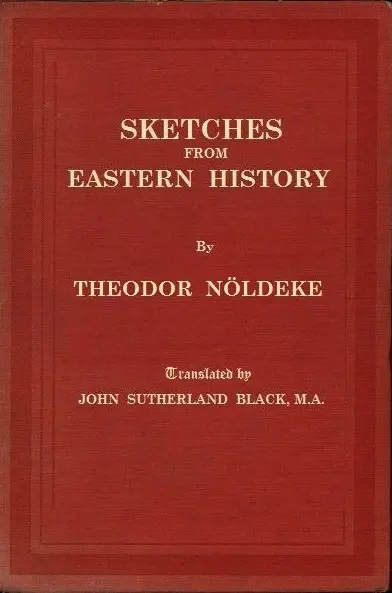
"Sketches from Eastern History" by Theodor Nöldeke is a historical account written in the late 19th century. This work provides a series of essays that explore key aspects of Eastern history, particularly focused on the Semitic races and the rise of Islam. The author, a noted orientalist, aims to provide insights into the culture, religion, and political dynamics of the region, enhancing the understanding of historical figures such as the Islamic prophet Mohammed and his works. At the start of the text, Nöldeke presents the complex task of depicting the moral and psychological characteristics of the Semitic races, acknowledging the challenges and contradictions involved. He critiques previous scholars who have portrayed these traits and outlines his intent to contribute meaningfully to the discourse. The opening engages the reader by elaborating on how geography, religion, and history have shaped the characteristics and civilizations of the Semitic peoples, and it sets the stage for a deeper examination that will unfold in subsequent chapters. Through his rigorous analysis, Nöldeke's work promises to be a valuable resource for both specialists and general readers interested in the history and influence of the Eastern world.
Introduction adapted from the source catalogue; source summaries may be automatically generated.
Free to read · English · 93,547 words · No account needed
MAKE TIME FOR A GOOD BOOK
On by default. Untick to stop anonymous reading totals. Each page counts after 10 seconds in view. How this works.
Anonymous counting is on unless you have switched it off.
The rebellion of the Alids had interrupted Mansúr in a great undertaking—the building of Bagdad. With the fall of the Omayyads it had become quite a matter of course that the rulers of the enormous empire, which extended from what is now Russian Turkestan and the Indus to Aden, Algeria, and Eastern Asia Minor,[34] should have their seat in Babylonia; but they had not as yet any definite capital. Mansúr lived a great deal in Háshimíya, founded by his predecessor, in the immediate neighbourhood of Cufa. But the Cufans, little attached as they were to the Abbásids, were no desirable neighbours. After the death of Ibráhím, Mansúr had preached them as sharp a sermon against their sins as any Omayyad governor could have delivered, and expressed in it his astonishment that the Omayyads had not long ago depopulated the accursed place as an abode of unbelievers. Moreover, nothing but a creation of his own could have satisfied Mansúr’s haughty nature. After long deliberation he determined to build the new capital on a site on the west bank of the Tigris, then occupied by a little place named Baghdád.[35] So far as we can judge, the district had already before this time been brought into communication with the Euphrates by means of canals. Mansúr caused the connection to be notably extended and improved. The official name of the city here planted was Madínat-as-Salám (“the city of welfare”), but in practical use the old name Bagdad maintained exclusive currency. Mansúr’s keen vision in the selection of this site may well be compared with that shown by Alexander when he founded the Egyptian Alexandria. At any rate, the situation of this city, which he called into being out of nothing, is so favourable that it soon became a world-city, with all the lights and shadows of such; a place which, Constantinople apart, had no rival, and which, even in the deep decline of all these countries since that time, and notwithstanding the irreparable injury suffered by Bagdad itself when it was destroyed by the Mongols in 1258, still remains a considerable city, by far the most important in the whole region of the Euphrates and Tigris. The work of building had been begun in early summer of 762. When news came of Mohammed’s revolt, the walls were hardly six feet high. When Ibráhím approached, the rumour spread that he had gained a great victory. Hereupon the freedman who had been left in charge of the vast accumulations of building materials set fire to the stores of timber, that they might not fall into the hand of the enemy. As soon as the empire was once more pacified, Mansúr caused operations to be resumed. The building was carried out on a magnificent scale. Vast sums were expended by the Caliph in building residences for himself, his dependants, kinsfolk, and freedmen, as well as his officers and troops, and also in constructing mosques, government offices, aqueducts, canal bridges, and fortifications. He assigned allotments to the members of the reigning house and the grandees on which to build their houses. Troops of handicraftsmen, traders, and other settlers flocked to the spot. Houses of sun-dried brick cost but little, and it is possible that even directly, certainly indirectly, the trifling outlay of the builders was in many cases made good out of the public exchequer. Traders had, moreover, to pay a duty upon their shops. In 766 the great city was practically finished; its walls were completed in 768. Mansúr’s city, as already mentioned, lay on the west bank of the river. Yet even he caused the opposite side, where now the main part of Bagdad lies, to be built on. “The camp” of his son Mahdí was there. It seemed expedient to place a portion of the garrison on the other side of the river, so that, in case of necessity, the two divisions of the army might be able to hold one another in check. A peculiar police regulation was introduced later by Mansúr; he caused the markets, which were frequented by an excessive number of strangers, whose supervision was not easy, to be removed outside the city proper. Bagdad was strongly fortified. Mansúr caused other important inland cities also to be fortified in such a way that the garrisons might be able to cope with casual insurrections. This he did also in the case of the city of Ráfika, founded by him in 772 in the neighbourhood of Rakka (Callinicus), on the east bank of the middle Euphrates, in which he placed a garrison of Khorásánians.
Your reading position is saved on this browser. Take it to another device with a library code. Reading pages adapt to text, rather than matching a printed edition.
BEHIND THE BOOK
This eBook is for the use of anyone anywhere in the United States and most other parts of the world at no cost and with almost no restrictions whatsoever. You may copy it, give it away or re-use it under the terms of the Project Gutenberg License included with this eBook or online at www.gutenberg.org. If you are not located in the United States, you will have to check the laws of the country where you are located before using this eBook. Read the source licence.
The original source file, including credits and licence, is retained by this library. Request an original-format copy at no charge. Please include the book title and Project Gutenberg identifier #54782.
KEEP YOUR CURIOSITY GOING
Cécile Tormay

Moritz Busch
John L. Ransom
Frances Wright
Cécile Tormay

Mabel Potter Daggett