THE CLASSIC COLLECTION✦An outlaw’s diary: the CommuneCLASSIC FREE BOOKS
An outlaw’s diary: the Commune
Cécile Tormay
THE CLASSIC COLLECTION · 1892
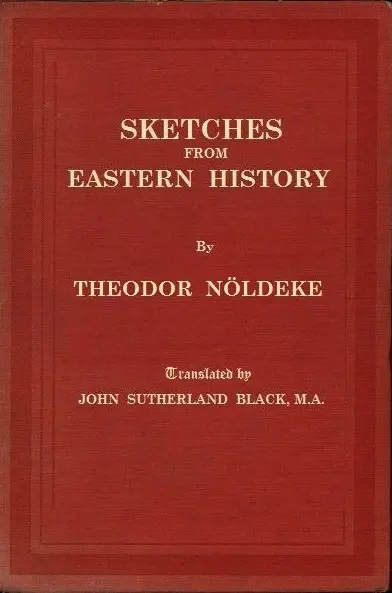
"Sketches from Eastern History" by Theodor Nöldeke is a historical account written in the late 19th century. This work provides a series of essays that explore key aspects of Eastern history, particularly focused on the Semitic races and the rise of Islam. The author, a noted orientalist, aims to provide insights into the culture, religion, and political dynamics of the region, enhancing the understanding of historical figures such as the Islamic prophet Mohammed and his works. At the start of the text, Nöldeke presents the complex task of depicting the moral and psychological characteristics of the Semitic races, acknowledging the challenges and contradictions involved. He critiques previous scholars who have portrayed these traits and outlines his intent to contribute meaningfully to the discourse. The opening engages the reader by elaborating on how geography, religion, and history have shaped the characteristics and civilizations of the Semitic peoples, and it sets the stage for a deeper examination that will unfold in subsequent chapters. Through his rigorous analysis, Nöldeke's work promises to be a valuable resource for both specialists and general readers interested in the history and influence of the Eastern world.
Introduction adapted from the source catalogue; source summaries may be automatically generated.
Free to read · English · 93,547 words · No account needed
MAKE TIME FOR A GOOD BOOK
On by default. Untick to stop anonymous reading totals. Each page counts after 10 seconds in view. How this works.
Anonymous counting is on unless you have switched it off.
IN eastern Irán lies the marshy district of lake Hámún, formed by waters draining from the east and north. The area of water varies greatly according to the season, as the streams rise and fall. These, and notably the Hélmend, which in the lower part of its course is broken up into a number of natural and artificial channels, render a great part of the hot low-lying plain extremely fertile, but the rest of the country is a dreary waste. The plain was anciently called, from the lake, Zaranka (“lakeland”), a designation preserved down to the Middle Ages in the name of the chief town Zereng. From the occupation of the region in the second century B.C. by the Sacæ, barbarians from the north, it was called Sakastán (“land of the Sacæ”), more recent forms of the word being Segistán (Arabic, Sejistân) or Sístán. The low country, which is notorious for its serpents, is almost surrounded by desert; on the east it borders upon Zábulistán,[62] which geographically belongs to the Afghan highlands, and in whole or part often fell under the same government with them, and was included under their name. Sístán was the home of the most heroic parts of the Iránian legends, the stories of Rostam the Strong and his race, of which no trace is to be found in the ancient sacred books. The legend may be taken as reflecting the brave character of the inhabitants, who were plainly separated by strongly marked distinctions from the other Iránians.
Sístán had been conquered at a comparatively early period by the Arabs, but the country was difficult of access, and long remained an insecure possession. Islam soon made great progress in the plain, but among the mountains to the east the new-comers only slowly established a footing. And even in Sístán proper the stubborn spirit of the natives inclined them to adhere rather to the Kharijites[63] than to the State Church. The governors of the first Abbásids had much difficulty with these Independents. The family of Táhir also, which from the days of Caliph Mámún had held the governorship of Khorásán, and of Sístán, which was regarded as an appendage, was unable to put down the Kharijites here, who steadily became more unruly as the power of the Táhirids waned. But in Sístán, as in other desert lands, Kharijite was often little more than a polite name for bandit. We thus understand how it was that, in the midst of this vigorous population, as the power of the State dwindled, volunteer bands were formed for defence against the Kharijites. Like their adversaries they, of course, declared that they were fighting solely for God; with what truth, we need not pause to discuss. At the head of a band of such volunteers one of the name of Dirhem succeeded in seizing Zereng, the chief town, and driving out the Táhirid prefect. Among his people was a certain Yakúb, son of Laith, who had formerly followed the trade of a coppersmith—a prosperous industry in Sístán,[64] whence the surname of “coppersmith” (Saffár) borne by himself and his successors. He, and his equally warlike brothers, belonged to the little town of Karmín, a day’s journey to the east of Zereng, in the direction of the notable city of Bust, the ruins of which are still visible. Near his birthplace was, and still is, shown the stable of Rostam’s gigantic war-horse.[65] It is possible that the heroic legend had its influence upon him. Yakúb had once before laid down the hammer for the sword. He had fought under Sálih of Bust (852), who had made himself master of Sístán, or at least of a part of Sístán, for a time, but afterwards had been overcome by Táhir, a grandson of the founder of the Táhirid dynasty. Subsequently Yakúb had passed through other adventures. Under Dirhem, his boldness and ability brought him to the front. Thus he killed in single combat a dreaded captain of the Kharijites named Ammán. In this way he rose to such repute among his fellows that Dirhem found it expedient to set out on pilgrimage to Mecca, and afterwards to settle in Bagdad, leaving the leadership to Yakúb.[66] Yakúb having thus risen to a position of command, doubtless assumed the title of Emír, which was vague enough to mean either a general or a local captain, but could also denote a powerful prince by whom even the Caliph was recognised as a merely nominal suzerain. He gradually became ruler of his native land, which always continued to be the central State and the place of refuge of himself and family. His energetic suppression of the robbers, whose villages he destroyed, and the security he obtained for traffic, brought him, it would seem, into high credit, and in any case the brave Sístánese felt themselves drawn to this countryman of theirs who had proved himself a born ruler. Accordingly, the kingdom founded by him is generally designated as that of the Sístánese. That Yakúb at every Friday service caused prayer to be offered, in the first instance, for the Caliph as the general commander of all the faithful, need hardly be said. A theoretical dependence such as this, which in fact was rendered necessary by his protest against the Kharijite independence, involved no real restriction of his power, but at most made it necessary to send money and presents more or less regularly to court. At the outset he seems to have recognised, also, the Táhirid Mohammed as overlord. In those times, indeed, it often happened that a lawful governor or vassal and a usurper made appeal to the same lord, and that in that case the usurper, if victorious, was also recognised by the overlord as his faithful subject.[67] The date of these occurrences was about 860.
Your reading position is saved on this browser. Take it to another device with a library code. Reading pages adapt to text, rather than matching a printed edition.
BEHIND THE BOOK
This eBook is for the use of anyone anywhere in the United States and most other parts of the world at no cost and with almost no restrictions whatsoever. You may copy it, give it away or re-use it under the terms of the Project Gutenberg License included with this eBook or online at www.gutenberg.org. If you are not located in the United States, you will have to check the laws of the country where you are located before using this eBook. Read the source licence.
The original source file, including credits and licence, is retained by this library. Request an original-format copy at no charge. Please include the book title and Project Gutenberg identifier #54782.
KEEP YOUR CURIOSITY GOING
Cécile Tormay

Moritz Busch
John L. Ransom
Frances Wright
Cécile Tormay

Mabel Potter Daggett