THE CLASSIC COLLECTION✦An outlaw’s diary: the CommuneCLASSIC FREE BOOKS
An outlaw’s diary: the Commune
Cécile Tormay
THE CLASSIC COLLECTION · 1892
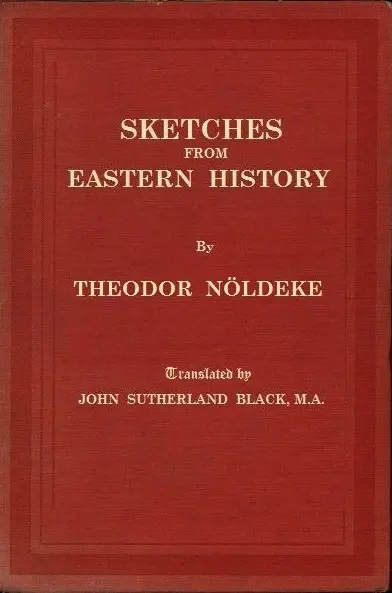
"Sketches from Eastern History" by Theodor Nöldeke is a historical account written in the late 19th century. This work provides a series of essays that explore key aspects of Eastern history, particularly focused on the Semitic races and the rise of Islam. The author, a noted orientalist, aims to provide insights into the culture, religion, and political dynamics of the region, enhancing the understanding of historical figures such as the Islamic prophet Mohammed and his works. At the start of the text, Nöldeke presents the complex task of depicting the moral and psychological characteristics of the Semitic races, acknowledging the challenges and contradictions involved. He critiques previous scholars who have portrayed these traits and outlines his intent to contribute meaningfully to the discourse. The opening engages the reader by elaborating on how geography, religion, and history have shaped the characteristics and civilizations of the Semitic peoples, and it sets the stage for a deeper examination that will unfold in subsequent chapters. Through his rigorous analysis, Nöldeke's work promises to be a valuable resource for both specialists and general readers interested in the history and influence of the Eastern world.
Introduction adapted from the source catalogue; source summaries may be automatically generated.
Free to read · English · 93,547 words · No account needed
MAKE TIME FOR A GOOD BOOK
On by default. Untick to stop anonymous reading totals. Each page counts after 10 seconds in view. How this works.
Anonymous counting is on unless you have switched it off.
How these revelations actually arose in Mohammed’s mind is a question which it is almost as idle to discuss as it would be to analyse the workings of the mind of a poet. In his early career, sometimes perhaps in its later stages also, many revelations must have burst from him in uncontrollable excitement, so that he could not possibly regard them otherwise than as divine inspirations. We must bear in mind that he was no cold systematic thinker, but an Oriental visionary, brought up in crass superstition, and without intellectual discipline; a man whose nervous temperament had been powerfully worked on by ascetic austerities, and who was all the more irritated by the opposition he encountered, because he had little of the heroic in his nature. Filled with his religious ideas and visions, he might well fancy he heard the angel bidding him recite what was said to him. There may have been many a revelation of this kind which no one ever heard but himself, as he repeated it to himself in the silence of the night (lxxiii. 4). Indeed the Koran itself admits that he forgot some revelations (lxxxvii. 7). But by far the greatest part of the book is undoubtedly the result of deliberation, touched more or less with emotion, and animated by a certain rhetorical rather than poetical glow. Many passages are based upon purely intellectual reflection. It is said that Mohammed occasionally uttered such a passage immediately after one of those epileptic fits which not only his followers, but (for a time at least) he himself also, regarded as tokens of intercourse with the higher powers. If that is the case, it is impossible to say whether the trick was in the utterance of the revelation or in the fit itself.
How the various pieces of the Koran took literary form is uncertain. Mohammed himself, so far as we can discover, never wrote down anything. The question whether he could read and write has been much debated among Moslems, unfortunately more with dogmatic arguments and spurious traditions than authentic proofs. At present, one is inclined to say that he was not altogether ignorant of these arts, but that from want of practice he found it convenient to employ some one else whenever he had anything to write. After the emigration to Medina (A.D. 622) we are told that short pieces—chiefly legal decisions—were taken down immediately after they were revealed, by an adherent whom he summoned for the purpose; so that nothing stood in the way of their publication. Hence it is probable that in Mecca, where, as in a mercantile town, the art of writing was commoner than in Medina, a place of agriculture, he had already begun to have his oracles committed to writing. That even long portions of the Koran existed in written form from an early date, may be pretty safely inferred from various indications; especially from the fact that in Mecca the Prophet had caused insertions to be made, and pieces to be erased, in his previous revelations. For we cannot suppose that he knew the longer súras by heart so perfectly that he was able after a time to lay his finger upon any particular passage. In some instances, indeed, he may have relied too much on his memory. For example, he seems to have occasionally dictated the same súra to different persons in slightly different terms. In such cases, no doubt, he may have partly intended to introduce improvements; and so long as the difference was merely in expression, without affecting the sense, it could occasion no perplexity to his followers. None of them had literary pedantry enough to question the consistency of the divine revelation on that ground. In particular instances, however, the difference of reading was too important to be overlooked. Thus the Koran itself confesses that the unbelievers cast it up as a reproach to the Prophet that God sometimes substituted one verse for another (xvi. 103). On one occasion, when a dispute arose between two of his own followers as to the true reading of a passage which both had received from the Prophet himself, Mohammed is said to have explained that the Koran was revealed in seven forms. In this dictum, which perhaps is genuine, seven stands, of course, as in many other cases, for an indefinite but limited number. But one may imagine what a world of trouble it has cost the Moslem theologians to explain the saying in accordance with their dogmatic beliefs. A great number of explanations are current, some of which claim the authority of the Prophet himself; as, indeed, fictitious utterances of Mohammed play throughout a conspicuous part in the exegesis of the Koran. One very favourite, but utterly untenable interpretation is that the “seven forms” are seven different Arabic dialects.
Your reading position is saved on this browser. Take it to another device with a library code. Reading pages adapt to text, rather than matching a printed edition.
BEHIND THE BOOK
This eBook is for the use of anyone anywhere in the United States and most other parts of the world at no cost and with almost no restrictions whatsoever. You may copy it, give it away or re-use it under the terms of the Project Gutenberg License included with this eBook or online at www.gutenberg.org. If you are not located in the United States, you will have to check the laws of the country where you are located before using this eBook. Read the source licence.
The original source file, including credits and licence, is retained by this library. Request an original-format copy at no charge. Please include the book title and Project Gutenberg identifier #54782.
KEEP YOUR CURIOSITY GOING
Cécile Tormay

Moritz Busch
John L. Ransom
Frances Wright
Cécile Tormay

Mabel Potter Daggett