THE CLASSIC COLLECTION✦An outlaw’s diary: the CommuneCLASSIC FREE BOOKS
An outlaw’s diary: the Commune
Cécile Tormay
THE CLASSIC COLLECTION · 1892
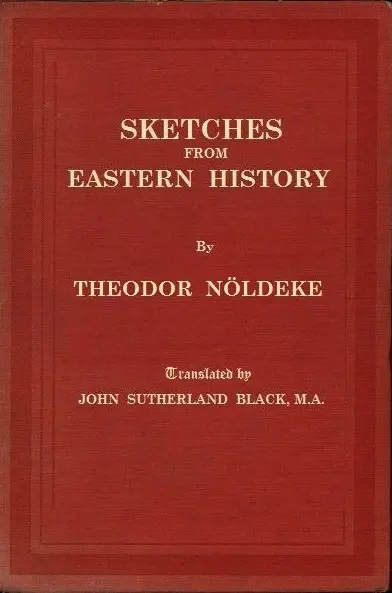
"Sketches from Eastern History" by Theodor Nöldeke is a historical account written in the late 19th century. This work provides a series of essays that explore key aspects of Eastern history, particularly focused on the Semitic races and the rise of Islam. The author, a noted orientalist, aims to provide insights into the culture, religion, and political dynamics of the region, enhancing the understanding of historical figures such as the Islamic prophet Mohammed and his works. At the start of the text, Nöldeke presents the complex task of depicting the moral and psychological characteristics of the Semitic races, acknowledging the challenges and contradictions involved. He critiques previous scholars who have portrayed these traits and outlines his intent to contribute meaningfully to the discourse. The opening engages the reader by elaborating on how geography, religion, and history have shaped the characteristics and civilizations of the Semitic peoples, and it sets the stage for a deeper examination that will unfold in subsequent chapters. Through his rigorous analysis, Nöldeke's work promises to be a valuable resource for both specialists and general readers interested in the history and influence of the Eastern world.
Introduction adapted from the source catalogue; source summaries may be automatically generated.
Free to read · English · 93,547 words · No account needed
MAKE TIME FOR A GOOD BOOK
On by default. Untick to stop anonymous reading totals. Each page counts after 10 seconds in view. How this works.
Anonymous counting is on unless you have switched it off.
The rationale of revelation is explained in the Koran itself as follows:—In heaven is the original text (“the mother of the book,” xliii. 3; “a concealed book,” lv. 77; “a well-guarded tablet,” lxxxv. 22). By a process of “sending down” (tanzíl), one piece after another was communicated to the Prophet. The mediator was an angel, who is called sometimes the “Spirit” (xxvi. 193), sometimes the “holy Spirit” (xvi. 104), and at a later time “Gabriel” (ii. 91). This angel dictates the revelation to the Prophet, who repeats it after him, and afterwards proclaims it to the world (lxxxvii. 6, etc.). It is plain that we have here a somewhat crude attempt of the Prophet to represent to himself the more or less unconscious process by which his ideas arose and gradually took shape in his mind. It is no wonder if in such confused imagery the details are not always self-consistent. When, for example, this heavenly archetype is said to be in the hands of an exalted “scribe” (lxxx. 13 sqq.), this seems a transition to a quite different set of ideas, namely, the books of fate, or the record of all human actions—conceptions which are actually found in the Koran. It is to be observed, at all events, that Mohammed’s transcendental idea of God, as a Being exalted altogether above the world, excludes the thought of direct intercourse between the Prophet and God.
It is an explicit statement of the Koran that the sacred book was revealed (“sent down”) by God, not all at once, but piecemeal and gradually (xxv. 34). This is evident from the actual composition of the book, and is confirmed by Moslem tradition. That is to say, Mohammed issued his revelations in fly-leaves of greater or less extent. A single piece of this kind was called either, like the entire collection, ḳor’án, i.e. “reading,” or rather “recitation;” or kitáb, “writing;” or súra, which is the late-Hebrew shúrá, and means literally “series.” The last became, in the lifetime of Mohammed, the regular designation of the individual sections as distinguished from the whole collection; and accordingly it is the name given to the separate chapters of the existing Koran. These chapters are of very unequal length. Since many of the shorter ones are undoubtedly complete in themselves, it is natural to assume that the longer, which are sometimes very comprehensive, have arisen from the amalgamation of various originally distinct revelations. This supposition is favoured by the numerous traditions which give us the circumstances under which this or that short piece, now incorporated in a larger section, was revealed; and also by the fact that the connection of thought in the present súras often seems to be interrupted. And in reality many pieces of the long súras have to be severed out as originally independent; even in the short ones parts are often found which cannot have been there at first. At the same time we must beware of carrying this sifting operation too far,—as I now believe myself to have done in my earlier works, and as Sprenger in his great book on Mohammed also sometimes seems to do. That some súras were of considerable length from the first is seen, for example, from xii., which contains a short introduction, then the history of Joseph, and then a few concluding observations, and is therefore perfectly homogeneous. In like manner, xx., which is mainly occupied with the history of Moses, forms a complete whole. The same is true of xviii., which at first sight seems to fall into several pieces; the history of the seven sleepers, the grotesque narrative about Moses, and that about Alexander “the Horned,” are all connected together, and the same rhyme runs through the whole súra. Even in the separate narrations we may observe how readily the Koran passes from one subject to another, how little care is taken to express all the transitions of thought, and how frequently clauses are omitted, which are almost indispensable. We are not at liberty, therefore, in every case where the connection in the Koran is obscure, to say that it is really broken, and set it down as the clumsy patchwork of a later hand. Even in the old Arabic poetry such abrupt transitions are of very frequent occurrence. It is not uncommon for the Koran, after a new subject has been entered on, to return gradually or suddenly to the former theme,—a proof that there at least separation is not to be thought of. In short, however imperfectly the Koran may have been redacted, in the majority of cases the present súras are identical with the originals.
Your reading position is saved on this browser. Take it to another device with a library code. Reading pages adapt to text, rather than matching a printed edition.
BEHIND THE BOOK
This eBook is for the use of anyone anywhere in the United States and most other parts of the world at no cost and with almost no restrictions whatsoever. You may copy it, give it away or re-use it under the terms of the Project Gutenberg License included with this eBook or online at www.gutenberg.org. If you are not located in the United States, you will have to check the laws of the country where you are located before using this eBook. Read the source licence.
The original source file, including credits and licence, is retained by this library. Request an original-format copy at no charge. Please include the book title and Project Gutenberg identifier #54782.
KEEP YOUR CURIOSITY GOING
Cécile Tormay

Moritz Busch
John L. Ransom
Frances Wright
Cécile Tormay

Mabel Potter Daggett