THE CLASSIC COLLECTION✦The golden fleeceCLASSIC FREE BOOKS
The golden fleece
A. L. O. E.
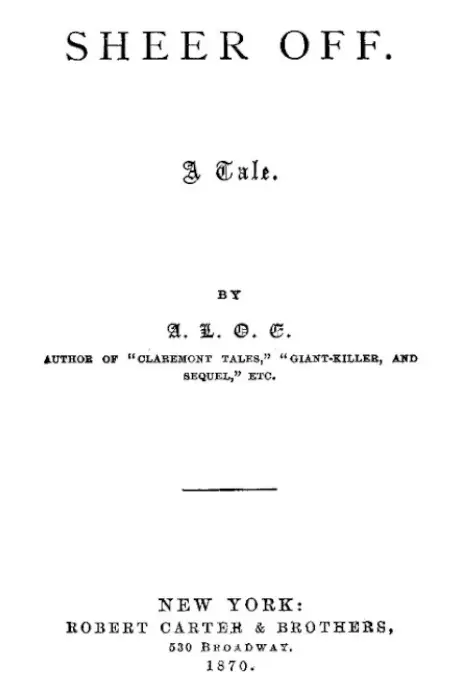
THE CLASSIC COLLECTION · 1870
"Sheer Off: A Tale" by A. L. O. E. is a novel likely written in the late 19th century. The story revolves around Ned Franks, a one-armed sailor turned schoolmaster, and his attempts to uplift his community in the village of Colme, particularly focusing on the plight of the damned almshouses and the struggles of his neighbor, John Sands, whose wife suffers from alcoholism. Through its exploration of themes like charity, community spirit, and personal responsibility, the novel invites readers to consider the moral dilemmas faced by its characters, setting the stage for deeper social commentary. At the start of the tale, readers are introduced to the contrasting worlds of Ned Franks and Nancy Sands, whose jealousy of Ned's newly appointed role as schoolmaster starkly contrasts the joyful occasion of his child’s christening. The opening scene captures a village gathering to celebrate, against which Nancy’s scorn highlights her bitterness. Franks himself is depicted as a kind-hearted individual, striving to maintain a positive environment for his students while contemplating his responsibilities towards the poor and the downtrodden of the village. Discussions about the state of the almshouses establish the book's central conflict: the need for community support and the challenge of overcoming personal obstacles. The arrival of Mr. Leyton, the young curate, adds another layer to the unfolding narrative, setting up future interactions that will further explore the themes of redemption and the human capacity for change.
Introduction adapted from the source catalogue; source summaries may be automatically generated.
Free to read · English · 73,333 words · No account needed
MAKE TIME FOR A GOOD BOOK
On by default. Untick to stop anonymous reading totals. Each page counts after 10 seconds in view. How this works.
Anonymous counting is on unless you have switched it off.
In a quiet and peaceful nook stands the vicarage of Colme, almost in the village, yet entirely screened from it by extensive shrubberies. High, green walls of luxuriant laurel, and rhododendra, with their thick buds swelling into blossoms, border the winding drive, and girdle the lawn, on whose smooth slope lies the shadow of a lofty cedar, the pride of the place. The vicarage itself is not large, but exceedingly pretty, with its rural porch and picturesque gables, and mullioned windows overhung with honeysuckle and clematis. If we were to pass over that velvet lawn, and glance in through the window at the right of the porch, we should see the vicar himself resting in his arm-chair, very pale and very thin from recent dangerous illness, but looking calm and serene. Though this is Saturday, there is no sign of preparation for the morrow's service; there is no desk open, no book on the table save the well-worn Bible. The vicar has been called into the "wilderness" of sickness to "rest for a while," and he may not yet venture to enter the church even as a worshipper, far less as a preacher. It is only to-day that his wife has been able to leave his side for a long round of visits amongst his parishioners. Mr. Curtis is anxious to hear of each and all of those amongst whom the good pastor has lived for twenty years as a father among his children; so his wife has set out this afternoon with a large basket on her arm, to visit half the cottages in Colme.
Mr. Curtis is not sitting alone; his wife's nephew, the young curate, Mr. Leyton, is beside him, giving him an account of his own work on that day. Claudius Leyton is, as has been before mentioned, of extremely youthful appearance; the smooth cheek, small features, and slight, delicate frame of the curate might induce a stranger to guess his age as scarcely beyond eighteen years. Summoned immediately after his ordination to take entire charge of the parish of Mr. Curtis, then alarmingly ill, the curate, whose life had been spent in London, Eton, and Cambridge, and who had scarcely ever so much as entered a cottage, had found himself at first almost overwhelmed by the sense of responsibility. Mr. Leyton had felt somewhat as a landsman might feel should he be called to take the command of a vessel on the very first occasion on which he ever entered one. The curate lacked neither talent nor devotion, but he had no experience in the peculiar work of a village pastor, and with a tender sensitive disposition and natural shyness, it seemed as if he had undertaken a task beyond his strength. The change was great from the easy luxury of home and college life to the position of a hard-working curate, with long church-services to tax a weak voice, and the various needs of a parish, in which almost every one was to him a stranger, to try his energies and test his discretion. Mr. Leyton had prayerfully resolved to do his very best to be a faithful minister to his flock, and overcome the difficulties before him. He had, some time before his ordination, left off some of his favorite pursuits, that he might devote himself to his duties; he had given away his cigar-case, had parted with his books of light literature, locked up his flute, and left his paint-box untouched for months. Claudius Leyton had resolutely turned his thoughts to sermons and schools, and other matters connected with parish business. But it had been a great trial to the young clergyman to have, as it were, to find his way almost alone in, to him, a new country. He was unable for weeks to avail himself of the experience of the vicar, and but for the information and help always cheerfully given him by Ned Franks, the curate would often have felt utterly discouraged by the difficulties attending his charge. It was no small relief to the young man to be at last able to consult the vicar, receive his sympathy, and ask his advice; for Claudius had none of the proud self-confidence which too often accompanies inexperience and youth; he was not one of those who need to be taught modesty by a number of failures.
Your reading position is saved on this browser. Take it to another device with a library code. Reading pages adapt to text, rather than matching a printed edition.
A. L. O. E.
A. L. O. E.
A. L. O. E.
A. L. O. E.
BEHIND THE BOOK
This eBook is for the use of anyone anywhere in the United States and most other parts of the world at no cost and with almost no restrictions whatsoever. You may copy it, give it away or re-use it under the terms of the Project Gutenberg License included with this eBook or online at www.gutenberg.org. If you are not located in the United States, you will have to check the laws of the country where you are located before using this eBook. Read the source licence.
The original source file, including credits and licence, is retained by this library. Request an original-format copy at no charge. Please include the book title and Project Gutenberg identifier #61804.
KEEP YOUR CURIOSITY GOING
Coulson Kernahan

Maurice Baring
Frances Wright
Cécile Tormay

Frederic Jesup Stimson

W. H. P. (William Henry Pope) Jarvis