THE CLASSIC COLLECTION✦The golden fleeceCLASSIC FREE BOOKS
The golden fleece
A. L. O. E.
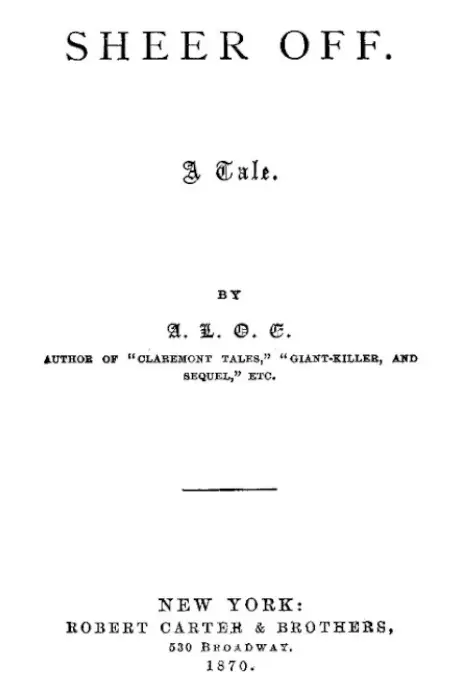
THE CLASSIC COLLECTION · 1870
"Sheer Off: A Tale" by A. L. O. E. is a novel likely written in the late 19th century. The story revolves around Ned Franks, a one-armed sailor turned schoolmaster, and his attempts to uplift his community in the village of Colme, particularly focusing on the plight of the damned almshouses and the struggles of his neighbor, John Sands, whose wife suffers from alcoholism. Through its exploration of themes like charity, community spirit, and personal responsibility, the novel invites readers to consider the moral dilemmas faced by its characters, setting the stage for deeper social commentary. At the start of the tale, readers are introduced to the contrasting worlds of Ned Franks and Nancy Sands, whose jealousy of Ned's newly appointed role as schoolmaster starkly contrasts the joyful occasion of his child’s christening. The opening scene captures a village gathering to celebrate, against which Nancy’s scorn highlights her bitterness. Franks himself is depicted as a kind-hearted individual, striving to maintain a positive environment for his students while contemplating his responsibilities towards the poor and the downtrodden of the village. Discussions about the state of the almshouses establish the book's central conflict: the need for community support and the challenge of overcoming personal obstacles. The arrival of Mr. Leyton, the young curate, adds another layer to the unfolding narrative, setting up future interactions that will further explore the themes of redemption and the human capacity for change.
Introduction adapted from the source catalogue; source summaries may be automatically generated.
Free to read · English · 73,333 words · No account needed
MAKE TIME FOR A GOOD BOOK
On by default. Untick to stop anonymous reading totals. Each page counts after 10 seconds in view. How this works.
Anonymous counting is on unless you have switched it off.
"You went off in such haste yesterday that we'd not time to have out half our say," said Ben Stone to Ned Franks, as, called in by the carpenter's wife, he walked up to the patient's bedside.
Franks smiled, agreeably surprised to find that Stone wished to renew
such a conversation.
"Take a chair, my good friend, and sit down. Bell, you needn't stop in for me. I know Franks won't grudge me a half-hour for once, even on a week day."
Mrs. Stone soon quitted the cottage, but not till she had warned her visitor with raised finger and shake of the head, "Don't you bother my husband about anything to make his mind uneasy."
When she had closed the door behind her, Ben Stone turned to Franks, and said, "I was looking over old papers, yesterday, which reminded me of my boyhood, and I suppose it's that which has brought back to me a bit of rhyme which I learned from my mother, and which has been running in my brain all this day, though it had gone clean out of my memory for years,--
"'There's not a sin that I commit,
Or wicked word I say,
But in Thy dreadful book 'tis writ
Against the judgment-day.'
"Now, do you suppose," said Stone, with an effort to speak in his usual careless tone, "that God keeps an account like that, as a creditor with his debtors, and that when folks die there are all the old bills, as it were, brought up, even debts that they'd clean forgotten?"
"Yes, assuredly, unless all those debts have been paid."
"That's the very nail that I want you to hit," cried the carpenter. "How are we to make sure that the debts are all paid,--I mean, that God has forgiven us outright? Are you sure that your debts are all paid?"
"Yes, thank God!" cried the sailor; "my debts were paid, every one of them, when my Saviour died on Calvary. Does not St. Paul say that Christ blotted out the handwriting of ordinances that was against us, which was contrary to us, and took it out of the way, nailing it to his cross?"
"Were every one's sins blotted out then?" asked Stone.
"The sins of all who have living faith in the Lord."
"Ah! faith; that's what you're always talking about, and I can never quite make out what it means."
"It simply means that we believe from the heart that the Son of God died for us," said Ned Franks.
"Is that all?" exclaimed Stone, in surprise. "Why, a poor wretch like Nancy Sands might believe that as well as yourself!"
Your reading position is saved on this browser. Take it to another device with a library code. Reading pages adapt to text, rather than matching a printed edition.
A. L. O. E.
A. L. O. E.
A. L. O. E.
A. L. O. E.
BEHIND THE BOOK
This eBook is for the use of anyone anywhere in the United States and most other parts of the world at no cost and with almost no restrictions whatsoever. You may copy it, give it away or re-use it under the terms of the Project Gutenberg License included with this eBook or online at www.gutenberg.org. If you are not located in the United States, you will have to check the laws of the country where you are located before using this eBook. Read the source licence.
The original source file, including credits and licence, is retained by this library. Request an original-format copy at no charge. Please include the book title and Project Gutenberg identifier #61804.
KEEP YOUR CURIOSITY GOING
Coulson Kernahan

Maurice Baring
Frances Wright
Cécile Tormay

Frederic Jesup Stimson

W. H. P. (William Henry Pope) Jarvis